
Good cupping aftercare is simple: for the rest of the day, keep the treated area covered and warm, drink water, eat a normal meal, rest, and wait a few hours (most practitioners say 4–6) before taking a short, lukewarm shower. For about 24 hours, skip hot tubs, saunas, cold plunges, hard workouts and alcohol. The …

Good cupping aftercare is simple: for the rest of the day, keep the treated area covered and warm, drink water, eat a normal meal, rest, and wait a few hours (most practitioners say 4–6) before taking a short, lukewarm shower. For about 24 hours, skip hot tubs, saunas, cold plunges, hard workouts and alcohol. The round marks are expected, and according to Cleveland Clinic they usually fade in a week or two, though everyone’s skin is different. This guide covers what to do and what not to do after cupping, and it’s upfront about which rules come from clinical evidence and which are long-standing practitioner habits. It also covers what’s normal the next day and the few signs that mean you should call your practitioner or get medical care.
This article is for general education only. It isn’t medical advice and doesn’t replace an evaluation by a licensed clinician. If anything about your skin or how you feel after a session worries you, contact your practitioner.
Key Takeaways
- The first 24 hours matter most: keep the area covered and warm, rest, drink water, and avoid extreme heat, extreme cold, intense exercise and alcohol.
- Showering: most practitioners suggest waiting about 4–6 hours, then using lukewarm water and patting the skin dry. Hot baths, hot tubs and swimming can wait 24 hours.
- Marks are expected: they look like bruises but aren’t true bruises, and they typically fade in one to two weeks.
- Serious problems are uncommon but real: an updated review of 135 randomized trials in PLoS One found no serious adverse effects reported, but burns, blisters and skin infections do happen, especially with fire cupping done at home.
- “Flushing toxins” isn’t evidence-based: drink water because it’s sensible on a recovery day, not because cupping releases toxins.
- Call your practitioner about blisters, worsening pain or marks that stay dark after about two weeks. Get same-day care for spreading redness, pus, fever or a blistering burn.
Your Cupping Aftercare Checklist, Hour by Hour
Use this post-cupping care checklist as a quick reference. Each row is explained in more detail further down.
| Time after your session | Do | Avoid |
|---|---|---|
| First 0–6 hours | Keep the treated area covered with loose, soft clothing; drink water; eat a normal meal; rest; sit for a minute before standing if you feel lightheaded | Showering; driving if you feel dizzy; hard exercise; ice packs or cold air directly on the marks; alcohol |
| 6–24 hours | Short lukewarm shower with mild soap, then pat dry; easy walking and gentle stretching; go to bed early | Hot tubs, saunas, steam rooms, hot baths, hot yoga; cold plunges; heavy lifting or intense training; scrubbing or exfoliating the marks |
| 24–72 hours | Resume normal workouts gradually; fragrance-free moisturizer if the skin feels dry or itchy; keep an eye on the marks | Deep tissue work or a new round of cupping on the same area; popping any blister; tight compression gear rubbing on tender spots |
| Day 3 until the marks fade (usually 1–2 weeks) | Protect the marks from strong sun; tell your other clinicians the marks came from cupping; book your next session once the area has cleared | Re-cupping the same spot before the marks have faded; ignoring pain that’s getting worse instead of better |
Why Aftercare Matters (and What Cupping Actually Does to Your Skin)
During cupping therapy, suction lifts the skin and the tissue beneath it into the cup. A 2019 review of cupping’s mechanisms in the Journal of Traditional and Complementary Medicine describes how that suction moves red blood cells out of small vessels into the surrounding tissue, which the authors call “dry diapedesis”. They also describe the redness, swelling and occasional blistering that can follow, which they put down to the vessels widening and fluid collecting in the tissue. In plain terms, for a day or two the treated skin is flushed, sensitive and more reactive than usual. Most after-cupping care rules are meant to protect that skin and keep you comfortable while it settles.
It’s also worth being clear about what aftercare can’t do. According to the National Center for Complementary and Integrative Health (NCCIH), most cupping research is of low quality, and while cupping may help reduce pain, “the evidence for this isn’t very strong.” A 2025 systematic review in JOSPT Open, summarized by PEDro, included 5 trials with 281 participants. For short-term pain, the pooled analysis found no meaningful difference between dry cupping and placebo cupping, and rated the evidence as very low certainty. So no aftercare routine “locks in” results. Results vary from person to person, and good aftercare is mainly about comfort and skin safety.
At Copper Wellness, cupping is performed by Dr. Anais Jackson-Gonzalez, who holds a Doctorate in Acupuncture and Chinese Medicine from the National University of Health Sciences. Her multimodal practice includes cupping, gua sha and moxibustion alongside acupuncture. The clinic uses fire cupping, where heated glass cups create the vacuum seal, so the skin-care and burn guidance below applies directly to sessions there.
What to Do After Cupping

Here’s what to do after cupping therapy over the first day or two, roughly in the order you’ll need it.
Keep the treated area covered and warm
Practitioners have long advised keeping freshly cupped skin covered and away from drafts. There’s no trial testing this, but it makes sense: freshly treated skin is sensitive, and a soft, loose layer protects it from friction and temperature swings. Wear a loose cotton shirt or a scarf if you had cupping on your neck and shoulders. Bring a layer even in summer, because air-conditioned offices and cars can feel harsh on freshly treated skin. In a Chicago winter, zip your coat up over your neck and upper back before you step out onto North Avenue. A cold lakefront wind on freshly cupped skin is the sort of discomfort aftercare is meant to prevent.
Drink water and eat a normal meal
Drinking water after cupping is the most common piece of aftercare advice on the web, and it’s reasonable. Staying hydrated is sensible on any day you feel tired or sore, and it may help with the mild lightheadedness some people feel after a session. What isn’t supported is the usual explanation that water “flushes out the toxins cupping released” (more on that in the myths section). A normal, balanced meal also helps if you went into your appointment hungry. Feeling lightheaded is more likely on an empty stomach.
Rest for the rest of the day
Fatigue is one of the possible effects Cleveland Clinic lists after cupping, alongside soreness and headaches. If you can, plan a quiet evening after your session instead of a packed schedule, and go to bed a little earlier. Feeling tired, or a bit “heavy” like after a massage, is common and usually passes within a day.
Move gently
Rest doesn’t mean staying still. A relaxed walk and gentle range-of-motion stretches for the treated area help keep stiffness down without stressing the skin and tissue. If you’re having cupping as part of a rehab plan, the movement your physical therapy clinician gave you usually stays on the schedule. Just keep it light the first day and skip the heavy loaded exercises.
Use gentle skin care
After your first shower, if the marks feel dry, tight or itchy, a plain fragrance-free moisturizer is enough. Some practices recommend oils, shea butter or arnica to make marks fade faster. Those are fine to use if they don’t irritate your skin, but no study shows that any product speeds up fading. Skip anything with fragrance, retinoids, acids or strong essential oils on the marks for the first couple of days.
Set yourself up before your next session
Good aftercare starts before you arrive. Eat a light meal a couple of hours beforehand, avoid booking cupping on skin that’s sunburned, broken or irritated, and give your practitioner a current list of your medications and health conditions (the section on who needs extra care explains why). Bring loose layers to wear home.
Above all, follow the specific instructions your practitioner gives you. They know which technique and suction strength they used, and how your skin reacted, and their advice should come before any general guide, this one included.
What Not to Do After Cupping
Most “what to avoid after cupping” lists cover the same handful of things. Here’s what they are and why practitioners recommend them.
Extreme heat: hot showers, hot tubs, saunas and steam rooms
For about 24 hours, skip hot tubs, saunas, steam rooms, hot baths and heated yoga classes. Freshly cupped skin is already flushed, and intense heat widens the surface blood vessels further, which can leave the marks stinging and the area feeling more inflamed. Heat can also make the lightheadedness some people feel after a session worse. No clinical study has tested whether a sauna after cupping changes your results, so treat this as sensible caution rather than proven physiology. Warm (not hot) water is fine once you’ve waited the first few hours.
Cold exposure: ice packs, cold plunges and cold wind
The opposite extreme is on the list too. Practitioners generally advise against ice packs, cold plunges and cold showers on the treated area for the first day. The rationale comes from traditional Chinese medicine’s emphasis on warmth after treatment, and it’s convention, not trial evidence. So should you ice after cupping? For normal marks there’s no reason to, since they aren’t an acute injury and don’t need to be iced down. If an area is genuinely swollen and sore, MedlinePlus’s general guidance for bruises (ice wrapped in a towel, no more than 15 minutes an hour) is a safe reference point, but call your practitioner first, because real swelling after cupping is worth mentioning. If cold plunges are part of your training routine, push the next one back a day.
Hard workouts and heavy lifting
Can you work out after cupping? Light activity is fine the same day: a walk, an easy spin, mobility work. Most practitioners recommend waiting about 24 hours before heavy lifting, sprinting or an intense class, because the treated tissue is often tender and the skin under a sweaty, rubbing shirt or strap gets irritated easily.
There’s limited research on recovery timing. A small 2021 study in Frontiers in Bioengineering and Biotechnology tested cupping (−300 mmHg for 5 minutes) on 12 healthy, untrained adults after fatiguing exercise. It found no significant immediate effect on muscle fatigue compared with sham cupping, but a significant effect on recovery at 24 hours. With 12 people and a single follow-up time point, this doesn’t prove a 24-hour rest rule, but it fits the practical habit of treating the day after cupping as a recovery day. If you’re an athlete, schedule cupping on a rest or easy day, never the morning of a race or a max-effort session. If you combine cupping with sports acupuncture during a training block, ask your practitioner to time both around your hard days.
If you’re sore from training rather than from the session itself, our article on deep tissue massage for muscle and joint pain explains how hands-on recovery work can fit in. Just keep it off the freshly cupped area for now.
Alcohol and caffeine
Skipping alcohol after cupping, at least for the rest of the day, is a reasonable choice. It dehydrates you, it can add to lightheadedness, and the day after a session is meant for recovery. Caffeine is less clear-cut. Many aftercare lists ban coffee to avoid “interfering with detox,” but there’s no evidence behind that. If your usual morning cup doesn’t leave you jittery or dehydrated, you don’t need to give it up, unless your practitioner has a specific reason to ask you to.
Food rules you can ignore
Some practice blogs tell you to avoid dairy, red meat, processed meat, sugar or “heavy” food after cupping. No study supports any specific food ban after cupping. A normal, balanced meal is all your body needs. If greasy food or a big sugar hit usually leaves you sluggish, that’s a good reason to skip it on a day you already feel tired, but it isn’t a cupping rule.
Irritating the skin
- No scrubbing, loofahs or exfoliants over the marks for a couple of days, and no harsh products like retinoids or acids.
- Don’t scratch if the marks itch. Use moisturizer or a cool (not icy) cloth instead.
- Keep the marks out of strong sun while they’re visible. Sunburn on already discolored skin is uncomfortable and adds irritation.
- Avoid tight compression gear, straps and backpacks rubbing directly on tender areas the first day.
- Hold off on pools, lakes and hot tubs for 24–48 hours, longer if any spot is blistered or broken, so the skin can settle before it’s soaked or exposed to chemicals.
Can You Shower After Cupping?
Yes. Most practitioners recommend waiting about 4–6 hours after cupping, then taking a short, lukewarm shower, and waiting 24 hours before a hot bath, hot tub or swim. If you’re wondering how long to wait to shower after cupping, “this evening, with lukewarm water” is the practical answer for most people who have a daytime session.
Why practitioners tell you not to shower right away
People often ask why you can’t shower after cupping, and the honest answer is that it’s a practitioner convention, not a rule a clinical trial has tested. The reasoning is simple. In the first few hours, the marks are at their most flushed and sensitive. Hot water widens the surface blood vessels further and can sting, scrubbing irritates the skin, and stepping out of a hot shower into a cool room is the kind of temperature swing practitioners try to avoid. Some blogs say that “open pores” let cold or toxins back in. There’s no evidence for that, and you don’t need it to see why a gentle, delayed first shower makes sense.
Showering after cupping for the first time, step by step
- Keep the water lukewarm, not hot and not cold.
- Keep it short, and avoid aiming a strong, hot stream directly at the marks.
- Use a mild, fragrance-free soap, and skip scrubs and loofahs over the treated area.
- Pat the skin dry with a soft towel instead of rubbing.
- Put a warm, loose layer on afterward, especially in winter.
If you had a blister or a break in the skin, follow your practitioner’s specific instructions for keeping that spot clean and covered.
How Long Do Cupping Marks Last?
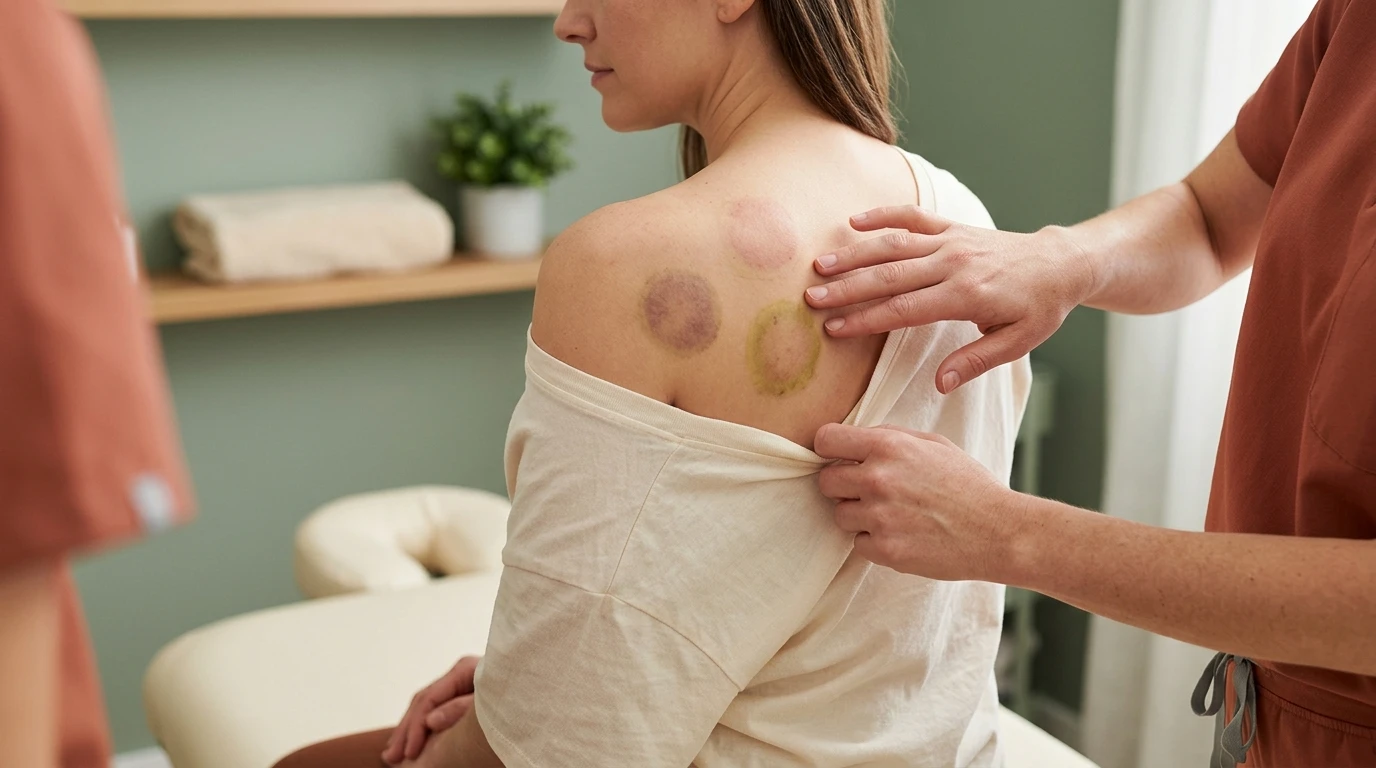
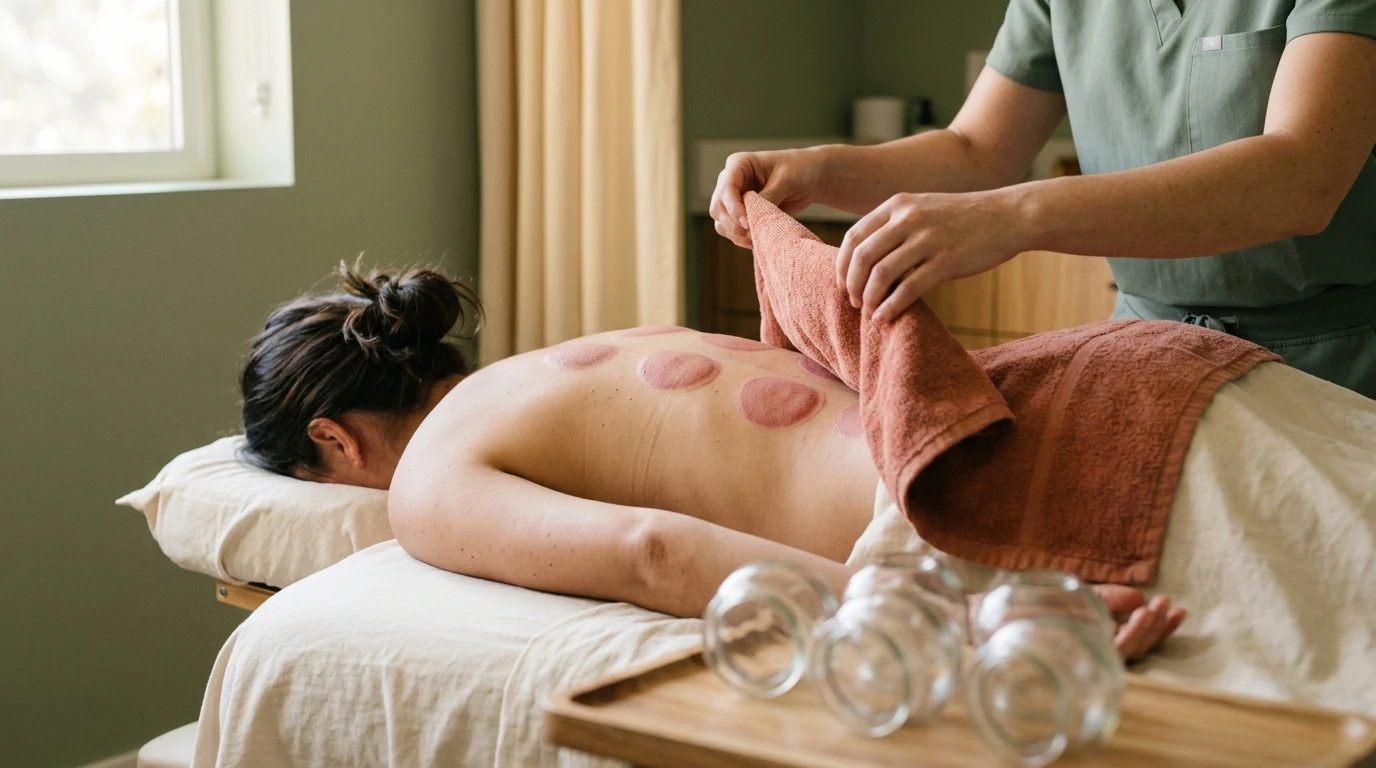
Most cupping marks fade within a week or two, according to Cleveland Clinic, and many light marks are gone in a few days. How long yours last depends on how strong the suction was, how long the cups stayed on, whether the cups were moved (sliding cupping), the area treated, and your own skin and blood vessels. Results vary: two people given the same treatment can leave with very different-looking marks.
What the colors usually mean
Marks range from light pink to deep red-purple. You’ll often read that darker marks mean more “stagnation” or more toxins, but no research supports reading cupping marks as a diagnosis. Color mainly reflects suction strength, time under the cup and how your skin responds. As they fade, the marks tend to change color the way a bruise does. MedlinePlus, the National Library of Medicine’s consumer health site, describes bruises moving from pinkish red to bluish, then greenish-yellow, then back to normal skin. Cupping marks often fade through a similar range of colors.
Are cupping marks bruises?
Not exactly. Cleveland Clinic notes that while the marks look like bruises, they’re “not true bruises that injure muscle fibers.” The suction draws blood into the tissue just under the skin (the “dry diapedesis” described earlier), rather than the marks coming from a blow. So when people ask how long cupping bruises last, the answer is the same as for the marks: typically one to two weeks. It’s also why bruising after cupping is usually not painful to the touch, or only mildly tender. Painful bruising after cupping that gets worse instead of better is worth a call to your practitioner.
Can you make cupping marks fade faster?
No method has been shown to speed up fading. What helps is avoiding anything that adds irritation: sun, scrubbing, scratching and tight gear. Our clinicians also don’t re-cup an area until the previous marks have cleared. Gua sha follows the same logic, since it also leaves temporary redness, and the two are scheduled so they don’t stack on the same skin.
Tell other clinicians where the marks came from
NCCIH specifically advises that the origin of cupping marks be explained to health care providers. A doctor, dermatologist or nurse seeing round bruise-like marks without context may worry about a bleeding problem or an injury. If you have a medical appointment while the marks are visible, mention the cupping first.
Cupping Side Effects the Day After: What’s Normal
Most cupping side effects the day after are mild and short-lived. Cleveland Clinic lists bruising, fatigue, headaches, muscle soreness, nausea, itching, skin infections, burns from heated cups and scarring as possible effects, while describing cupping overall as relatively low-risk. In the PLoS One review of 135 trials mentioned above, no serious adverse effects were reported in any of the included trials. However, the authors rated most of the trials at high risk of bias, so no reports of serious problems doesn’t mean problems never happen.
Lightheadedness right after a session happens to some people. In rare cases, Cleveland Clinic notes, people faint from a sudden drop in blood pressure and heart rate (vasovagal syncope), most often after wet cupping in people who also faint with needle sticks. If you feel dizzy, sit or lie down, have some water and a snack, and don’t drive until it has fully passed.
Sore after cupping: how long it lasts and what helps
Feeling sore after cupping is common. It usually feels like the tenderness after a firm massage or a workout, and it tends to ease over a day or two. Gentle movement, warmth from clothing, and a lukewarm shower once the first few hours have passed all help. Soreness after cupping is not normal if it’s severe, keeps getting worse after the first day, or comes with swelling, heat or fever. Cleveland Clinic lists extreme pain or soreness among the reasons to call your provider.
If you’re having cupping for an ongoing problem such as low back pain, soreness from the session is different from your original pain. Tell your practitioner how each one changed. Cupping is often one part of a broader plan that may include acupuncture for back pain or massage for back pain, and that feedback helps adjust it.
Itching after cupping
Mild itching after cupping, especially as the marks start to fade, is common and harmless. Don’t scratch. Use a fragrance-free moisturizer or a cool, damp cloth. One thing deserves a call: a new cluster of small blisters or a cold-sore-like rash on the treated area. A case report in the Annals of Dermatology described a 56-year-old woman who developed herpes simplex lesions on her forearm 3 days after acupuncture and cupping at that site. The authors suggested the virus was either introduced by a contaminated acupuncture needle or reactivated by the mechanical trauma to the skin. It’s a single case, not a common outcome, but a rash like that needs a clinician’s look rather than home care.
Feeling tired or headachy after cupping
Fatigue and a mild headache after cupping are both on Cleveland Clinic’s list of possible effects. Water, food, an early night and a quiet evening usually take care of them. For a tension-type headache, our guide to pressure points for headaches covers simple self-care. A sudden, severe headache, or any headache with confusion, weakness, vision changes or a stiff neck, is not an aftercare issue: seek emergency care.
Blisters and Burns After Cupping: What to Do
Blisters after cupping
Strong suction or longer cup times sometimes raise small fluid-filled blisters, which the mechanisms review describes as part of the skin’s response to suction. If you notice blisters after cupping, the American Academy of Dermatology’s blister guidance applies:
- Don’t pop or drain the blister, because that can lead to infection.
- Leave the blister’s roof in place, since it protects the skin underneath.
- Cover it loosely with a bandage.
- Most blisters heal on their own in one to two weeks.
- See a clinician if you notice redness, pus, or increased pain or swelling.
Let your practitioner know about any cupping blisters even if they look minor. It tells them to adjust suction or timing at your next visit.
Burns from fire cupping
Fire cupping, where a flame briefly heats the inside of a glass cup to create suction, carries a small but real burn risk. A study in the Medical Journal of Australia reviewed 18,703 patients in the Burns Registry of Australia and New Zealand from 2009 to 2016. Twenty of them (0.11%) had cupping-related burns. Sixteen of those 20 burns happened at home, an accelerant was used in at least 19 cases (17 with methylated spirits, 2 with hot oil), and 8 patients needed skin grafts. The authors concluded that medical practitioners should warn patients of the dangers of cupping.
A normal mark is a smooth, round area of discoloration, sometimes slightly raised, that doesn’t hurt much. A burn may look shiny, wet or white, blister quickly, sit off-center from the cup ring, or hurt more over the following hours instead of less. If you think you have a burn, don’t pop any blister that forms, and call your practitioner or get medical care the same day, especially if it’s blistering or larger than a small spot.
Why fire cupping belongs in a clinic
The registry data point to home use, with flammable liquids, as where most cupping burns happen. Don’t try to recreate fire cupping at home. In a clinic, a licensed practitioner controls the flame, the cup temperature and the timing, and checks your skin throughout. NCCIH also notes that cupping equipment contaminated with blood and reused without proper sterilization can spread bloodborne diseases such as hepatitis B and C, which is one more reason to choose a licensed practitioner with strict equipment hygiene.
When to Call Your Practitioner — and When to Seek Urgent Care
Most of what you feel after cupping belongs in the first column below. Use the other two columns to decide whether to call your practitioner or get medical care today.
| Normal — manage at home | Call your practitioner | Seek same-day medical care or emergency care |
|---|---|---|
| Round pink-to-purple marks that are not very painful | Any blister, even a small one (don’t pop it) | A blistering burn, or any burn larger than a small spot |
| Mild soreness or tenderness for a day or two | Pain or soreness that’s getting worse instead of better after the first day | Spreading redness or red streaks from the area, pus or drainage, or fever |
| Feeling tired or “heavy” the rest of the day | Marks still dark and unchanged after about two weeks | Extreme pressure, rapidly increasing swelling or severe pain in the treated area |
| Mild itching as marks fade | A new cold-sore-like or clustered blistering rash on the treated skin | Fainting, or a sudden severe headache, confusion or weakness |
| A mild headache or brief lightheadedness that passes with rest, water and food | Anything that just doesn’t feel right to you | Trouble breathing, chest pain or any other emergency symptom: call 911 |
The middle and right columns follow published warning signs: MedlinePlus lists red streaks, pus, drainage and fever as infection signs and advises seeking care right away for extreme pressure in a bruised area; Cleveland Clinic lists burns, extreme pain or soreness, fever and signs of skin infection; and the AAD flags redness, pus and increasing pain or swelling around a blister. If you’re unsure where to go, our explainer on urgent care vs. primary care can help. For non-urgent questions about your session, contact our clinic directly.
Who Needs Extra Care After Cupping
Some people should take extra precautions with cupping, and in some cases avoid it entirely. Tell your practitioner at intake if any of the following apply to you:
- Blood thinners. MedlinePlus notes that blood thinners such as aspirin, warfarin or clopidogrel make you bruise more easily, so expect darker or longer-lasting marks, and make sure your practitioner knows before the cups go on. Never stop a prescribed medication to have cupping.
- Bleeding or clotting conditions and related history. Cleveland Clinic advises against cupping if you have anemia, a pacemaker, a bleeding disorder, blood clotting problems (including deep vein thrombosis or a history of stroke), cardiovascular disease or epilepsy.
- Eczema or psoriasis. NCCIH warns that cupping may worsen these conditions. Treated areas should avoid flare-prone skin.
- A history of cold sores or herpes simplex. Mention it, given the case report above, and call if a blistering rash appears at a treated site.
- Diabetes or skin that heals slowly. Tell your practitioner, who may use lighter suction and will want to hear about any blister or break in the skin promptly.
- Pregnancy. Cleveland Clinic states that you shouldn’t have cupping therapy if you’re pregnant. If you’re pregnant and dealing with aches, options such as prenatal massage or Webster Technique chiropractic care during pregnancy can be discussed with your care team instead.
- Menstruation. Guidance varies between sources, so let your practitioner know, and they’ll decide whether and where to cup.
Cupping is a complementary therapy. It doesn’t replace a medical evaluation for new, severe or unexplained symptoms.
Does Aftercare Depend on the Type of Cupping?
The basics (covered and warm, delayed lukewarm shower, no extreme heat or cold, easy day) apply to every kind of cupping, but a few details differ:
- Dry (static) cupping: cups stay in place for a few minutes. This gives the classic round marks, and all the guidance above applies as written.
- Fire cupping: heat creates the vacuum. Aftercare is the same as dry cupping, plus extra attention to any spot that looks or feels like a burn rather than a mark (see the burns section).
- Sliding (moving) cupping: oil is applied and the cup glides across the skin. Redness tends to be streaky and spread out rather than in distinct circles. Shower off the oil gently once the first few hours have passed.
- Flash cupping: cups are applied and removed quickly, many times. Marks are usually lighter, but the same first-day guidance applies.
- Wet cupping: the skin is lightly scarified so a small amount of blood is drawn into the cup. This is a different procedure with wound-care needs. The mechanisms review notes that adhesive strips are applied afterward and left on for 48 hours. NCCIH notes that rare cases of anemia have been reported after repeated wet cupping, and the bloodborne-disease risk from improperly sterilized equipment mentioned above is most relevant here. Keep the strips dry and in place, follow your provider’s wound-care instructions exactly, and watch closely for infection signs.
Copper Wellness performs fire cupping. If you’ve had a different technique elsewhere, ask that practitioner for their specific aftercare instructions.
Cupping Aftercare Myths vs. Evidence
Most aftercare advice online mixes sensible practice with claims that don’t hold up. Here’s how the common rules actually compare with the evidence:
| Rule or claim | Where it comes from | What the evidence says | Our practical take |
|---|---|---|---|
| “Cupping pulls toxins out of the body” | Traditional theory; repeated on most practice blogs | Unproven. The mechanisms review lists “blood detoxification” among several proposed theories and says these theories “need to be verified by advanced scientific basic research.” | Don’t choose cupping, or judge your marks, on the basis of “detox” |
| “Drink extra water to flush the toxins out” | Practitioner convention | NCCIH’s guide to detoxes and cleanses cites a 2015 review that found no compelling research supporting “detox” diets for weight management or eliminating toxins from the body. | Do drink water, because hydration helps on a tired, sore day, not to flush anything |
| “Wait 4–6 hours before showering” | Practitioner/TCM convention | Never tested in a trial | Reasonable and easy to follow: wait a few hours, then use lukewarm water |
| “No sauna, hot tub or cold plunge for 24 hours” | Practitioner convention | Not studied directly | Sensible for skin comfort and lightheadedness; costs you nothing to follow |
| “Ice the marks” | Confusion with sports injuries | Marks aren’t true bruises from an injury | Not needed for normal marks; call if there’s real swelling |
| “No workout for 24 hours” | Practitioner convention | One small study (12 adults) found improved recovery at 24 hours, but no immediate effect | Light movement is fine; save hard sessions for the next day |
| “No coffee” | Detox framing | No evidence it affects cupping | Your usual cup is fine unless your practitioner says otherwise |
| “Avoid dairy, meat and sugar” | Detox framing | No evidence for any specific food ban | Eat a normal, balanced meal |
| “Darker marks mean more toxins or stagnation” | Traditional diagnostic theory | No research validates marks as a diagnosis; color reflects suction, time and skin response | Darker marks aren’t a “better” result; mention anything unusual |
The practical rules people follow are mostly fine to keep. It’s the explanations that are often wrong, and knowing the real reason makes it easier to tell when a symptom isn’t normal.
Planning Cupping Around Massage, Chiropractic, PT and Workouts
Many patients have cupping alongside other treatments, so a common follow-up question is when you can get a massage after cupping, or book an adjustment. There’s no published evidence on how to sequence these, so the table below reflects how our clinicians coordinate it on a shared care plan. Your own practitioner may adjust it based on how your skin and tissue respond.
| After cupping, when can I… | How our clinicians usually plan it |
|---|---|
| Get a massage on a different area | Same day or any time. Cupping and massage therapy are often combined in one plan. |
| Get deep tissue massage over the cupped area | Wait until the tenderness has settled, typically a few days. Lighter work is an option sooner; see Swedish vs. deep tissue massage for the difference. |
| Have a chiropractic adjustment | Usually fine, including on the same day; let your chiropractor know where the cups were so they can avoid pressing on fresh marks. See our chiropractic care services. |
| Do a physical therapy session | Light and mobility work can continue; heavy loading of the treated area waits a day. If you’re unsure which provider leads which part of your plan, see chiropractor vs. physical therapist. |
| Have acupuncture | Often in the same visit; your practitioner plans needle placement around the cupped area. |
| Have gua sha on the same area | Not until the cupping marks have faded |
| Repeat cupping on the same area | Not until the previous marks have cleared |
| Race, compete or do a max-effort session | Schedule cupping at least a day before, never the morning of |
Cupping With Aftercare Built In: How Copper Wellness Coordinates Your Recovery
Aftercare is easier when the people treating you talk to each other. At Copper Wellness, cupping is performed by Dr. Anais Jackson-Gonzalez, whose doctoral training in acupuncture and Chinese medicine and multimodal practice (acupuncture, cupping, gua sha, moxibustion) mean your session is part of a considered plan, not a one-off add-on. She sees patients in both English and Spanish.
Under the same roof, our massage therapists (including Benicia Blue, trained in deep tissue and myofascial release, and Andy Holsteen), chiropractors Dr. Adam Mohr and Dr. Mimosa Nguyen, and our physical therapy and acupuncture teams all work from a shared care plan. In practice, that means the scheduling table above comes from how we actually plan care. Your cupping won’t land the day before deep tissue work on the same muscles, and your chiropractor will know where the cups were.
We see patients at one clinic, 1654 W. North Ave. on the Bucktown/Wicker Park line, and many travel from Logan Square, Lincoln Park and West Town; our cupping therapy in Wicker Park page covers the local details. We accept Blue Cross Blue Shield and Aetna, as well as FSA and HSA, and our billing team verifies coverage before treatment. Details are on our insurance page. New patients can start with a free virtual consultation to ask what to expect and how to care for their skin afterward.
FAQ
More general questions about visiting the clinic are answered on our FAQ page.
Can I get a massage after cupping?
Yes. A massage on a different area is fine the same day. For deep tissue work directly over the cupped area, wait until the tenderness settles, which typically takes a few days.
Should you ice after cupping?
Usually not. Normal marks aren’t an acute injury and don’t need ice, and practitioners generally recommend keeping the area warm the first day. If an area becomes genuinely swollen or painful, call your practitioner.
Can I go in a sauna or hot tub after cupping?
Wait about 24 hours. Intense heat can make fresh marks sting and add to lightheadedness. After that, if your skin has settled and there are no blisters, normal heat use is generally fine.
Why can’t you shower right after cupping?
For the first few hours the marks are at their most flushed and sensitive, and hot water or scrubbing can irritate them. Waiting 4–6 hours and then using lukewarm water is a sensible practitioner convention. It has nothing to do with “open pores” or toxins.
Is it normal to be sore after cupping?
Yes. Mild tenderness, a bit like after a firm massage, usually eases within a day or two. Soreness that is severe or keeps getting worse is a reason to call your practitioner.
Why am I so tired after cupping?
Fatigue is a recognized, short-lived effect, and many people feel relaxed and heavy afterward. Drink water, eat, and get a good night’s sleep. Tell your practitioner if you’re still unusually exhausted after a day.
What should I not eat after cupping?
There’s no evidence-based list of foods to avoid after cupping, so a normal, balanced meal is ideal. Skipping alcohol for the rest of the day is a sensible choice.
Is itching after cupping normal?
Mild itching as the marks fade is common. Moisturize and don’t scratch. A new clustered blistering or cold-sore-like rash at the site should be checked by a clinician.
How long does it take to recover from cupping?
Most people feel back to normal within a day. The marks take longer, typically one to two weeks, and the exact timeline varies with technique, suction and your skin.
Does cupping pull out knots or inflammation?
There’s no evidence that cupping physically “pulls out” knots, inflammation or toxins. The suction draws blood into the tissue just under the skin, which is what creates the marks. Pain research on cupping is limited and mostly low quality, so treat it as one part of a broader plan for muscle tension.
How can you tell if cupping is working?
Judge it by changes in the problem you came in for, such as pain, stiffness or range of motion, over several sessions. The color or size of the marks tells you nothing. Your practitioner should check in on those changes and adjust the plan if nothing is improving.
How often can I get cupping?
Your practitioner sets the interval based on your goals and how your skin responds. As a rule, our clinicians don’t cup the same area again until the previous marks have faded.
Schedule your complimentary consultation at Copper Wellness — call (872) 267-1717, email Hello@CopperWells.com, or book online at copperwellness.janeapp.com. Our team will plan your cupping around the rest of your care and walk you through your aftercare before you head home.