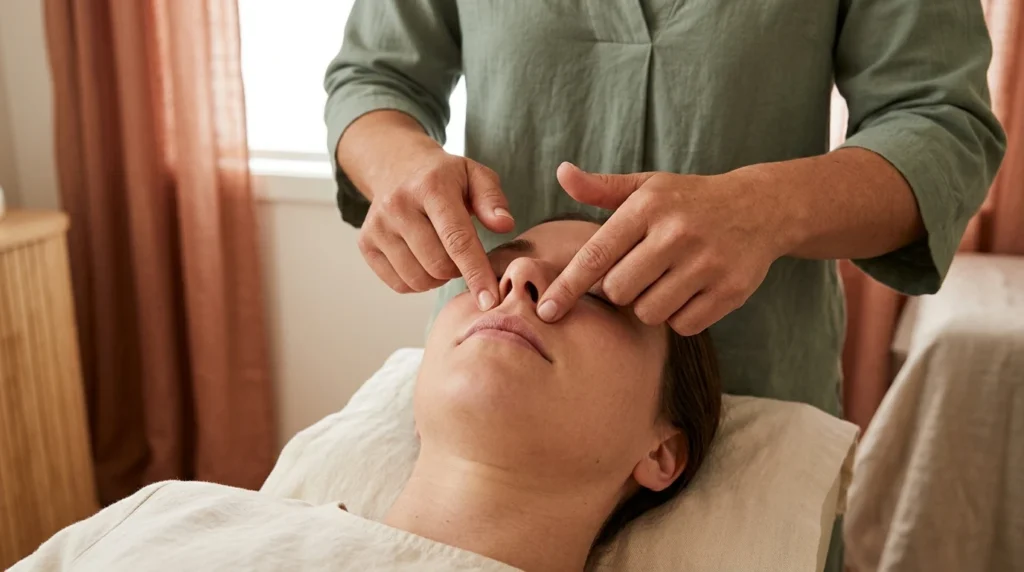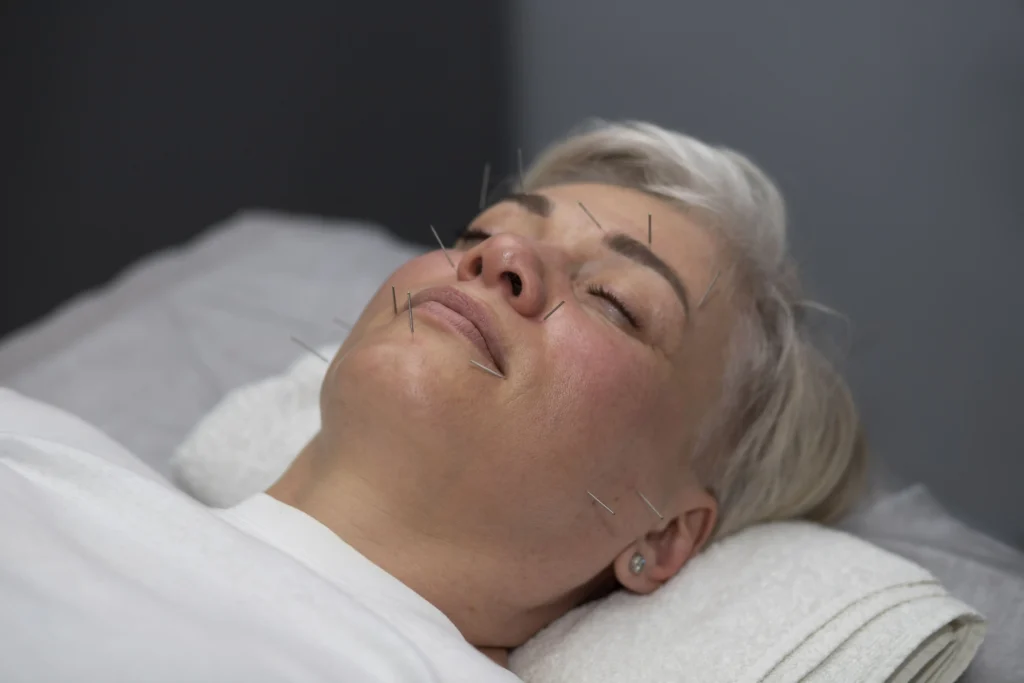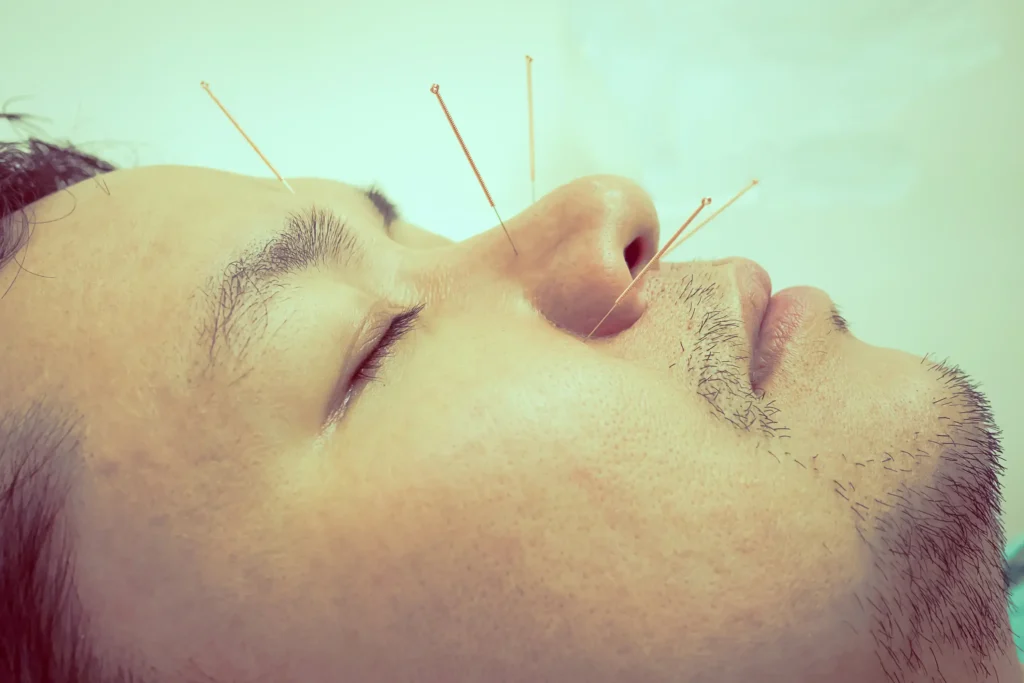

The most commonly used pressure points for headaches are LI4 in the web of the hand, GB20 in the two hollows at the base of the skull, the temples (Taiyang), the inner ends of the eyebrows (BL2) and the spot between the eyebrows (Yintang). Press each one with firm but comfortable pressure, steady or in …

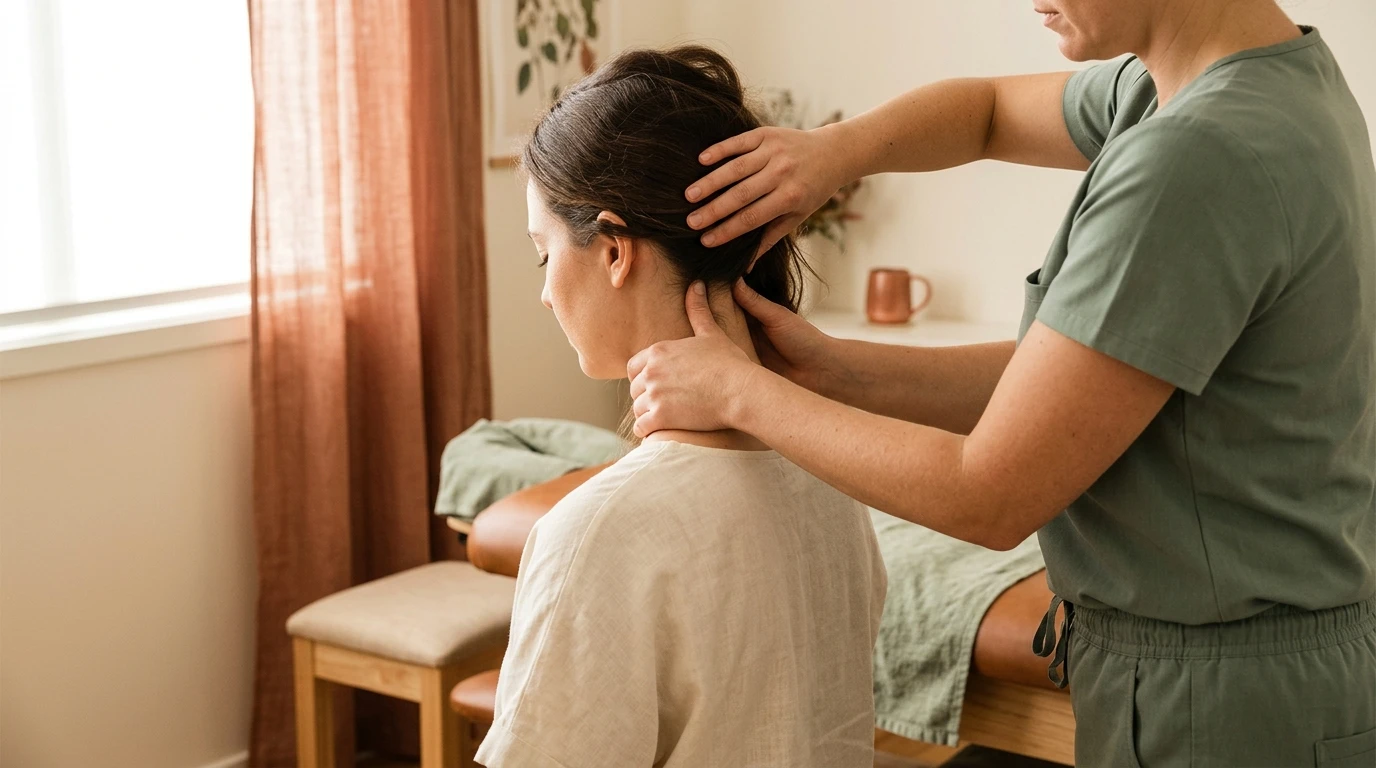
The most commonly used pressure points for headaches are LI4 in the web of the hand, GB20 in the two hollows at the base of the skull, the temples (Taiyang), the inner ends of the eyebrows (BL2) and the spot between the eyebrows (Yintang). Press each one with firm but comfortable pressure, steady or in small circles, for 30 seconds up to 2–3 minutes, then repeat on the other side. For migraines, the same points are used, plus PC6 on the inner wrist for nausea. Here is the honest part: acupressure may ease mild tension-type pain and migraine nausea, but the research on pressing points yourself is small and mixed, and it doesn’t replace an evaluation for headaches that are frequent, severe or changing. You are far from alone in looking for relief — headache disorders affect approximately 40% of the population, or 3.1 billion people in 2021, according to the World Health Organization.
This article is for general education and isn’t a diagnosis or a treatment plan. If you’re unsure whether a headache is serious, contact your doctor or call 911.
Key Takeaways
- Five points cover most headaches. LI4 (hand web), GB20 (base of the skull), Taiyang (temples), BL2 (inner eyebrows) and Yintang (between the eyebrows). PC6 on the inner wrist is the one to know for migraine nausea.
- Press for 30 seconds to 2–3 minutes. A U.S. Department of Veterans Affairs acupressure handout suggests 30 seconds per point, up to five times daily; Memorial Sloan Kettering Cancer Center suggests 2 to 3 minutes on LI4. Firm, never painful.
- The strongest evidence is for needles, not fingers. In a 2016 Cochrane review of acupuncture for migraine prevention (22 trials, 4,985 participants), headache frequency was at least halved in 41% of people receiving acupuncture versus 17% receiving none. Trials of self-acupressure are much smaller and their results are mixed.
- Wrist pressure may help migraine nausea. In a study of 40 women published in Neurological Sciences, pressure on PC6 from a wristband lowered nausea scores during migraine attacks. It was not a test of pain relief.
- Pregnant? Skip LI4 unless your OB or midwife says otherwise, and check with them before using acupressure at all.
- Red flags need medical care, not pressure points. A sudden severe headache (possibly with a stiff neck), a severe headache with fever, a “first” or “worst” headache with confusion or weakness, or a headache after a brain injury are on the National Institute of Neurological Disorders and Stroke (NINDS) list of reasons to call or see a doctor right away.
Headache Pressure Points at a Glance
If you came looking for a diagram of pressure points for headache relief, this table is the text version: every point in this guide, where to find it, and how to press it. The codes (LI4, GB20) are the standard acupuncture names our acupuncturists use for the same acupressure points for headache care.
| Point | Where it is | How to press | Typically used for |
|---|---|---|---|
| LI4 — Hegu, Union Valley | Back of the hand, in the muscle between thumb and index finger | Opposite thumb, small circles, 30 sec to 2–3 min per hand | General headaches; the most widely taught point. Avoid in pregnancy. |
| PC6 — Neiguan, Inner Gate | Inner forearm, three finger-widths from the wrist crease, between the two tendons | Thumb, steady pressure, 30 sec to 2–3 min per wrist | Nausea during a migraine |
| GB20 — Feng Chi, Gates of Consciousness | Two hollows under the base of the skull, either side of the neck | Both thumbs, pressing upward under the skull ridge | Back-of-head pain, tension-type headaches with a tight neck |
| GB21 — Shoulder Well | Top of the shoulder, midway between the neck and the shoulder tip | Opposite hand, fingers pressing down or a gentle pinch | Shoulder and neck tension. Ask your provider first in pregnancy. |
| Taiyang — temples | Soft hollow at each temple, behind the outer end of the eyebrow | Index and middle fingers, slow circles, both sides together | Temple and side-of-head pain |
| BL2 — Drilling Bamboo | Inner end of each eyebrow, in the notch beside the bridge of the nose | Both index fingers, gentle upward pressure | Forehead pain, headaches after screen work |
| Yintang — Third Eye | Midway between the eyebrows | One fingertip, steady light-to-moderate pressure | Forehead tension (traditional use) |
| GV20 — Baihui | Top of the head, on the midline, level with the tops of the ears | One or two fingertips, steady pressure | Used in acupressure trials for chronic headache and migraine |
| Ear Shenmen | Upper ear, in the shallow triangular hollow | Fingertip and thumb, gentle squeeze | Traditional calming point; headache evidence is thin |
| LR3 — top of the foot | Hollow between the first and second toe bones | Thumb, firm pressure, both feet | Traditional use for headaches; shown in the VA handout |
What Pressure Points Are — and What Acupressure Can Realistically Do
What is acupressure, and acupressure vs. acupuncture
Acupressure is firm finger or thumb pressure applied to the same mapped points that acupuncture uses. The difference between acupressure vs acupuncture is the tool and the person holding it: acupressure is something you can do for yourself, while acupuncture uses very fine sterile needles placed by a licensed practitioner who chooses points for your particular pattern.
In traditional Chinese medicine, these points sit along channels (meridians) through which qi is said to flow. That is the traditional framework, not established physiology. The National Center for Complementary and Integrative Health (NCCIH), part of the NIH, says how acupuncture works is not fully understood, and describes three likely contributors: effects on the nervous system, effects on tissue at the site, and nonspecific effects such as expectation. We think it’s fairer to tell you that than to promise a precise mechanism.
At Copper Wellness, these points are everyday tools for our acupuncturists. Dr. Stephanie Madden is a Doctor of Acupuncture trained at AOMA Graduate School of Integrative Medicine and a board-certified herbalist. Dr. Anais Jackson-Gonzalez holds a Doctorate in Acupuncture and Chinese Medicine from National University of Health Sciences and focuses on pain management. Acupressure for headaches is often what they teach patients to use between visits.
Which headache do you have?
The points you start with depend on the pattern. A band of pressure on both sides with a tight neck suggests a tension-type headache, the most common type according to NINDS. One-sided throbbing with nausea or light sensitivity points toward migraine. Our guide to tension headache vs. migraine walks through the differences. Pressure behind the cheeks and nose with congestion is a separate topic with its own set of points, so we don’t cover sinus points here.
How to Get Rid of a Headache With Pressure Points: Technique First
No technique clears every headache, and results vary from person to person. What good technique does is give each point a fair chance. The steps are the same for all headache relief pressure points:
- Get comfortable. Sit or lie down, drop your shoulders, and breathe slowly.
- Find the point. Most sit in a small hollow between muscles or bones and feel slightly tender compared with the skin around them.
- Apply firm, steady pressure or small circles with a thumb or fingertip.
- Hold for 30 seconds, building up to 2–3 minutes if it feels good.
- Release slowly and repeat on the other side of the body.
- Stop if you feel dizzy or uncomfortable, as the VA handout advises.
How long should you press? What the sources actually say
Online guides give numbers from 10 seconds to 5 minutes, usually without saying where they come from. Here is what institutional handouts and trial protocols actually instruct:
| Source | Instruction or protocol | Context |
|---|---|---|
| VA acupressure handout | Press or rub each point for 30 seconds, both sides, up to five times daily | Patient self-care handout for headaches |
| Memorial Sloan Kettering | Small circles on LI4 for 2 to 3 minutes, a few times a day | Patient self-care instructions |
| Xu and Mi, 2017, Medicine | 5 minutes per point, 20 minutes in total, 3 times a week for 8 weeks | Trial protocol in 98 people with chronic migraine with aura |
| Vagharseyyedin et al., 2019, Complementary Therapies in Clinical Practice | Self-administered, 3 times a week at bedtime for 4 weeks | Trial protocol in 76 people with migraine |
The takeaway: there is no single proven “dose.” Start with 30 seconds per point, build toward 2–3 minutes, and let comfort set the limit.
How hard? Memorial Sloan Kettering’s wording is the best guide: firm, but not so hard that it hurts. The VA handout describes pressure that “feels good and not painful.” Mild tenderness at these spots is common. Sharp pain is a reason to ease off or stop.
When? Try the points at the first sign of a headache, or as a short daily routine if your headaches are tied to long hours at a desk. If your thumb tires, Memorial Sloan Kettering notes you can use the eraser end of a pencil instead.
Hand and Wrist Pressure Points for Headaches
LI4 (Hegu, Union Valley): the hand pressure point for headache
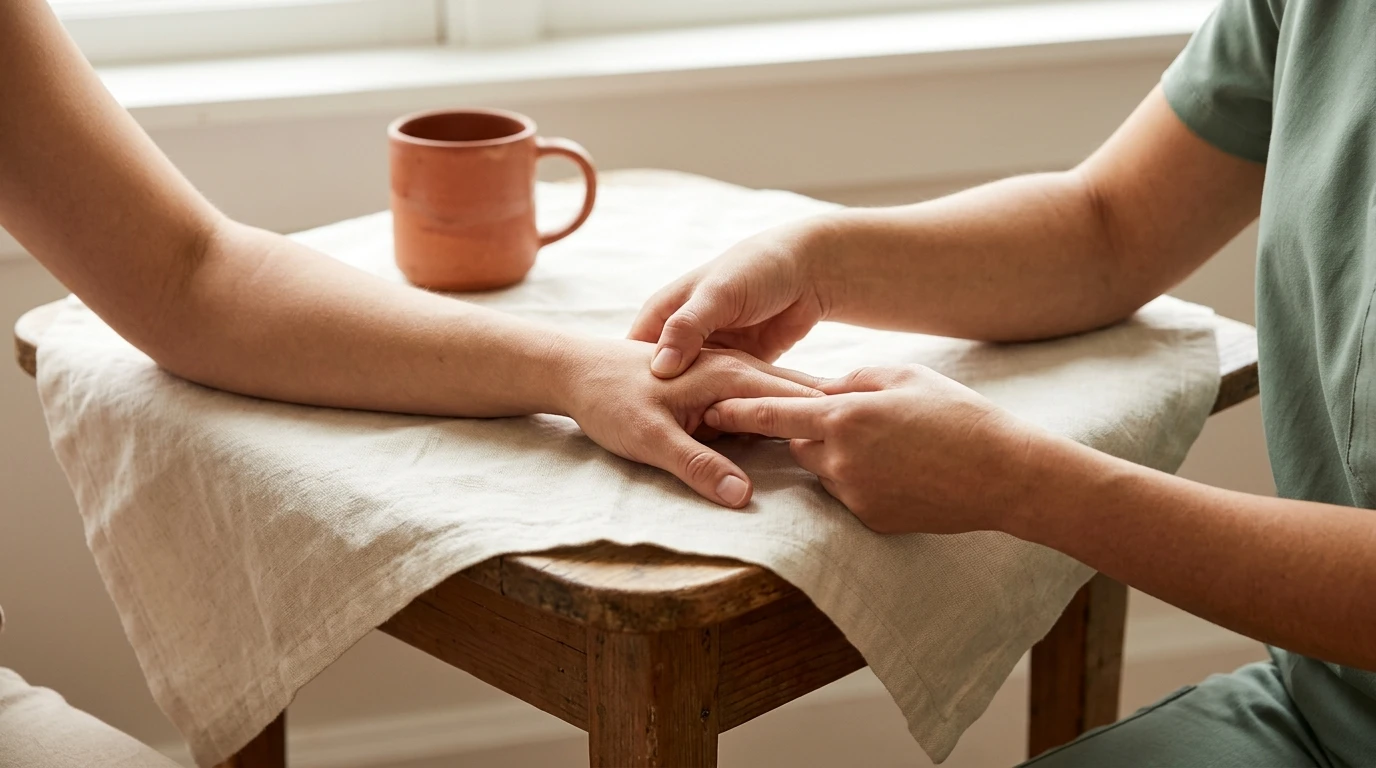
If you learn one pressure point in the hand for headache relief, make it this one. The LI4 pressure point is also called the Hegu pressure point or the Union Valley pressure point.
- Find it: Squeeze your thumb and index finger together. Memorial Sloan Kettering describes the point as the highest spot of the muscle bulge that forms on the back of the hand.
- Press it: Relax the hand, then press that spot with the thumb of your other hand in small circles for 2 to 3 minutes. Switch hands.
- Evidence note: LI4 appears in both the Memorial Sloan Kettering and VA handouts, but we found no trial showing that pressing LI4 alone reduces headache pain.
- Pregnancy: Memorial Sloan Kettering tells patients not to use this point during pregnancy. See the safety section below.
PC6 (Neiguan, Inner Gate): for migraine nausea
Among migraine pressure points, hand and wrist points are the ones with the most specific data, and it is for nausea rather than pain.
- Find it: Turn your palm up. Place three fingers across the inner forearm, starting at the wrist crease. PC6 sits just beyond them, between the two tendons running down the middle.
- Press it: Steady thumb pressure, 30 seconds to 2–3 minutes, both wrists.
- Evidence note: In the Neurological Sciences study, 40 women with migraine without aura wore a PC6 pressure wristband during three of six attacks. Nausea scores were significantly lower with the band at 30, 60, 120 and 240 minutes, and consistent responders made up 28% at 60 minutes, 40% at 120 minutes and 59% at 240 minutes. In the 2017 Medicine trial, acupressure that included PC6 reduced nausea but not pain.
A third hand point, SI3, sits on the outer edge of the hand just below the little-finger knuckle. It is one of the six points pictured in the VA handout, and you can press it the same way for 30 seconds per side.
Pressure Points on the Head and Face
Head pressure points are the ones most people find by instinct, rubbing the temples or the brow without knowing the names.
Taiyang (temples)
Find the soft hollow about a finger-width behind the outer end of your eyebrow. Use your index and middle fingers on both temples at once and make slow circles for 30 seconds to a minute. Taiyang is shown in the VA handout and was one of four points in the 2017 Medicine trial. Keep pressure light here.
Drilling Bamboo (BL2): the eyebrow point
For a forehead or eyebrow headache, this is the pressure point to try first. Drilling Bamboo sits at the inner end of each eyebrow, in the small notch where the brow meets the bridge of the nose. Press both sides gently upward with your index fingers. BL2 was among the most commonly used points in a 2010 randomized trial in the American Journal of Chinese Medicine, where 28 people with chronic headache received either one month of acupressure treatment or a muscle relaxant. Average pain scores afterward were 32.9 with acupressure versus 55.7 with medication, and the difference persisted at six months. It was a small, single-center study, so treat it as encouraging, not settled.
Third Eye (Yintang)
The Yintang pressure point lies midway between the eyebrows. Hold one fingertip there with steady, moderate pressure while you breathe slowly. It is traditionally used for forehead tension, and most guides include it. None of the headache studies we reviewed tested Third Eye specifically, so we can’t attach an evidence claim to it.
GV20 (Baihui), top of the head
Trace a line up from the tops of both ears to where it meets the midline of the scalp. GV20 was used in both the 2010 and 2017 trials. Some traditional routines add points just inside the front hairline, such as GV24. These have traditional use only.
Neck and Shoulder Points: Tension Headache Relief Pressure Points

When a headache starts at the back of the head and wraps forward, the useful points are usually in the neck and shoulders, not on the head itself.
GB20 (Feng Chi, Gates of Consciousness)
- Find it: The GB20 pressure point is a pair of hollows just under the ridge at the base of the skull, on either side of the neck between the two thick vertical muscles.
- Press it: Interlace your fingers behind your head and set your thumbs into the hollows. Press upward, toward the skull, and let your head rest back into your thumbs for 30 seconds to 2 minutes.
- Evidence note: GB20 is in the VA handout and was used in both acupressure trials above. If this area is stubbornly tight, acupuncture for neck pain treats the same point with a needle.
GB21 (Shoulder Well)
GB21 is on the top of the shoulder, halfway between the base of the neck and the shoulder tip. Reach across with the opposite hand and press down with your middle fingers, or gently pinch the muscle, for 30 seconds per side. Its use for headaches is traditional, and the studies we reviewed did not test it. If you are pregnant, ask your provider before using it.
Why the neck matters, and where hands-on care comes in
Many people with tension-type headaches notice tight, tender muscles across the neck and shoulders. A 2018 systematic review in Frontiers in Neurology pooled 7 randomized trials of manual trigger-point treatment to head and neck muscles. Attack frequency fell by 3.5 per month in tension-type headache and by 1.92 per month in migraine. The authors rated the quality of that evidence as very low, so these figures are a signal, not a promise.
This is where trained hands do more than your own thumbs can. At our clinic, massage therapy with Benicia Blue (The Soma Institute; deep tissue and myofascial release) or Andy Holsteen, a licensed massage therapist who works with myofascial release and breathwork, targets these muscles directly, including dedicated massage for migraine. When the neck joints themselves are involved, Dr. Adam Mohr (Doctor of Chiropractic, National University of Health Sciences) and Dr. Mimosa Nguyen (Doctorate of Chiropractic, Logan University) see patients as a chiropractor for headaches and provide chiropractic care for neck pain. Posture and desk-related strain are often addressed in physical therapy.
Migraine Pressure Points in the Ear: What’s Real and What Isn’t
Searches for migraine pressure points in the ear usually lead to two things: ear acupressure and daith piercings. They deserve very different answers.
Ear acupressure. Auricular therapy maps points across the outer ear. One of the best known is Shenmen, in the shallow triangular hollow of the upper ear. Practitioners often tape tiny “ear seeds” over points so a patient can press them through the day. A 2021 systematic review in Pain Management Nursing found 46 randomized trials of auricular point acupressure for pain. Used on its own, it was studied mainly for low-back pain and menstrual pain, and otherwise it was combined with other care. NCCIH, which describes the research on chronic back pain and cancer pain as promising, cites a 2019 review of 15 studies with 930 participants in which auricular acupuncture or auricular acupressure significantly reduced pain intensity. Neither source is about headaches. Gently squeezing Shenmen for 30 seconds is low-risk, but headache-specific evidence is thin.
Daith piercing. A 2024 review in Headache, the journal of the American Headache Society, screened 186 articles and found one retrospective study and three case reports, with no clinical trial. Where relief was reported, symptoms returned within weeks to months. The authors concluded that current evidence does not support daith piercing for migraine, tension-type headache or other headache disorders. Our advice: don’t get pierced for migraines.
If ear points interest you, auricular acupuncture is a practitioner-delivered service at our clinic.
Foot Pressure Points for Headaches
Headache pressure points on the feet appear in many guides, usually without a source. The VA handout is the one institutional source we found that pictures them. It shows two:
- LR3 — on top of the foot, in the hollow between the first and second toe bones, about two finger-widths back from the web of the toes.
- KD1 — on the sole, in the dip just behind the ball of the foot.
Press each for 30 seconds per foot. GB41, between the fourth and fifth toe bones on top of the foot, is a traditional variant. We found no headache trial testing any foot pressure point for headache relief, so consider these optional additions.
Match the Points to Where It Hurts
This table reflects how our clinicians think about which pressure points to relieve headaches make sense to try first. It is a starting point for self-care, not a diagnosis.
| Where or how it hurts | Points to try first | Who to see if it keeps coming back |
|---|---|---|
| Band-like pressure on both sides, tight neck and shoulders | GB20, GB21, LI4 | Massage therapist, acupuncturist or chiropractor |
| Back of the head, base of the skull | GB20, GV20 | Chiropractor or physical therapist for a neck assessment |
| Forehead or between the eyes after screen work | BL2, Yintang, Taiyang | An eye care provider if it’s frequent; acupuncturist or massage therapist |
| One-sided throbbing with nausea or light sensitivity | PC6 for nausea; Taiyang, GB20, LI4 | Primary care or a neurologist for diagnosis and prescription options; acupuncture as a complement |
| Headaches around your period | LI4, GB20, PC6 if nauseated | Primary care or gynecology; our acupuncturists also provide acupuncture for period pain and PMS |
| Headache with jaw clenching or a sore jaw on waking | Taiyang, GB20 | A dentist if you clench or grind; TMJ massage or acupuncture for TMJ |
A 5-minute desk sequence
Here is a routine you can use today without leaving your chair. It uses the migraine relief pressure points and tension points above, in an order that works from the neck forward.
- GB20 — thumbs in the hollows under the skull, head resting back: 1 minute.
- GB21 — opposite hand on the top of each shoulder: 30 seconds per side.
- Taiyang — slow circles on both temples: 1 minute.
- BL2, then Yintang — inner eyebrows for 30 seconds, then between the brows for 30 seconds.
- LI4 — small circles in the web of each hand: 30 seconds per hand.
Pregnancy variant: get your provider’s OK for acupressure first. Leave out LI4 and GB21, and spend that time on slow breathing and gentle temple circles instead.
Simple habits support any routine: drinking enough water, keeping sleep and meals regular, and taking breaks from screens. When headaches track with poor sleep or stress, those are worth treating in their own right. Our acupuncturists offer acupuncture for insomnia and acupuncture for anxiety.
Does Acupressure Work for Headaches? What the Research Actually Shows
Most articles on this topic quote acupuncture studies as proof that pressing a point works. Those are different treatments. This table separates what was actually tested.
| Study or guideline | What was tested | Result | What it means for pressing points at home |
|---|---|---|---|
| Cochrane review, 2016 (migraine) | Practitioner acupuncture; 22 trials, 4,985 people | Frequency at least halved: 41% vs 17% with no acupuncture; 50% vs 41% with sham; 57% vs 46% with preventive drugs at 3 months | Supports a course of needle acupuncture. The edge over sham is small. |
| Cochrane review, 2016 (tension-type headache) | Practitioner acupuncture; 12 trials, 2,349 people | Frequency at least halved: 48% vs 19% with routine care in the larger of two trials; 51% vs 43% with sham | Same: evidence for acupuncture, not for acupressure |
| NICE guideline CG150 (UK) | Guideline recommendation | Consider up to 10 sessions of acupuncture over 5 to 8 weeks to prevent chronic tension-type headache, and for migraine if standard preventive drugs are unsuitable or haven’t worked | A course of care, not a single session or a single point |
| American Journal of Chinese Medicine, 2010 | One month of acupressure treatment vs a muscle relaxant; 28 people | Pain score 32.9 vs 55.7 after one month | Encouraging, but very small and from a single center |
| Medicine, 2017 | Acupressure added to sodium valproate; 98 people with chronic migraine with aura | No added benefit for pain, attack frequency, painkiller use or quality of life; nausea significantly reduced | Don’t expect acupressure to prevent migraines. Nausea is the realistic target. |
| Neurological Sciences, 2012 | PC6 wristband; 40 women | Lower nausea scores at 30 to 240 minutes | Reasonable to try PC6 for migraine nausea |
| Complementary Therapies in Clinical Practice, 2019 | Self-acupressure vs sham; 76 people with migraine | Fatigue improved more than sham; no significant difference in sleep quality. Pain was not measured. | May ease fatigue; says nothing about pain |
| Frontiers in Neurology, 2018 | Manual trigger-point treatment of head and neck muscles; 7 trials | 3.5 fewer attacks per month in tension-type headache; very low-quality evidence | Supports hands-on work on neck and shoulder muscles |
| Headache, 2024 | Daith piercing | No clinical trials; not supported | Skip the piercing |
What acupressure can and can’t do
What it can reasonably do:
- Offer a low-risk thing to try for a mild tension-type headache.
- Help with nausea during a migraine (PC6).
- Possibly ease migraine-related fatigue when used regularly.
What it hasn’t been shown to do:
- Reduce migraine pain or attack frequency when added to preventive medication.
- Match the courses of needle acupuncture studied in the Cochrane reviews.
- Replace a diagnosis, or the migraine treatment your doctor prescribed.
So does acupressure work? For some people and some symptoms, modestly. Even for acupuncture, NCCIH’s headache fact sheet cautions that much of the benefit may be due to nonspecific effects, and describes massage as possibly helpful for migraines based on limited evidence from two small studies. That page doesn’t mention acupressure at all. If acupressure for migraines gives you partial relief, acupuncture for migraines is the better-studied next step, and our overview of the benefits of acupuncture explains what else it is used for. Responses differ from person to person.
Who Should Be Careful With Pressure Points (Including During Pregnancy)
Acupressure is low-risk for most people, but it has limits.
Pregnancy. The main pressure points to avoid during pregnancy, based on the sources we verified, start with LI4: Memorial Sloan Kettering tells patients not to use it because it “can make you go into labor.” The VA handout advises talking to your provider before using acupressure at all while pregnant. To be transparent about the evidence, a 2017 Cochrane review of acupuncture or acupressure for induction of labour (22 trials, 3,456 women) found no clear benefit of acupressure on the labour outcomes it measured. The warning is precautionary, and we still follow it. A new or severe headache during pregnancy is a reason to call your OB or midwife, not to self-treat. For hands-on care designed for pregnancy, we offer prenatal massage, and Dr. Mohr, who is Webster Certified, provides prenatal chiropractic care.
Skin and circulation. The VA handout says to skip points over numb areas, wounds, severe swelling, active infection or a recent blood clot. Memorial Sloan Kettering adds skin that is peeling or blistering, an open wound, a rash, or signs of infection such as redness, swelling, warmth or pus at or near the point.
Blood thinners or easy bruising. Check with your provider first and keep pressure light.
During use. Stop if you feel dizzy, if pain sharpens, or if the headache gets worse.
Red Flags: When a Headache Needs a Doctor, Not a Pressure Point
No pressure point is appropriate for the situations below. NINDS advises calling or seeing a doctor right away if you have:
- A sudden, severe headache, which may come with a stiff neck
- A severe headache with fever, nausea or vomiting that isn’t explained by another illness
- A “first” or “worst” headache that comes with confusion, weakness, double vision or loss of consciousness
- A headache that worsens over days or weeks, or a change in your usual pattern
- A headache after a brain injury
- A headache with loss of sensation or weakness in any part of the body, which could be a sign of stroke
- A headache with convulsions or trouble breathing
- Two or more headaches a week
- A constant headache when you’ve never had headaches before, especially if you are over 50
- New headaches with a history of cancer or HIV/AIDS
For a sudden severe headache, weakness, numbness, confusion, vision changes, convulsions, trouble breathing or loss of consciousness, call 911 or go to an emergency department. Do not wait to see whether pressure points help.
Self-care, evaluation or emergency: a quick checklist
| Try pressure points at home | Book an evaluation | Urgent or emergency care now |
|---|---|---|
| Mild to moderate headache in a pattern you recognize | Two or more headaches a week | Sudden, severe headache or the worst of your life |
| Occasional, not weekly | The pattern has changed or is slowly worsening | Weakness, numbness, confusion, double vision or fainting |
| Responds to rest, fluids or your usual remedy | Acetaminophen, aspirin or NSAIDs on 15 or more days a month, or triptans, opioids or combination painkillers on 10 or more days a month, for 3 months or more (NICE’s thresholds for suspecting medication-overuse headache) | Fever with a stiff neck, or vomiting with no other explanation |
| No red-flag symptoms | Headaches that limit work or sleep | After a head injury; with convulsions or trouble breathing |
Who handles what: the emergency department handles red flags. A primary care provider or neurologist makes the diagnosis, decides whether imaging is needed and prescribes migraine medication. If you’re unsure where to start for a non-emergency, see our guide to urgent care vs. primary care. Our role at Copper Wellness is conservative, coordinated care alongside that medical work-up.
When Pressing Your Own Hand Isn’t Enough: How Copper Wellness Treats Recurring Headaches
Self-acupressure uses a few general points with the pressure your thumb can produce. An acupuncturist works differently. Points are selected for your headache pattern, stimulated with fine needles, and sometimes paired with electroacupuncture. For tight neck and shoulder tissue, cupping therapy or gua sha may be added. If you are weighing needle options, our article on dry needling vs. acupuncture explains the distinction.
What a first headache visit looks like
- History. Where the pain sits, how often it comes, what triggers it, what you’ve tried and what medication you take.
- Red-flag screen. If anything suggests you need a medical work-up first, we tell you and point you to the right clinician.
- Hands-on exam. Neck range of motion, and tenderness in the jaw, shoulders and base of the skull.
- A plan you understand. Which points and modalities we suggest, how many visits we’d try before reassessing, and what to do at home, often including two or three of the points in this guide.
- Coordination. If your neck joints or muscles are driving the headaches, your acupuncturist brings in our chiropractic, massage or physical therapy colleagues on one shared care plan.
For context on how long a fair trial takes, NICE’s benchmark is up to 10 sessions over 5 to 8 weeks. That describes the kind of course that has been studied, not a promised outcome. Plans here are individualized, and results vary.
The integrative part is structural. Acupuncturists, chiropractors, massage therapists and a physical therapy team work under one roof at 1654 W. North Ave., on the Bucktown and Wicker Park border, and talk to each other about shared patients. Dr. Jackson-Gonzalez offers care in English and Spanish. New patients can start with a complimentary 15-minute virtual consultation. We accept Blue Cross Blue Shield and Aetna, plus FSA and HSA, and our billing team verifies coverage before treatment; details are on our insurance page.
FAQ
Where is the pressure point for a headache?
There are several. The best-known pressure point for headache relief is LI4, in the muscle between the thumb and index finger. Others are GB20 in the hollows at the base of the skull, the temples, and the inner ends of the eyebrows. Start with whichever is closest to where your pain is.
What gets rid of a headache fast?
Nothing is proven to work quickly for everyone. Reasonable first steps are rest in a quiet room, water, your usual pain reliever if you use one, and a few minutes on GB20, the temples and LI4. If a headache is sudden and severe or comes with neurological symptoms, skip self-care and get medical help.
Where should I massage if I have a headache?
Try the base of the skull, the tops of the shoulders and the temples. Those areas hold the muscles most often tight in tension-type headaches. Use slow, firm circles for a minute or two per area, and ease off if anything feels sharp.
How long should I press a pressure point for a headache?
Between 30 seconds and 2–3 minutes per point. The VA handout suggests 30 seconds, up to five times a day, and Memorial Sloan Kettering suggests 2 to 3 minutes on LI4. There is no proven ideal duration, so stay within what feels comfortable.
Do pressure points really work for migraines?
Partly. In a trial of 98 people with chronic migraine, adding acupressure to medication reduced nausea but not pain or attack frequency. Pressure points for migraines are best seen as a comfort measure alongside the treatment plan from your doctor, not a substitute for it.
Is there a female pressure point for headaches?
No. The points are the same for everyone. What differs is timing, since some women get migraines around their period. A pilot study in the Journal of Acupuncture and Meridian Studies with 18 participants found fewer menstrual-migraine days with acupuncture or acupressure during the treatment period, with no difference at follow-up. That is too small to draw conclusions from.
Which pressure points should I avoid during pregnancy?
Avoid LI4 in the hand, which Memorial Sloan Kettering specifically warns against in pregnancy, and ask your OB or midwife before pressing any other point. Report any new or severe headache in pregnancy to your provider promptly.
What’s the difference between acupressure and acupuncture?
Both use the same point map. Acupressure uses finger pressure and can be self-applied. Acupuncture uses sterile needles placed by a licensed practitioner, and it has been studied far more extensively for headaches.
Does a daith piercing help migraines?
Current evidence says no. The 2024 review in Headache found no clinical trials, and the relief described in case reports faded within weeks to months.
If headaches keep returning despite your best efforts at home, we’re glad to take a look. Schedule your complimentary consultation at Copper Wellness — call (872) 267-1717, email Hello@CopperWells.com, or book online at copperwellness.janeapp.com. Our clinic at 1654 W. North Ave. in Chicago serves patients from Bucktown, Wicker Park, Lincoln Park, West Town and Logan Square.