How much does acupuncture cost? In a peer-reviewed U.S. price study of 723 clinics, the median self-pay price was $112 for a first visit and $80 for a follow-up session. Prices ranged from $15 to $400. What you actually pay depends on three things: whether your health plan covers acupuncture for your condition, whether you …


How much does acupuncture cost? In a peer-reviewed U.S. price study of 723 clinics, the median self-pay price was $112 for a first visit and $80 for a follow-up session. Prices ranged from $15 to $400. What you actually pay depends on three things: whether your health plan covers acupuncture for your condition, whether you can use pre-tax HSA or FSA money, and the kind of session you book (private room or community setting, length, and any add-ons). Only about half of acupuncture visits in recent national data had any insurance coverage at all. This guide shows where those numbers come from, how to verify your own coverage before your first appointment, and how to plan the cost of a full course of care.
This article is for general education. Prices quoted are published national and Chicago benchmarks, not a quote from Copper Wellness, and nothing here is medical, insurance, or tax advice for your individual situation.
Key Takeaways
- Average acupuncture cost: a national median of about $112 for the first visit and $80 for follow-ups, across clinics in U.S. metro areas, with city medians ranging from $45 to $150.
- Insurance is improving but far from universal: the share of acupuncture visits with any insurance coverage rose from 41.1% to 50.2% between 2010 and 2019, and patients still paid 57.5% of the total spending out of pocket.
- Medicare covers acupuncture only for chronic low back pain: up to 12 sessions in 90 days, 8 more if you’re improving, and no more than 20 a year. Medicare can’t pay licensed acupuncturists directly.
- HSA and FSA funds can be used: the IRS lists acupuncture as a qualifying medical expense. The 2026 health FSA limit is $3,400, and the 2026 HSA limits are $4,400 (self-only) and $8,750 (family).
- Self-pay patients have rights: under the No Surprises Act you can get a good faith estimate before treatment, and you may be able to dispute a bill that comes in at least $400 above it.
- At Copper Wellness, Blue Cross Blue Shield and Aetna plans are accepted depending on the service, FSA and HSA payments are accepted, and coverage is verified before treatment.
Acupuncture Costs at a Glance
| Scenario | What you typically pay | Source |
|---|---|---|
| First visit (self-pay, national) | Median $112 (range $15–$400) | Fan et al., J Integr Med 2019 |
| Follow-up visit (self-pay, national) | Median $80 (range $15–$300) | Fan et al., 2019 |
| Chicago teaching clinic (low end of the local market) | $39–$59 per visit; $20 community acupuncture | Pacific College Chicago clinic, prices current as of May 2025 |
| Commercial insurance | Your copay or coinsurance, after any deductible, for covered diagnoses only | Set by your plan (verify before booking) |
| Medicare Part B (chronic low back pain only) | 20% of the Medicare-approved amount after the Part B deductible | Medicare.gov |
| Paying with HSA/FSA funds | Same price, paid with pre-tax dollars | IRS Publication 502 |
How Much Does an Acupuncture Session Cost?
The most useful national benchmark is a peer-reviewed price study published in the Journal of Integrative Medicine. Researchers collected listed out-of-pocket prices from 723 acupuncture clinics in U.S. metropolitan regions. In that analysis by Fan and colleagues, first visits ranged from $15 to $400 with a median of $112. Follow-up visits ranged from $15 to $300 with a median of $80. Location mattered: city medians for a first visit ran from $45 in St. Louis to $150 in Charleston, South Carolina, and follow-up medians from $40 in Miami to $108 in Charleston. Across the ten cities with the highest medians, the medians were $120 for a first visit and $85 for a follow-up. The same study estimated that U.S. patients spent about $3.5 billion out of pocket on acupuncture in 2018.
Two caveats matter when you use those figures. The prices come from online listings (OkCopay.com) gathered for a study published in 2019, so they work as a benchmark rather than today’s exact price in your neighborhood. And the wide range is real: a $20 community session and a $250 specialty session are both “an acupuncture session,” but they are not the same service. So, how much is an acupuncture session for you? It depends on the fee factors below, plus whatever your insurance does or doesn’t pay.
Length is part of the picture too. At Copper Wellness, an acupuncture session typically runs 30 to 60 minutes, depending on the treatment plan, and the acupuncture cost per session reflects that time with a licensed practitioner.
First Visit vs. Follow-Up: Why the First One Costs More
Nearly every clinic charges more for the first appointment, and the 2019 price data confirm it ($112 vs. $80 median). The first visit is longer because it includes a detailed intake: your health history, medications, previous imaging or diagnoses, sleep, digestion and stress, and what you’ve already tried. The practitioner then examines you, works out whether acupuncture is appropriate, and builds an individualized plan before any needles go in. Follow-up visits are shorter and focus on treatment and on tracking how you’re responding.
Some clinics bill a separate consultation or intake fee on top of the first treatment, so ask whether a quoted acupuncture cost per visit includes the intake. At Copper Wellness, new patients can start with a complimentary virtual consultation before committing to a treatment visit. It’s a conversation, not a treatment session: you talk through your goals, get directed to the right specialist, and go over costs before your first appointment. The consultation is led by Dr. Stephanie Madden, the clinic’s founder. She holds a Doctor of Acupuncture from AOMA Graduate School of Integrative Medicine in Austin, is a board-certified herbalist, and previously worked at a VA clinic, Seton clinics, a substance-use recovery center, and fertility clinics in Austin and Chicago.
What Drives the Price: 8 Fee Factors

When two clinics quote very different prices, one or more of these factors is usually the reason. Knowing them helps you compare quotes on equal terms.
1. Session length and billing units
Insurers don’t pay acupuncture “per visit” the way many people assume. Under Aetna’s Clinical Policy Bulletin on acupuncture, the standard billing codes (CPT 97810–97814) are written in 15-minute units of personal, one-on-one contact with the patient, and each additional 15 minutes is a separate code. A longer session with more one-on-one time can therefore cost more, both in a self-pay price and in what’s billed to your plan.
2. Practitioner credentials and experience
A practitioner with a doctorate, years of specialty experience, or additional certifications usually charges more than a newer practitioner. Credentials also determine what can be billed: Medicare, for example, has specific rules about which clinicians it can pay (covered below).
3. Private room vs. community setting
Community acupuncture treats several patients at once in a shared room, often on a sliding scale, which brings the price down sharply. Private treatment rooms cost more because each patient gets dedicated time and space.
4. Location
The Fan study’s city medians spanned more than threefold, from $45 to $150 for a first visit. Rent, local wages, and competition all feed into what clinics charge.
What Acupuncture Costs in Chicago
No peer-reviewed study publishes a current Chicago-specific median, so the most reliable local anchor is a dated, published price list. The Pacific College of Health and Science teaching clinic in Chicago listed, as of May 2025: $46 for an initial visit with student interns and $39 for a return visit; $59 initial and $49 return with a licensed acupuncturist; and $20 for community acupuncture. That clinic states it cannot accept insurance, and as a teaching clinic it represents the low end of the Chicago market. Private, one-on-one care in a multidisciplinary clinic typically sits higher, closer to the national medians or above them, which is exactly why insurance and HSA/FSA funds matter so much. If you’re searching for acupuncture cost near me from Bucktown, Wicker Park, or nearby neighborhoods, Copper Wellness treats patients at its single clinic at 1654 W. North Ave. (see our acupuncture in Bucktown page for directions and neighborhood details).
5. Technique
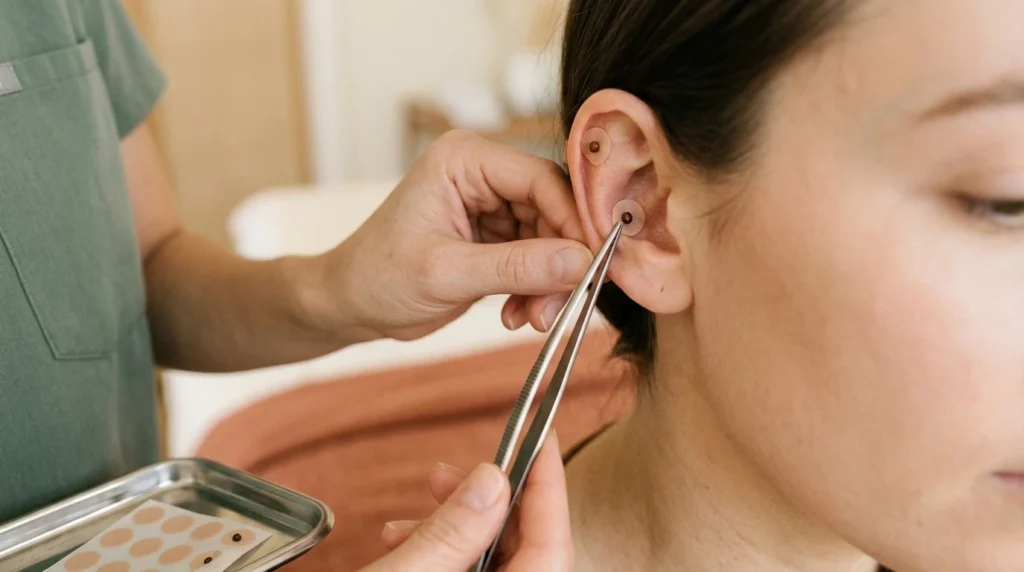
Some techniques are billed differently. Electroacupuncture, which adds a mild electrical current to the needles, uses separate CPT codes (97813/97814) from manual acupuncture (97810/97811) in Aetna’s policy. Auricular (ear) acupuncture may be done on its own or alongside body points, and how it’s priced varies by clinic.
6. Specialty programs
Specialty work often costs more per session because it involves more planning and coordination. Fertility acupuncture may be timed around a menstrual cycle or an IVF transfer, which can mean more visits in a short window; our article on how fertility acupuncture works explains typical timing. Sports acupuncture is tailored to training load and injury recovery. Cosmetic acupuncture is another specialty that generally costs more than standard sessions at clinics that offer it. When you compare fertility acupuncture cost or cosmetic acupuncture cost between clinics, check how many sessions the quoted program actually includes.
7. Add-ons: cupping, gua sha, and herbs
How much does cupping cost? At many clinics, cupping therapy is priced either as an add-on to an acupuncture visit or as its own appointment, and the same goes for gua sha. Plan on paying for cupping yourself: Aetna’s policy on complementary and alternative medicine lists cupping among services it considers experimental and investigational, so it’s generally not covered under that insurer’s medical policy, even when acupuncture is.
Herbal formulas are a separate cost from needling. If your practitioner recommends Chinese herbal medicine, ask what a typical supply costs and how long you’d take it. Whether you can pay for herbs with HSA/FSA funds depends on documentation (see the HSA/FSA section below).
Multimodal sessions are where an experienced practitioner earns their fee. Dr. Anais Jackson-Gonzalez, who earned her Doctorate in Acupuncture and Chinese Medicine at the National University of Health Sciences, focuses on pain management and women’s health and combines acupuncture with cupping, gua sha, and moxibustion. She also sees patients in English or Spanish. Ask in advance which techniques a session includes so the price you’re quoted is the price you pay.
8. Number of visits in your plan
A single session price tells you little on its own. The total cost of care depends on how many visits your condition needs, which is why the full-course section below matters more than any per-visit number.
How Much Does Dry Needling Cost (and Why It’s Billed Differently)?
Dry needling is a different service from acupuncture. It’s usually performed by physical therapists or chiropractors to target muscular trigger points, and dry needling therapy cost depends on whether it’s bundled into a PT or chiropractic visit. Insurers treat it inconsistently: Medicare counts dry needling within its acupuncture benefit for chronic low back pain, while Aetna’s policy classifies dry needling as experimental and unproven. Copper Wellness focuses on acupuncture rather than dry needling; our guide to dry needling vs. acupuncture explains how the two differ.
Does Insurance Cover Acupuncture?

Sometimes, and more often than it used to. A national analysis of Medical Expenditure Panel Survey data, published in JAMA Network Open in 2022, found that the share of acupuncture visits with any insurance coverage rose from 41.1% in 2010–2011 to 50.2% in 2018–2019. Over the same period, the share of acupuncture spending paid out of pocket fell from 66.9% to 57.5%. Still, about half of visits had no coverage at all, and the average user’s out-of-pocket spending went up, from $375.51 to $554.26 a year, because people were also getting more visits.
Is acupuncture covered by insurance in your case? The honest answer is “it depends on the plan and the diagnosis.” As the National Center for Complementary and Integrative Health puts it, some health insurance policies cover acupuncture and others don’t, and coverage is often limited based on the condition being treated. Medicaid coverage of acupuncture varies from state to state.
What Commercial Plans Typically Cover
Insurer medical policies show how acupuncture insurance coverage works in practice. Aetna’s policy is a useful example because it’s public and detailed. It considers acupuncture medically necessary for a defined list of conditions, including:
- chronic neck pain and chronic headache (each lasting at least 12 weeks), which correspond to the conditions we see for acupuncture for neck pain and acupuncture for migraines;
- low back pain, a common reason people book acupuncture for back pain;
- temporomandibular disorders, covered on our acupuncture for TMJ page;
- knee and hip osteoarthritis pain (as an adjunct to other care);
- nausea of pregnancy, post-operative and chemotherapy-related nausea and vomiting, and post-operative dental pain.
The same policy spells out limits that directly affect your acupuncture cost with insurance. Maintenance care is not considered medically necessary, so ongoing “tune-up” visits after you’ve improved are usually self-pay. And if no clinical benefit is seen after four weeks, the treatment plan should be reevaluated. This is one insurer’s policy; your plan’s benefit design (copay, coinsurance, deductible, visit cap) sits on top of it, and other insurers write their own rules.
Medicare
Under Medicare’s acupuncture coverage rules, Part B covers acupuncture (including dry needling) only for chronic low back pain, defined as pain lasting 12 weeks or longer, with no identifiable systemic cause, and not associated with surgery or pregnancy. Medicare covers up to 12 sessions in 90 days, plus 8 more if you’re improving, for a maximum of 20 treatments in 12 months. If you aren’t improving, coverage stops. You pay 20% of the Medicare-approved amount after the Part B deductible.
The detail most cost guides miss: Medicare can’t pay licensed acupuncturists directly. Covered acupuncture must be provided by a doctor or another health care provider, such as a nurse practitioner or physician assistant, who holds a master’s or doctoral degree in acupuncture or Oriental Medicine from an accredited school and a current, unrestricted state acupuncture license. A Medicare patient who books with an independent acupuncturist may end up paying the full price out of pocket even with a qualifying diagnosis, so ask how the visit will be billed before your first appointment.
Blue Cross Blue Shield and Aetna at Copper Wellness
Copper Wellness accepts Blue Cross Blue Shield and Aetna plans, depending on the type of service. Benefits differ widely from plan to plan even within the same insurer, so the clinic doesn’t assume coverage. Instead, you can submit your details on the insurance verification page, and a third-party billing department confirms your benefits before treatment.
How to Verify Your Acupuncture Coverage Before Your First Visit (Step by Step)
A ten-minute call to your insurer can be the difference between a $25 copay and a full-price bill. Use the number on the back of your card and work through these seven steps.
- Have your member ID and group number ready. Also note the name of the plan (HMO, PPO, HDHP), since that shapes everything that follows.
- Ask whether acupuncture is a covered benefit, and whether it’s in-network or out-of-network. If the clinic is out of network, ask whether your plan has out-of-network benefits and how reimbursement works.
- Ask which diagnoses are covered. Coverage is often limited to specific conditions, such as chronic low back pain, chronic neck pain, chronic headache, or osteoarthritis, sometimes with a minimum duration like 12 weeks. If your reason for coming isn’t on the list, expect to pay yourself.
- Ask about visit limits, referrals, and prior authorization. Many plans cap acupuncture visits per year, and some require a referral or pre-approval before the first session. Ask whether progress has to be documented to continue (Aetna, for example, calls for reevaluation if there’s no benefit after four weeks).
- Ask how cost-sharing works. Is it a flat copay or a percentage coinsurance? Does the deductible apply first, and how much of it have you met this year?
- Ask about billing codes and add-ons. Ask how the plan handles CPT codes 97810–97814 and additional 15-minute units, and whether electroacupuncture, cupping, or herbs are covered. Cupping and dry needling are often excluded.
- Write down a reference number, the date, and the representative’s name. If a claim is later denied, that record helps your appeal.
| If your insurer says… | Expect to pay… |
|---|---|
| Covered, in-network, deductible met | Your copay or coinsurance per visit, up to the visit cap |
| Covered, but deductible not met | The plan’s negotiated rate until the deductible is met, then your copay/coinsurance |
| Covered only for certain diagnoses, and yours isn’t listed | Self-pay price (HSA/FSA funds can still help) |
| Out-of-network benefits only | The full fee up front, with possible partial reimbursement after you file a claim |
| Not covered at all | Self-pay price; request a good faith estimate |
The shortcut at Copper Wellness: rather than making the call yourself, you can send your insurance details through the clinic’s insurance page. Per the clinic’s FAQ, coverage is verified within 24 hours, so you know what to expect before your first visit.
Paying Out of Pocket: How Much Is Acupuncture Without Insurance?
How much is acupuncture without insurance? Use the national medians as a reality check: about $112 for a first visit and $80 for follow-ups, with Chicago teaching-clinic prices in the $39–$59 range at the low end and private specialty care above the median. If you’re paying yourself, the questions to ask are simple: what does the first visit include, what does a follow-up cost, are add-ons extra, and is there a cancellation fee?
Ask for a Good Faith Estimate
If you’re uninsured or choose not to use insurance, the No Surprises Act gives you the right to a written good faith estimate of expected charges. According to the Centers for Medicare & Medicaid Services, you get one if you ask for it or if you schedule at least three business days in advance, and you may be able to dispute your bill if it’s at least $400 more than the estimate. The timing rules in the CMS good faith estimate guide look like this:
| When you schedule | When you should receive the estimate |
|---|---|
| 0–2 business days before the visit | Not required to be provided |
| 3–9 business days before the visit | Within 1 business day of scheduling |
| 10 or more business days before the visit | Within 3 business days of scheduling |
| Final bill is $400+ above the estimate | You may be able to start a dispute (keep a copy of the estimate, since you can’t dispute without one) |
Costs People Don’t Expect
- Late-cancellation fees. Many clinics charge for missed appointments. Copper Wellness has a 24-hour cancellation policy, and the Chicago teaching clinic cited above uses the same 24-hour window.
- Separate intake fees at some clinics, on top of the first treatment.
- Add-ons such as cupping or electroacupuncture, which may be priced separately or excluded by insurance.
- Herbal formulas, billed separately from treatment and only conditionally HSA/FSA-eligible.
- Maintenance visits after you’ve improved, which insurers like Aetna don’t consider medically necessary.
Using HSA or FSA Funds for Acupuncture
Is acupuncture covered by HSA and FSA accounts? Yes. IRS Publication 502 states that you can include in medical expenses the amount you pay for acupuncture. Health savings accounts and health flexible spending accounts reimburse qualified medical expenses as defined by the same section of the tax code (section 213(d)), so acupuncture treatment generally qualifies. Copper Wellness accepts both FSA and HSA payments.
How much you can set aside in 2026:
- Health FSA: up to $3,400 in salary reductions for plan years beginning in 2026, per IRS Publication 15-B.
- HSA: up to $4,400 for self-only coverage and $8,750 for family coverage, per IRS Publication 969. To contribute to an HSA, you need a qualifying high-deductible health plan; for 2026, the minimum deductible is $1,700 for self-only and $3,400 for family coverage.
What may need extra documentation. Herbal supplements and “natural medicines” are not deductible medical expenses under Publication 502 unless a medical practitioner recommends them as treatment for a specific medical condition diagnosed by a physician. If you plan to pay for herbs from an HSA or FSA, ask your plan administrator whether they need a letter of medical necessity. General wellness spending, like health club dues, doesn’t qualify.
An illustrative calculation (not tax advice). Take an 8-visit course priced at the national medians: $112 + (7 × $80) = $672. That fits comfortably inside the 2026 FSA limit. If you pay with pre-tax dollars and your combined tax rate were, hypothetically, 25%, that $672 would cost you roughly the same take-home pay as $504 spent after tax ($672 × 0.75). Your real savings depend on your own tax situation and your plan’s rules, so check with your plan administrator or a tax professional.
What a Full Course of Acupuncture Costs
Most people don’t book a single session, so the number that matters for budgeting is the course total. In the JAMA Network Open data, the average acupuncture user had 8.2 visits a year by 2019 and spent a mean of $1,021.57 a year in 2018–2019. The table below shows what a course costs at the national median prices and at the medians for the ten highest-priced metro areas in the 2019 price study.
| Visits in the course | At national medians ($112 first, $80 follow-up) | At medians of the 10 highest-priced cities ($120 first, $85 follow-up) |
|---|---|---|
| 4 visits | $112 + 3 × $80 = $352 | $120 + 3 × $85 = $375 |
| 6 visits | $112 + 5 × $80 = $512 | $120 + 5 × $85 = $545 |
| 8 visits | $112 + 7 × $80 = $672 | $120 + 7 × $85 = $715 |
| 12 visits | $112 + 11 × $80 = $992 | $120 + 11 × $85 = $1,055 |
Illustration based on published self-pay medians, not a quote. Your actual price, insurance cost-share, and number of visits will differ.
How many visits will you need? It depends on your condition, how long you’ve had it, and how you respond, and results vary from person to person. No practitioner can promise a specific outcome or visit count in advance. A realistic plan is set after an evaluation and includes checkpoints. The payer rules above build those checkpoints in: Aetna’s policy calls for reevaluation if there’s no benefit after four weeks, and Medicare stops covering visits if you aren’t improving. For a long-standing problem such as sciatica-related pain, it’s reasonable to ask your practitioner up front what improvement should look like by visit four or six, and what happens if it doesn’t come.
Is Acupuncture Worth the Cost?
For some conditions, the evidence is solid enough that major medical bodies recommend acupuncture. For others it’s weaker. A fair way to judge value is to look at both.
Where the evidence is strongest:
- Low back pain. The American College of Physicians clinical practice guideline lists acupuncture among first-line nondrug treatments for acute or subacute low back pain (low-quality evidence) and for chronic low back pain (moderate-quality evidence), both as strong recommendations.
- Chronic pain more broadly. An individual-patient-data meta-analysis in The Journal of Pain pooled 39 trials and 20,827 patients. It found acupuncture more effective than both sham acupuncture and no acupuncture for musculoskeletal pain, osteoarthritis, chronic headache, and shoulder pain, and the treatment effect fell by only about 15% after one year.
- Osteoarthritis and migraine. NCCIH notes that a 2019 American College of Rheumatology/Arthritis Foundation guideline conditionally recommends acupuncture for knee, hip, or hand osteoarthritis, and that there is moderate-quality evidence acupuncture may reduce the frequency of migraines.
Where to be cautious: evidence quality varies by condition, and for some uses it is limited or mixed. Acupuncture works best as part of a plan that includes a proper diagnosis, not as a replacement for one. NCCIH explicitly advises against using acupuncture to postpone seeing a health care provider about a health problem. For an overview of what acupuncture is commonly used for, see our article on the benefits of acupuncture.
Value also depends on the alternative. For chronic pain, weigh the course cost against what you’re already spending on visits, medications, or missed work, and agree with your practitioner on measurable goals (pain scores, sleep, function) so you can tell after a few sessions whether it’s paying off.
Ways to Lower Your Acupuncture Costs
- Verify before you book. Use the seven-step checklist above, or have the clinic verify for you. A covered diagnosis billed in-network is usually the single biggest saving.
- Use pre-tax money. Put expected acupuncture costs into your FSA during open enrollment, or pay from your HSA.
- Ask for a good faith estimate if you’re self-pay, and keep it.
- Ask about prepaid packages or multi-visit pricing. Some clinics offer them, but check the cancellation and refund terms before you prepay.
- Consider community or teaching clinics if budget is the deciding factor. In Chicago, published teaching-clinic prices start around $20–$59 per visit.
- Set checkpoints. Agree on when you’ll reassess (for example, after four weeks), so you aren’t paying for visits that aren’t helping.
- Coordinate care. If you’re also seeing a chiropractor, physical therapist, or massage therapist for the same problem, care planned together can avoid overlapping visits that address the same thing twice.
Cheap Isn’t the Same as Qualified
Whatever you pay, make sure the person treating you is properly credentialed. Illinois licenses acupuncturists through the Illinois Department of Financial and Professional Regulation, which offers a free public License Look Up you can use before your first visit. According to NCCIH’s guidance on credentialing, most states require acupuncturists to be certified by, or pass the exams of, the National Certification Commission for Acupuncture and Oriental Medicine (NCCAOM), though a license or certificate alone doesn’t prove someone is the right fit for your condition. Ask about training and experience with your specific problem. Also confirm the clinic uses sterile, single-use needles: the FDA regulates acupuncture needles as medical devices and requires them to be sterile and labeled for single use only.
Before You Pay: When to See a Medical Provider First
Acupuncture is not a substitute for diagnosis. NCCIH reports relatively few complications when acupuncture is done properly, but complications have resulted from nonsterile needles and improper delivery, and delaying medical evaluation of a serious problem is its own risk. Seek urgent or emergency care, not an acupuncture appointment, if you have:
- sudden, severe pain, or the worst headache of your life;
- chest pain, shortness of breath, or pain spreading to the arm or jaw;
- new numbness, weakness, or trouble speaking or walking;
- loss of bladder or bowel control, or numbness in the groin or inner thighs, with back pain;
- back pain with fever, unexplained weight loss, or a history of cancer;
- pain after a fall, car accident, or other trauma.
Before treatment, tell your acupuncturist if you take blood thinners or have a bleeding disorder, have a pacemaker or other implanted device (relevant to electroacupuncture), or are pregnant or trying to conceive. These don’t necessarily rule acupuncture out, but they change how it’s done.
How Copper Wellness Keeps Acupuncture Costs Predictable
Copper Wellness doesn’t publish a one-size price list, because what you pay depends on your plan, your diagnosis, and the care you actually need. What the clinic does is make that cost visible before you commit:
- Insurance verified before treatment. A third-party billing department checks your benefits, and the clinic aims to confirm coverage within 24 hours of receiving your details.
- Blue Cross Blue Shield and Aetna accepted depending on the type of service, along with FSA and HSA payments.
- A complimentary virtual consultation with Dr. Madden, who talks through your needs, directs you to the right specialist, and walks you through costs before your first visit. No commitment required.
- Coordinated, integrative care under one roof. Acupuncturists, chiropractors, physical and pelvic floor therapists, massage therapists, and a nurse practitioner work from a shared care plan across the clinic’s services, so treatment is planned together rather than booked piecemeal.
- Doctorate-level acupuncturists, including Dr. Stephanie Madden and Dr. Anais Jackson-Gonzalez, with care focused on the underlying cause of your symptoms, not just symptom relief.
FAQ
How much is acupuncture per session on average?
In a peer-reviewed U.S. price study of 723 clinics, the median was $112 for a first visit and $80 for a follow-up, with city medians from $45 to $150 for a first visit. Treat these as benchmarks: specialty sessions and private one-on-one care can cost more, and community clinics can cost much less.
How much is acupuncture without insurance?
Expect roughly the national medians above, more for longer or specialty sessions, and as little as $20–$59 at Chicago teaching or community clinics. If you’re self-pay, ask for a good faith estimate before your visit. You may be able to dispute a final bill that comes in at least $400 above it.
Is acupuncture covered by insurance?
About half the time. Nationally, 50.2% of acupuncture visits had some insurance coverage by 2019. Coverage usually depends on your diagnosis, with chronic back pain, neck pain, headache, and osteoarthritis among the most commonly covered conditions, so verify your specific plan before booking.
Does Aetna cover acupuncture?
Aetna’s medical policy considers acupuncture medically necessary for specific conditions, including chronic neck pain, chronic headache, low back pain, TMJ disorders, and knee or hip osteoarthritis pain, but not maintenance care. Whether your own Aetna plan pays depends on its benefit design. Copper Wellness accepts Aetna depending on the type of service and verifies your benefits before treatment.
Does Blue Cross Blue Shield cover acupuncture?
It depends entirely on your specific BCBS plan, since benefits vary by employer, state, and plan type. Copper Wellness accepts Blue Cross Blue Shield depending on the type of service, and its billing team can check your plan’s acupuncture benefits before your first visit.
Can I use my HSA or FSA for acupuncture?
Yes. The IRS lists acupuncture as a qualifying medical expense, and Copper Wellness accepts both HSA and FSA payments. Herbal formulas are different: they generally qualify only when a practitioner recommends them to treat a specific diagnosed condition, so check with your plan administrator first.
Does Medicare cover acupuncture?
Only for chronic low back pain lasting at least 12 weeks: up to 12 sessions in 90 days, 8 more if you’re improving, and no more than 20 a year, with you paying 20% after the Part B deductible. Medicare can’t pay licensed acupuncturists directly, so confirm how the visit will be billed before you book.
Why does the first acupuncture visit cost more?
Because it’s longer and does more. It includes a full health history, an exam, and an individualized plan in addition to treatment. Nationally, first visits run about $30 more than follow-ups at the median ($112 vs. $80).
How many sessions will I need, and what will the total cost be?
The average acupuncture user had about 8 visits a year in national data, and an 8-visit course at median prices comes to about $672 before insurance. Your number depends on your condition and how you respond, and results vary. A good plan includes a reassessment point, typically around four weeks.
Are cupping or herbs included in the price?
Often not. Cupping is frequently priced as an add-on or a separate visit, and some insurers, including Aetna, consider it experimental, so it’s usually self-pay. Herbal formulas are billed separately from treatment. Ask before your session what’s included.
Is cheaper acupuncture just as good?
Lower-cost community and teaching clinics can be a good option, and a lower price doesn’t mean poor care. What matters is a valid Illinois license (you can check it on the IDFPR License Look Up), sterile single-use needles, and experience with your specific condition. Private sessions cost more mainly because of dedicated one-on-one time.
Want to know what acupuncture will actually cost under your plan? Schedule your complimentary consultation at Copper Wellness: call (872) 267-1717, email Hello@CopperWells.com, or book online at copperwellness.janeapp.com. If you plan to use insurance, send your plan details first, and the clinic will confirm your coverage before your first visit.