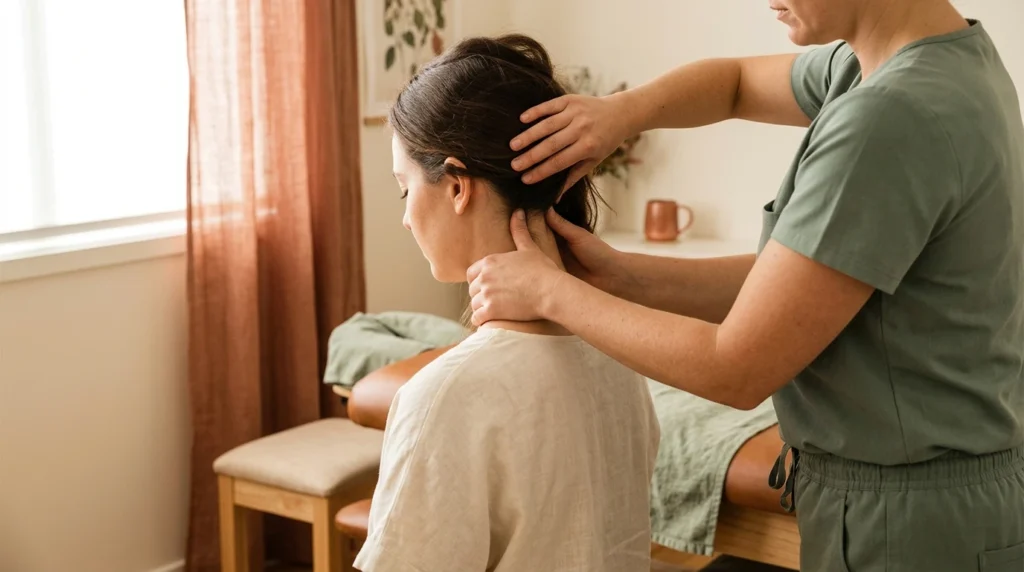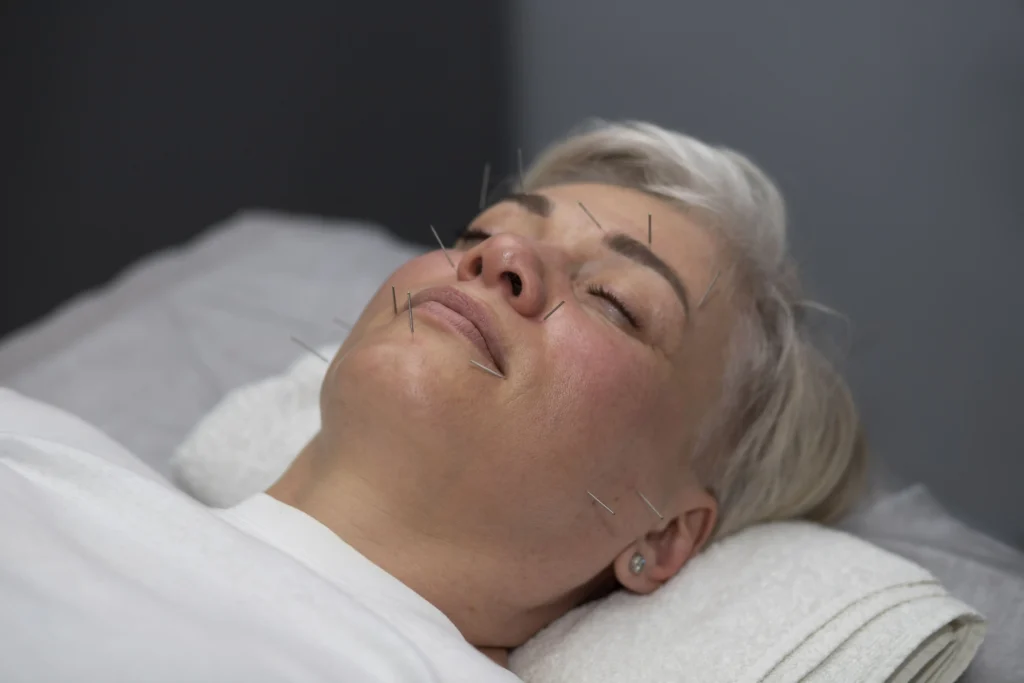

The pressure points for sinus relief that are used most often are LI20 beside each nostril, BL2 at the inner ends of the eyebrows, Yintang between the brows, the cheekbone points under the eyes, LI4 in the web of the hand and GB20 at the base of the skull. Press each one gently but firmly, …

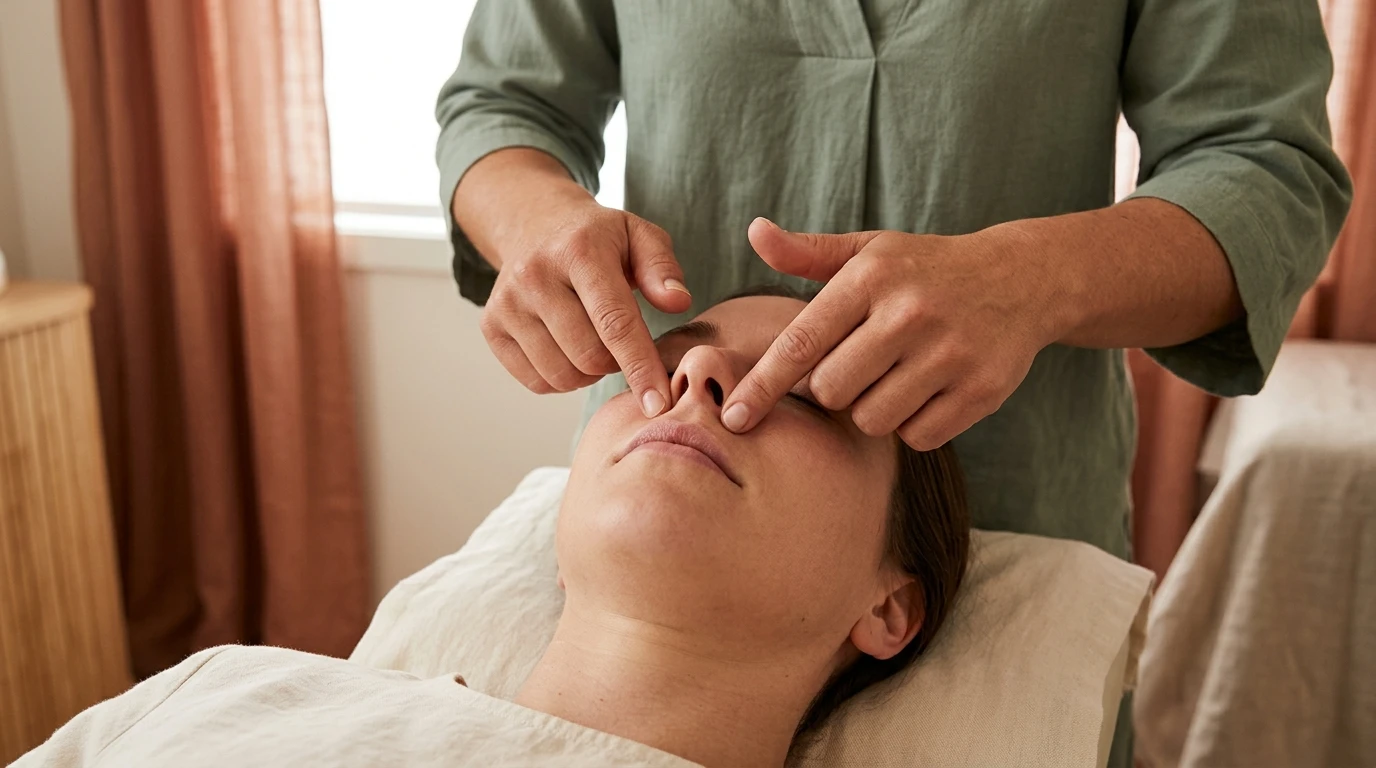
The pressure points for sinus relief that are used most often are LI20 beside each nostril, BL2 at the inner ends of the eyebrows, Yintang between the brows, the cheekbone points under the eyes, LI4 in the web of the hand and GB20 at the base of the skull. Press each one gently but firmly, steady or in small circles, for 30 seconds up to about 2 minutes. The honest part: these sinus pressure relief points may ease the feeling of congestion and facial pressure, they have mostly been studied in people with hay fever, and they do not treat a sinus infection. Think of them as pressure points for congestion comfort, alongside saline, steam and rest.
This article is for general education and isn’t a diagnosis or a treatment plan. If you’re unsure whether your symptoms are serious, contact your doctor or an urgent care clinic.
Key Takeaways
- Six locations cover most sinus routines. LI20 (beside the nostrils), BL2 (inner eyebrows), Yintang (between the brows), the cheekbone points SI18 and ST3, LI4 (hand web) and GB20 (base of the skull). LI11 at the elbow is a seventh worth knowing.
- Press for 30 seconds to about 2 minutes per point. Thirty seconds is what a small trial of nasal massage in the American Journal of Rhinology used for cold congestion; 2 minutes per point is what a randomized trial of self-acupressure published in Chinese Medicine used for hay fever. Keep pressure light on the face.
- The best evidence is for allergy congestion, and it is modest. In that 41-person hay fever trial, four weeks of daily self-acupressure improved symptom and quality-of-life scores, but there was no sham comparison. A 15-person pilot trial in Acupuncture in Medicine that did use a comparison set of points found no significant difference.
- No trial shows acupressure treats a sinus infection. Most sinus infections are viral and get better on their own, according to the Centers for Disease Control and Prevention (CDC).
- Pregnant? Skip LI4. Memorial Sloan Kettering Cancer Center advises against pressing this hand point during pregnancy. Ask your OB or midwife before using acupressure at all.
- Know the red flags. Symptoms past 10 days without improving, symptoms that get worse after improving, or a fever lasting longer than 3–4 days call for a medical visit (CDC). Any change in vision is on the MedlinePlus (National Library of Medicine) list of reasons to contact a provider, and swelling or redness around an eye needs prompt care.
Sinus Pressure Points at a Glance
People searching for sinus pressure points usually want to see them. This table is the text version of a face diagram: each point, where to find it, how to press it, and a column you won’t find elsewhere — whether that point was actually part of a self-acupressure or self-massage trial. The codes (LI20, GB20) are the standard names our acupuncturists use.
| Point | Where it is | How to press | Traditionally used for | Tested in a self-pressure trial? |
|---|---|---|---|---|
| LI20 — Yingxiang, Welcome Fragrance | In the groove where each nostril meets the cheek | Both index fingers, in and slightly up; 30 sec to 2 min | Stuffy nose, nasal congestion | Yes — cold congestion (20 people) and hay fever (41 people) |
| BL2 — Zanzhu, Drilling Bamboo | Small notch at the inner end of each eyebrow | Thumbs or index fingers, up into the bone, away from the eye | Forehead and brow pressure | No |
| Yintang | Midway between the eyebrows | One fingertip, gentle circles; up to 2 min | Forehead pressure, stuffiness | Yes — hay fever trial |
| SI18 and ST3 — cheekbone points | Under the cheekbone, below the outer corner of the eye (SI18) and below the pupil, level with the nostril (ST3) | Index or middle fingers, light upward pressure under the bone | Cheek pressure | No |
| LI4 — Hegu, Union Valley | Back of the hand, in the muscle between thumb and index finger | Opposite thumb, small circles; 2–3 min per hand | Face and head discomfort. Avoid in pregnancy. | Yes — hay fever trial |
| LI11 — Quchi | Outer end of the elbow crease, with the arm bent | Opposite thumb, firm steady pressure; up to 2 min per arm | Used alongside LI4 and LI20 | Yes — hay fever trial |
| GB20 — Fengchi, Wind Pool | Two hollows under the skull ridge, either side of the neck muscles | Both thumbs, up and in; up to 2 min | Head pressure with a tight neck | Yes — hay fever trial |
What Sinus Pressure Points Are — and What They Can Realistically Do

Acupressure in plain terms
Acupressure uses the same point map as acupuncture, with fingers instead of needles. You can do it yourself; acupuncture is performed by a licensed practitioner. In traditional Chinese medicine, points along the Large Intestine, Bladder and Gallbladder channels are described as moving qi through the face and head. That is the traditional framework, and we name it as such. In biomedical terms the mechanism is not fully worked out: the National Center for Complementary and Integrative Health (NCCIH), part of the NIH, summarizes acupuncture research for seasonal allergies but says nothing about acupressure specifically, which tells you how thin the finger-pressure evidence is.
So what is sinus acupressure realistically for? Comfort. Acupressure for sinus symptoms is aimed at how blocked and pressured your face feels, not at physically emptying a sinus. At Copper Wellness, these are points that Dr. Stephanie Madden (Doctor of Acupuncture, AOMA Graduate School of Integrative Medicine, and a board-certified herbalist) and Dr. Anais Jackson-Gonzalez (Doctorate in Acupuncture and Chinese Medicine, National University of Health Sciences) work with in practice, and the ones they teach patients to press between visits.
Where your sinuses are and why they feel like pressure
You have four pairs of sinuses: in the forehead (frontal), in the cheeks (maxillary), between the eyes (ethmoid) and behind the eyes (sphenoid). When their lining swells and mucus can’t move freely, you feel it as fullness or aching over those areas. The cause matters. ENT Health, the patient site of the American Academy of Otolaryngology–Head and Neck Surgery Foundation, defines acute sinusitis as symptoms lasting under 4 weeks and chronic sinusitis as symptoms lasting longer than 12 weeks, and notes that about 98 percent of acute cases are viral.
Allergies are the other big driver. Allergic rhinitis affects nearly 1 in every 6 Americans, according to the AAO-HNSF clinical practice guideline on allergic rhinitis. Chicago sits at #32 of the 100 largest U.S. metro areas in the Asthma and Allergy Foundation of America’s 2026 Allergy Capitals report, which ranks how challenging each city is for people with pollen allergies. That matters here because allergy congestion is where the evidence for acupressure points for sinus congestion is least thin.
How to Press: Technique, Pressure and Timing
- Wash your hands and sit upright. If your nose is blocked, breathe slowly through your mouth.
- Find the point. It is usually a small hollow, and it is often a little tender.
- Use the pad of a fingertip or thumb. Press steadily, or make small slow circles.
- Hold for 30 seconds to start, building to about 2 minutes if it feels comfortable.
- Release slowly, then repeat on the other side for paired points.
- Stop if it hurts, or if you feel dizzy or nauseated.
How hard? On the face, lighter than you think. For massage strokes, Cleveland Clinic describes the right touch as being like the weight of a penny on your face, and warns that pressing too hard can cause lightheadedness, dizziness or vertigo. Point holds can be slightly firmer than that, but never painful. The hand, elbow and neck points tolerate firmer pressure.
How long? Competing guides quote anything from 5 seconds to “at least 3 minutes” without saying where the number comes from. Here is what published protocols and institutional instructions actually used when people are shown pressure points to relieve sinus pressure and related symptoms:
| Source | What people did | What happened |
|---|---|---|
| American Journal of Rhinology trial, 20 people with cold congestion | Self-massage of LI20 for 30 seconds, once | No significant change in measured airflow; more people felt less congested |
| Acupuncture in Medicine pilot, 15 people with allergic rhinitis | 1 minute per point, twice a day, 4 weeks | No significant difference versus non-specific points |
| Chinese Medicine trial, 41 people with seasonal allergic rhinitis | 2 minutes per point and side, at least 20 minutes a day, 4 weeks | Better symptom and quality-of-life scores than medication alone; no sham group |
| Memorial Sloan Kettering instructions for LI4 | Thumb circles for 2 to 3 minutes, a few times a day | Patient instruction, not a trial result |
| Cleveland Clinic sinus massage instructions | Very light holds of 5–10 seconds, plus sweeping strokes | Patient instruction; the article notes no studies support it |
The plain conclusion: there is no proven “dose.” Start at 30 seconds, build toward 2 minutes per point, and let comfort set the limit. During a stuffy spell, a few rounds a day is reasonable; the one positive trial relied on daily practice for four weeks, not a single session.
Sinus Pressure Points on the Face

LI20 (Yingxiang, “Welcome Fragrance”) — the stuffy-nose point
Of all the pressure points for stuffy nose complaints, this is the one to learn first. Place an index finger in the groove where each nostril meets the cheek and press in and slightly upward. It is also the only point studied for exactly what you are doing at home: in the American Journal of Rhinology trial, 20 people with congestion from a cold either massaged LI20 for 30 seconds or did nothing. Measured nasal airway resistance did not change significantly at 2 or 10 minutes, but more people in the massage group felt their congestion had improved. The authors concluded it “may provide some relief” and called for larger studies. LI20 was also one of the five points in the hay fever trial. You may see “Bitong,” just above it along the side of the nose, listed as a traditional alternative.
BL2 (Zanzhu, “Drilling Bamboo”) — inner eyebrow
Feel for the small notch at the inner end of each eyebrow, where the brow meets the bridge of the nose. Using your thumbs or index fingers, press upward into the bone, never toward the eyeball. BL2 is traditionally used for pressure across the forehead and brow. It was not tested for sinus symptoms in the studies we reviewed, so treat it as a traditional point, not a proven one.
Yintang — between the eyebrows
One fingertip, midway between the brows, in gentle circles. Yintang was one of the five points used in the hay fever trial, which makes it one of the few face points with any self-acupressure data behind it.
Cheekbone points (SI18 and ST3) — and pressure points for sinus pain in teeth
SI18 sits in the hollow under the cheekbone, straight down from the outer corner of the eye. ST3 is closer to the nose, below the pupil and level with the bottom of the nostril. Press lightly upward under the bone with your index or middle fingers. Both are traditionally used for cheek pressure; neither was tested in the sinus studies we reviewed.
These are the points usually offered to people asking about pressure points for sinus pain in teeth, so here is the accurate version. Your upper back teeth sit directly beneath the maxillary sinuses. Because of that close anatomical relationship, maxillary sinusitis can present as toothache, as a review in the Australian Dental Journal explains; MedlinePlus also lists toothache among sinusitis symptoms. The same review notes the problem runs the other way too: dental infection can spread to the sinus, and tooth-origin sinusitis accounts for about 10–40% of sinusitis cases. No study shows that a pressure point relieves sinus tooth pain. If one tooth hurts on its own, hurts with hot or cold, or hurts when you bite, see a dentist. And if your face ache comes with jaw clenching or clicking instead of congestion, that is a different problem, one our team addresses with acupuncture for TMJ.
Other points you’ll see listed. LI19 (on the upper lip below the edge of the nostril), GV26 (the groove under the nose) and GV23 (on the midline just inside the front hairline) appear in many guides to sinus pressure points on the face. They are traditional points and were not tested for sinus symptoms in the studies we reviewed.
Pressure Points for Sinus on the Hands, Arms and Neck
LI4 (Hegu, “Union Valley”) — hand
Squeeze your thumb and index finger together and find the highest point of the bulge of muscle that forms. Relax the hand and press there with the opposite thumb, moving in a circle for 2 to 3 minutes, as Memorial Sloan Kettering instructs. LI4 was one of the five hay fever trial points. Do not use LI4 if you are pregnant — Memorial Sloan Kettering’s instructions say so explicitly.
LI11 (Quchi) — elbow
Bend your arm and find the outer end of the elbow crease. Press firmly with the opposite thumb for up to 2 minutes, then switch arms. None of the ranking sinus guides we read mention LI11, yet it is one of only five points in the one positive self-acupressure trial. If you want your routine to follow the research, include it.
GB20 (Fengchi, “Wind Pool”) — base of the skull
Clasp your hands behind your head and let your thumbs fall into the two hollows under the skull ridge, either side of the neck muscles. Press up and in. GB20 was the fifth trial point, and it is a sensible choice when congestion comes with a stiff, tight neck. If that neck tension lingers after the congestion passes, acupuncture for neck pain is a separate conversation worth having.
What about the feet? LV3, on top of the foot between the first and second toe bones, and various “reflexology” spots appear on many lists, along with LU5 at the elbow crease and LU9 at the wrist. We found no study of any of them for sinus symptoms. Pressing them is unlikely to hurt, but we make no claim for them.
A Five-Point Routine Built From the Trial Protocol
This sequence uses the exact five-point set from the hay fever trial. Start with a minute of steam or a warm compress over your nose and forehead, both of which the CDC lists as home care for sinus symptoms.
- Yintang — between the brows, gentle circles, 2 minutes.
- LI20 — both sides of the nose at once, 2 minutes.
- LI4 — 2 minutes on each hand.
- LI11 — 2 minutes on each elbow.
- GB20 — both hollows at once, 2 minutes.
That comes to about 14 minutes. For a first try, do 30 seconds per point and side instead, which takes under 4 minutes. Pregnancy variant: leave out LI4, and check with your OB or midwife before starting.
Keep expectations honest. Trial participants practiced at least 20 minutes a day for four weeks, for hay fever, with an antihistamine available as needed. That is not a test of what one session does for a cold, and results vary from person to person.
Sinus Massage: Pressure Points to Drain Sinuses and Ease Congestion
Sinus massage is a close cousin of acupressure. Instead of holding single points, you use light sweeping strokes across the face. Many people look for it as sinus drainage massage or as pressure points to drain sinuses; we’ll describe the moves, then be straightforward about what they have and haven’t been shown to do.
- Inner-brow hold. Rest your fingertips at the inner ends of the eyebrows and hold very lightly for 5–10 seconds.
- Brow sweep. Glide from the inner brow outward to the temples. Repeat a few times.
- Nostril-crease hold. Rest your index fingers beside the nostrils for 5–10 seconds.
- Cheekbone sweep. Glide from beside the nostrils outward, just under the cheekbones. Repeat a few times.
The holds and the two sweeping paths follow Cleveland Clinic’s description. Keep the touch at “weight of a penny” level throughout.
Does sinus drainage massage really work?
Cleveland Clinic’s own article states that there are no research studies supporting sinus massage. The closest evidence is the small LI20 trial, where people felt less congested without a measurable change in airflow. So a sinus massage for congestion may feel good, and feeling better has value, but no study shows that fingers physically drain a sinus. The same goes for so-called pressure points for sinus drainage.
Congestion often travels with a tight neck, jaw and face. That is territory for hands-on massage therapy. Benicia Blue, a massage therapist trained at The Soma Institute in Chicago, works with deep tissue and myofascial release techniques for that kind of tension. We don’t claim that any massage technique drains the sinuses.
Sinus Headache Relief Pressure Points — and Why It May Not Be Your Sinuses
The pressure points for sinus headache complaints are the ones you already know: BL2 and Yintang for the forehead, the cheekbone points for the mid-face, GB20 for pressure that wraps to the back of the head. Before you rely on them, consider one finding.
In a study of 2,991 people with self-described or physician-diagnosed “sinus headache,” published in the Archives of Internal Medicine, 88% met the criteria for migraine-type headache. Their most common symptoms were sinus pressure (84%), sinus pain (82%) and nasal congestion (63%) — in other words, migraine can feel exactly like sinus trouble. The American Migraine Foundation describes true sinus headache as rare and secondary to a viral or bacterial sinus infection, marked by thick, discolored nasal discharge, possibly decreased smell, facial pain or pressure and commonly fever.
If your “sinus” headaches come with nausea or light sensitivity, are disabling, or keep returning without a cold, have them evaluated as a headache disorder. Our comparison of tension headache vs. migraine is a useful starting point, and for recurring headaches the clinic offers acupuncture for migraines and an evaluation with a chiropractor for headaches.
Does Acupressure Work for Sinus Pressure? What the Research Shows
Most guides blur two distinctions that change the answer: fingers versus needles, and allergies versus infection. This table keeps them apart.
| Study | What was tested | In whom | Result | What it means at home |
|---|---|---|---|---|
| American Journal of Rhinology, 1999 | 30 seconds of LI20 self-massage vs. none | 20 people with cold congestion | No significant change in airway resistance; more people felt improved | May feel better; airflow may not change |
| Chinese Medicine, 2021 | Daily self-acupressure at 5 points plus rescue medication vs. medication alone | 41 people with seasonal allergic rhinitis | After 4 weeks, quality-of-life score 0.9 points better and symptom score 21.6 mm better on a visual scale; medication use not significantly different; no serious adverse events | The most encouraging result, but with no sham group |
| Acupuncture in Medicine, 2022 | Self-acupressure vs. non-specific points | 15 people with allergic rhinitis | No significant difference in symptoms, quality of life or medication use | The specific points may matter less than hoped |
| Systematic review in Acupuncture in Medicine, 2017 | Acupressure for respiratory allergic diseases | 186 papers screened, 4 trials included | “No reliable conclusions”; acupressure seems safe | The evidence base is small |
| American Journal of Rhinology & Allergy, 2014 | Ear acupressure applied weekly at a clinic and stimulated by participants three times a day vs. sham, 8 weeks | 245 people with perennial allergic rhinitis | Greater improvement in quality of life; at 12-week follow-up, greater reduction in nasal symptoms | Ear acupressure set up at a clinic, not finger pressure on the face |
| Meta-analysis in American Journal of Rhinology & Allergy, 2015 | Acupuncture (needles) | 13 trials, 2,365 participants with allergic rhinitis | Lower nasal symptom and medication scores vs. control; no serious systemic reactions | Needles by a practitioner, not fingers |
| Annals of Internal Medicine, 2013 | 12 acupuncture treatments over 8 weeks vs. sham vs. medication alone | 422 people with seasonal allergic rhinitis | Statistically significant improvement in quality of life and antihistamine use; authors say it “may not be clinically significant”; no difference at 16 weeks | A real but modest effect for needles |
| Complementary Therapies in Medicine, 2005 | 10 acupuncture treatments vs. sham vs. conventional treatment | 65 people with CT-confirmed chronic sinusitis | Sinus swelling on CT and quality of life improved only with conventional treatment | No demonstrated benefit from acupuncture for chronic sinusitis in this trial |
| Systematic review in Evidence-Based Complementary and Alternative Medicine, 2022 | Acupuncture alone or added to conventional care | 10 trials in chronic rhinosinusitis | Better symptom scores and quality of life; evidence quality moderate to low | Promising, not settled |
The gap that matters most: no trial has tested acupressure for a sinus infection.
What pressing points can and can’t do
- Can: offer a low-risk thing to try for the feeling of congestion, with the most support in hay fever. People with colds report feeling better after pressing LI20.
- Can’t: claim to beat a comparison treatment — it didn’t in the one small trial that had one. It hasn’t been tested in sinus infection. It doesn’t replace the intranasal steroid sprays and second-generation antihistamines that the AAO-HNSF guideline strongly recommends for allergic rhinitis, or an evaluation for an infection that won’t resolve.
Professional acupuncture has a larger evidence base. NCCIH notes that a 2015 evaluation of 13 studies involving 2,365 participants found evidence that acupuncture may be helpful for allergic rhinitis, and the AAO-HNSF guideline lists it as an option clinicians may offer to patients interested in nonpharmacologic therapy. That is the reasoning behind our acupuncture for allergies care, and one of several researched uses covered in our overview of the benefits of acupuncture. Results vary from person to person, and none of this is a promise of a particular outcome.
What’s behind the pressure? How our clinicians think it through
This is a way of organizing the possibilities, not a diagnosis. Only an evaluation can tell you which one applies to you.
| Likely driver | Typical pattern | Evidence for acupressure | First-line care | Who to see if it persists |
|---|---|---|---|---|
| Allergies | Congestion with sneezing and itching, seasonal or around a known trigger | One positive 41-person trial, one negative 15-person pilot | Steroid nasal sprays and second-generation antihistamines (AAO-HNSF guideline) | Primary care or an allergist |
| A cold (viral) | Stuffiness and pressure that improve within about 10 days | One 20-person LI20 trial: felt better, airflow unchanged | Warm compress, steam, saline spray (CDC) | Primary care if it isn’t improving |
| Possible bacterial sinus infection | No improvement at all within 10 days, or worse again after starting to improve (ENT Health) | None | Medical evaluation | Primary care or urgent care; an ENT for chronic or repeated cases |
| Migraine that feels like sinus | Recurring facial pressure with nausea or light sensitivity, often without a cold | Not studied for this pattern | Headache evaluation | Primary care or neurology |
| A tooth problem | One upper tooth that aches on its own, with temperature or on biting | None | Dental exam | Dentist |
What Else Helps Sinus Congestion at Home
Acupressure fits alongside the basics, not in place of them.
- Warmth and steam. The CDC suggests a warm compress over the nose and forehead and breathing in steam from a bowl of hot water or a shower.
- Saline. A saline nasal spray is on the CDC’s list. If you use a neti pot or rinse bottle, water safety is not optional: the U.S. Food and Drug Administration (FDA) says to use distilled or sterile water, or tap water boiled for 3 to 5 minutes and cooled to lukewarm. Plain tap water isn’t safe for nasal rinsing because it isn’t adequately filtered or treated.
- How well rinsing works. For chronic sinusitis, a Cochrane review of saline irrigation found only 2 trials with 116 adults. Daily large-volume (150 ml) hypertonic rinsing showed some benefit for quality of life, based on low to very low quality evidence.
- Fluids and humidity. MedlinePlus lists drinking plenty of fluids and using a humidifier.
- Medicines. ENT Health names pain relievers and steroid nasal sprays among the options. Ask your pharmacist or provider which is appropriate for you.
Most sinus infections get better without antibiotics, the CDC notes, since viruses cause most of them. For allergy-driven congestion, reducing exposure to your known triggers is a reasonable everyday habit to discuss with your provider.
Who Should Be Careful With Sinus Pressure Points
- Pregnancy. Skip LI4; Memorial Sloan Kettering warns it “can make you go into labor.” That caution is precautionary: in a Cochrane review of acupuncture or acupressure for induction of labour (22 trials, 3,456 women), the acupressure trials showed no clear benefit on outcomes such as the time from treatment to birth. We still follow the warning. Congestion is common in pregnancy, so check with your OB or midwife before using acupressure or any medicine. For hands-on care in pregnancy, the clinic offers prenatal massage.
- Skin and eyes. Never press on the eyeball. Memorial Sloan Kettering advises against acupressure on skin that is peeling, blistered, broken, rashy, red, swollen or infected. A red, swollen, hot cheek or eyelid is a reason for medical care, not massage.
- Dizziness. Keep facial pressure light and stop if you feel dizzy, lightheaded or nauseated. In the hay fever trial, the only side effects reported were minor ones in 3 patients, such as nausea and mild pain at the points.
- Recent surgery or injury, blood thinners. After facial, nasal or dental surgery or a facial injury, or if you have a bleeding disorder or take blood thinners, ask your provider first.
- Children. This guide is written for adults.
Red Flags: When Sinus Pressure Needs a Doctor, Not a Pressure Point
Use this three-tier checklist. It is built from CDC, ENT Health and MedlinePlus thresholds.
| Home care is reasonable | Book an evaluation | Urgent or emergency care now |
|---|---|---|
|
|
|
The right-hand column exists because sinus infections can, uncommonly, spread. MedlinePlus lists orbital cellulitis (infection around the eye) and meningitis among the complications, and ENT Health calls spread of infection to the eye, face or brain an emergency. Call 911 or go to an emergency department for those signs.
Who handles what. A primary care or urgent care clinician evaluates a suspected bacterial infection; our guide to urgent care vs. primary care can help you choose. An ENT (otolaryngologist) manages chronic or recurrent sinusitis, including nasal endoscopy, CT imaging and surgery when needed. An allergist handles allergy testing and immunotherapy. A dentist handles tooth-origin pain. To be plain: those are not services Copper Wellness provides. Our role is complementary care for congestion and allergy symptoms alongside that medical care, and our clinicians refer out when red flags appear.
When Your Fingertips Aren’t Enough: How Copper Wellness’s Acupuncturists Approach Stubborn Congestion
Self-acupressure has limits. You press the same handful of points the same way each time. An acupuncturist selects points for your particular presentation across the face, hands, arms and neck, and stimulates them with needles, which is what the larger trials studied. For context, the Annals of Internal Medicine trial used 12 treatments over 8 weeks. That is background, not a prescription: plans here are individualized, and results vary.
Here is how our acupuncturists typically approach a first visit for congestion or allergy symptoms:
- History. Seasonal or year-round? Known triggers? Which medications have you tried, and what happened?
- Red-flag screen. If your symptoms point to an infection that needs medical evaluation, a dental problem or a migraine pattern, we say so and refer you.
- Point selection. A plan built around your symptoms, not a fixed recipe.
- Treatment and adjuncts. Acupuncture, with options such as auricular (ear) acupuncture, or gua sha and cupping therapy for the neck and upper-back tension that often accompanies congestion.
- Home plan. Which points to press between visits, how long, and what should prompt a call to your doctor.
The structural advantage is coordination. Acupuncturists, massage therapists and chiropractic providers work under one roof at 1654 W. North Ave., on the Bucktown and Wicker Park border, and share a care plan for patients they have in common. Dr. Madden is a board-certified herbalist, so herbal medicine is available after an individual intake. Dr. Jackson-Gonzalez offers care in English and Spanish. You can read about every clinician’s training on the team page, and if you’re unsure how acupuncture differs from similar-looking techniques, see our explainer on dry needling vs. acupuncture.
New patients can start with a complimentary 15-minute virtual consultation. The clinic accepts Blue Cross Blue Shield and Aetna, plus FSA and HSA; coverage depends on your plan, and a billing team verifies it before treatment. Details are on the insurance page.
FAQ
What is the Chinese pressure point to clear sinuses?
The point most associated with nasal congestion is LI20, called Yingxiang or “Welcome Fragrance,” in the groove beside each nostril. In a 20-person trial, 30 seconds of massage there left more people feeling less congested, although measured airflow didn’t change significantly. It is worth trying, with modest expectations.
What relieves sinus pressure immediately?
Nothing is proven to work right away for everyone. Reasonable things to try together are a warm compress, steam, a saline spray and a few minutes of gentle pressure at LI20 and between the brows. If pressure is severe, or comes with fever or eye swelling, skip home care and get evaluated.
How do you massage your sinuses to drain?
Use very light strokes: hold the inner eyebrows for 5–10 seconds, sweep out to the temples, hold beside the nostrils, then sweep out under the cheekbones. People searching for how to drain sinuses should know that no study shows massage physically drains them. It may simply make your face feel less tight.
Does massaging your sinuses really work?
The evidence is thin. Cleveland Clinic states there are no research studies supporting sinus massage, and the one small LI20 trial found people felt better without a measurable change in airflow. It is low-risk when done gently, so it is fine to try.
How long should I hold a sinus pressure point?
Start with 30 seconds and build to about 2 minutes per point if it’s comfortable. Those numbers come from real protocols: 30 seconds in the cold-congestion trial, 2 minutes per point in the hay fever trial. There is no proven best duration.
Are there pressure points for sinus pain in the teeth?
The cheekbone points SI18 and ST3 are traditionally used for cheek pressure, but no study shows they relieve tooth pain. Upper back teeth can ache during sinusitis because they sit under the maxillary sinuses. A single tooth that hurts on its own, with hot or cold, or on biting needs a dentist.
Can pressure points help clogged ears from sinus congestion?
We found no study of finger pressure for ear fullness. Ear acupressure set up at a clinic was tested for allergic rhinitis symptoms in a 245-person trial, which is a different thing from pressing around a clogged ear. Ear pain or fullness with fever or a change in hearing should be checked by a provider.
Are there sinus pressure points on the hands or feet?
On the hands and arms, yes: LI4 in the hand web and LI11 at the elbow were both part of the hay fever trial. Foot points such as LV3 are traditional only, with no sinus research behind them.
Is acupressure safe for sinus congestion during pregnancy?
Avoid LI4, which Memorial Sloan Kettering specifically warns against in pregnancy, and ask your OB or midwife before pressing other points or taking any congestion medicine. Gentle warmth and saline are worth asking them about too.
Can acupressure get rid of a sinus infection?
No. Acupressure has never been tested as a treatment for sinus infection, and it doesn’t address the infection itself. Most are viral and resolve on their own; if yours lasts more than 10 days without improving, gets worse after improving, or brings a fever beyond 3–4 days, see a provider.
If congestion or allergy symptoms keep coming back despite your best efforts at home, we’re glad to take a look. Schedule your complimentary consultation at Copper Wellness — call (872) 267-1717, email Hello@CopperWells.com, or book online at copperwellness.janeapp.com. Our clinic at 1654 W. North Ave. in Chicago serves patients from Bucktown, Wicker Park, Lincoln Park, West Town and Logan Square.