

The single clearest clue is whether the pain stays put or travels: a muscle strain usually stays localized in your lower back and eases up with rest, while a herniated disc more often sends pain, numbness, or tingling radiating down through the buttock and leg because it's pressing on a nerve root rather than just …


The single clearest clue is whether the pain stays put or travels: a muscle strain usually stays localized in your lower back and eases up with rest, while a herniated disc more often sends pain, numbness, or tingling radiating down through the buttock and leg because it’s pressing on a nerve root rather than just irritating soft tissue. That said, the two conditions can overlap in how they feel in the first 24-48 hours, and the only way to know for certain is a real clinical exam — this guide will help you understand how to tell if back pain is muscle or disc-related, and make an educated read on what’s likely going on before you decide how urgently to get evaluated.
Key Takeaways
- Radiating pain, numbness, or tingling below the knee is the single biggest sign of nerve involvement from a herniated disc — a muscle strain almost never causes this.
- Most herniated discs improve on their own: research summarized on NCBI’s StatPearls reports that 85-90% of lumbar disc herniations resolve within 6-12 weeks without surgery.
- Muscle strain pain typically peaks 24-48 hours after the activity that caused it, then steadily improves — a pattern documented in NCBI’s StatPearls overview of mechanical back strain.
- You usually don’t need an X-ray or MRI right away — American College of Physicians guidance published in Annals of Internal Medicine recommends against routine imaging unless red-flag symptoms or a progressive neurological deficit are present.
- Saddle numbness, loss of bladder or bowel control, or weakness in both legs are emergency warning signs that require immediate medical attention, not a wait-and-see approach.
- Both conditions are highly treatable with the right conservative care plan — the key is matching the plan to the actual condition, not guessing.
Muscle Strain vs. Herniated Disc: Quick Comparison
Whether you search for it as muscle strain vs herniated disc or the other way around, the underlying question is the same, and this table breaks down the practical differences at a glance:
| Symptom | Muscle Strain | Herniated Disc |
|---|---|---|
| Pain location | Localized to the lower back or one side | May start in the back but often radiates into the buttock and leg |
| Onset | Often sudden, tied to a specific lift/twist, or from overuse | Can be sudden or build gradually over days |
| Effect of rest | Noticeably improves with rest | May persist or only partially improve with rest |
| Effect of sitting/bending | Usually not dramatically worse | Often worse with sitting, bending, or lifting (increases disc pressure) |
| Nerve symptoms (numbness, tingling, weakness) | Rare to none | Common — dermatomal pattern following a specific nerve root |
| Typical recovery window | Days to a few weeks | 6-12 weeks for most cases to substantially improve |
What a Muscle Strain Actually Feels Like
A lumbar muscle strain — sometimes described simply as a strained back muscle — happens when fibers in the muscles or tendons supporting your spine are overstretched or torn — usually from a specific lifting motion, a sudden twist, or repetitive overuse. According to NCBI’s StatPearls overview of mechanical back strain, the pain is typically localized, without radiation into the leg, and tends to peak 24-48 hours after the triggering activity as inflammation builds — then gradually eases. You’ll often notice decreased range of motion when bending forward, tenderness when the affected muscle is pressed directly, and pain that worsens with specific movements (twisting, reaching) but improves meaningfully with rest, ice, and gentle movement. The course is generally benign and self-limiting, which is exactly why targeted massage therapy — techniques like deep tissue work for back pain — can meaningfully speed recovery by easing muscle guarding and improving blood flow to the area.
What a Herniated Disc Actually Feels Like
If you’re trying to work out how to know if you have a herniated disc, start with what it does to your spine’s discs, which act as cushions between vertebrae; a herniation happens when the soft inner material pushes through a weakened or torn outer layer, as described in NCBI’s StatPearls entry on disk herniation. What makes a herniated disc feel different from a strain is what that displaced material does next: it can directly compress or chemically irritate a nearby nerve root, triggering an inflammatory cascade that produces pain, numbness, tingling, or weakness that radiates along the path of that specific nerve — a pattern clinicians call a dermatomal distribution, detailed in StatPearls’ overview of lumbosacral radiculopathy. In the lower back, that usually means pain traveling from the lower back through the buttock, down the back or side of the thigh, and sometimes into the calf or foot — a pattern commonly experienced as sciatica. Sitting, bending forward, coughing, or sneezing can all increase pressure on the disc and intensify symptoms, which is a meaningfully different pattern than what you’d expect from a simple pulled muscle. If this description matches what you’re feeling, learn more about what to do once you suspect a disc issue.
The Nerve Test: Why Radiating Pain Is the Biggest Clue
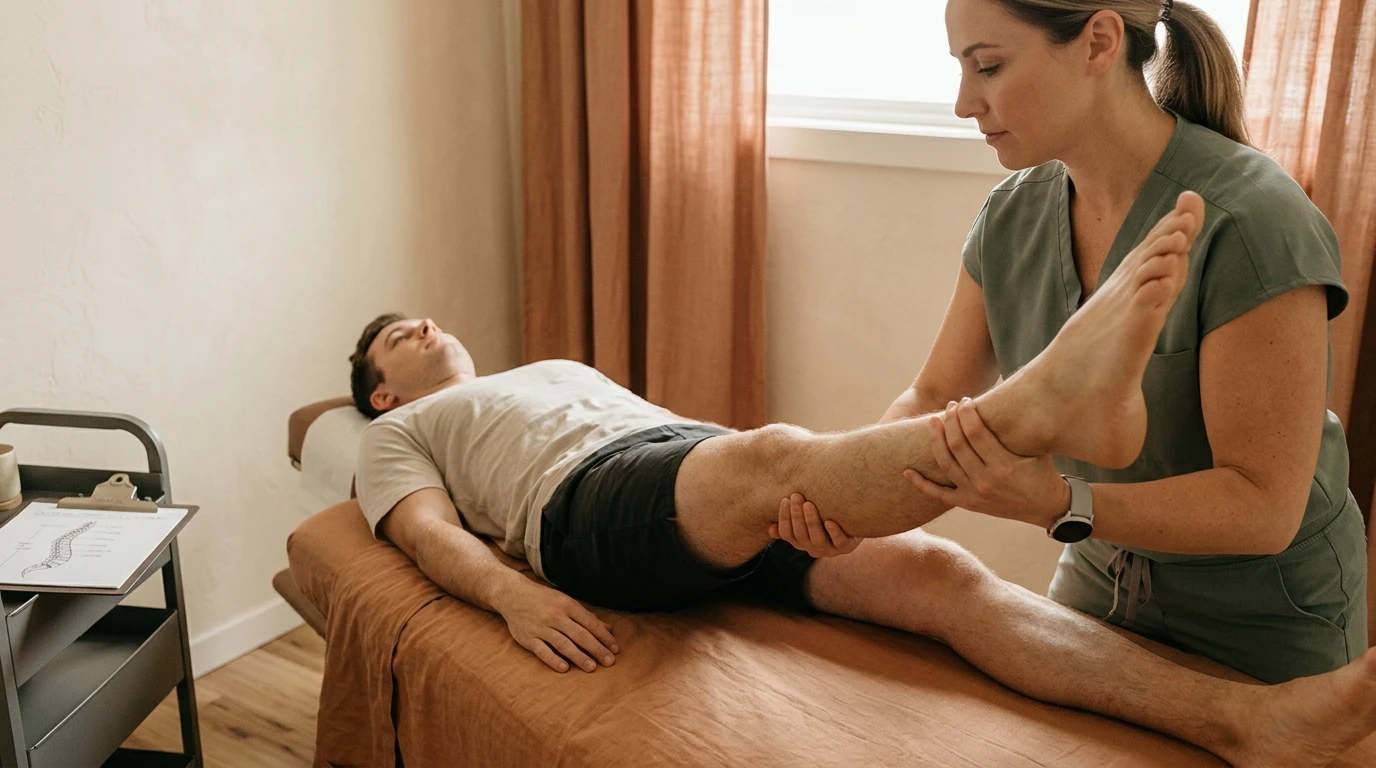
If there’s one distinguishing sign worth remembering, it’s this: does the pain, numbness, or tingling travel past your buttock and down your leg, or does it stay in your lower back? Nerve-root involvement is the clearest dividing line between the two conditions, because a muscle strain — no matter how painful — doesn’t typically compress or irritate a spinal nerve root the way a herniated disc can. In a clinical exam, one of the classic ways a provider evaluates this is the straight-leg-raise test: with you lying down, the provider slowly raises your straightened leg, and pain that radiates below the knee before the leg reaches roughly 45 degrees is considered a positive finding suggestive of nerve-root irritation, per StatPearls’ review of lumbar disc herniation. You shouldn’t try to replicate this test rigorously on yourself at home — the point here is simply to understand what your provider is checking for, and why “does it radiate below the knee” is one of the first questions a good clinical history will ask.
Herniated Disc vs. Muscle Strain in the Lower Back (the Most Common Case)
The lower back (lumbar spine) is by far the most common site for both conditions, since it bears the most mechanical load during lifting, bending, and twisting. In practice, this is where the distinction matters most for patients: a lumbar muscle strain from yard work or an awkward lift tends to stay localized and improve within days, while a lumbar disc herniation is the condition most often responsible for true sciatica — radiating pain that follows the sciatic nerve’s path down the back of the leg. If your lower back pain is accompanied by leg symptoms, it’s worth reading more about how a sciatica chiropractor in Chicago approaches this specific presentation, since sciatica management differs meaningfully from general back-strain care.
A Simple Self-Check Walkthrough
This isn’t a substitute for a clinical evaluation, but running through these five questions can help you get a clearer read on what’s likely going on before you decide how quickly to seek care:
- Does the pain radiate past your buttock, into your thigh, or below your knee? If yes, nerve involvement (more consistent with a disc issue) is more likely than a simple strain.
- Do you notice any numbness, tingling, or weakness in your leg or foot? These are classic nerve-root signs that point away from a pure muscle strain.
- Is the pain worse when sitting than when standing or walking? Increased disc pressure from sitting is a disc-herniation pattern; a strain doesn’t usually behave this way.
- Did the pain start suddenly during a specific lift or twist, or build up gradually? A sudden onset tied to a specific movement is common to both, but a strain more often has an obvious, immediate trigger.
- Is it getting noticeably better day over day with rest? Steady, clear improvement favors a strain; pain that plateaus or worsens despite rest deserves a closer look.
Whichever way your answers lean, the next right step is the same: get a real clinical evaluation from a back pain chiropractor rather than guessing indefinitely, especially if nerve symptoms are present.
When It’s a Medical Emergency: Cauda Equina Warning Signs
Seek emergency care immediately if you experience any of the following — these can signal cauda equina syndrome, a rare but time-sensitive surgical emergency caused by severe compression of the nerve bundle at the base of the spinal cord, per StatPearls’ overview of cauda equina and conus medullaris syndromes:
- Numbness in the “saddle” area — inner thighs, groin, or around the genitals/rectum
- New loss of bladder or bowel control, or difficulty starting urination
- Progressive weakness or numbness in both legs
- Severe, worsening pain accompanied by any of the above
These symptoms do not wait for a scheduled appointment — go to an emergency room right away. Separately, per StatPearls’ framework for evaluating low back pain, symptoms like unexplained fever, unintentional weight loss, or a personal history of cancer alongside new back pain are also red flags that warrant prompt medical evaluation rather than a conservative wait-and-see approach.
Do You Need an MRI?
In most cases, no — not right away. Guidance from the American College of Physicians, published in Annals of Internal Medicine, recommends against routine imaging (X-ray, CT, or MRI) for low back pain in the absence of red-flag symptoms or a progressive neurological deficit, because imaging findings often don’t change initial treatment and can even reveal incidental findings unrelated to your actual pain. That means most people with either a muscle strain or a suspected disc herniation can reasonably start with a clinical evaluation and conservative care rather than jumping straight to imaging — imaging becomes appropriate when there are emergency warning signs (see above), symptoms that aren’t improving after a reasonable trial of conservative care, or progressive weakness. Our labs and imaging services can help coordinate this when it’s genuinely indicated.
How Each Condition Is Treated
For a muscle strain, treatment generally focuses on calming the acute inflammation and restoring normal movement: relative rest (not complete bed rest, which can actually slow recovery), ice in the first 24-48 hours, and hands-on soft-tissue work such as massage therapy to reduce muscle guarding, followed by gentle mobilization as pain allows.
For a herniated disc, the first-line approach is typically conservative as well. Dr. Adam Mohr, our Doctor of Chiropractic and co-owner, notes that spinal manipulation is a reasonable starting point for appropriate cases: a systematic review conducted for the Department of Veterans Affairs found that spinal manipulative therapy is associated with moderate-quality-evidence, modest improvements in pain and function for acute low back pain. Alongside chiropractic care, physical therapy — including physical therapy specifically for back pain — builds the core stability and movement patterns that support long-term recovery and help prevent recurrence. Dr. Mimosa Nguyen, who trained in the Graston Technique and Activator Method, often incorporates targeted soft-tissue and mobilization work alongside adjustment for patients dealing with disc-related nerve irritation. For a broader look at how these two disciplines complement each other, see our comparison of a chiropractor vs. a physical therapist, and our overview of the benefits of chiropractic care more broadly. As with any recovery timeline, results may vary by individual — most muscle strains resolve within days to a few weeks, and most disc herniations meaningfully improve within 6-12 weeks, but your own course depends on the severity of the injury and how consistently you follow your care plan.
Slipped Disc, Bulging Disc, Herniated Disc: Clearing Up the Terminology
When people search “slipped disc vs muscle strain,” they’re really asking the same question this whole guide answers — “slipped disc” is simply a common lay term for what clinicians call a herniated disc — the disc itself doesn’t actually slip out of place, but the phrase has stuck in everyday language. It’s worth being precise about one more distinction, though: a bulging disc and a herniated disc are related but not identical. A bulge means the disc’s outer layer extends beyond its normal boundary without the inner material breaking through, while a true herniation involves that inner material pushing through a tear in the outer layer — the two can produce similar symptoms but aren’t interchangeable diagnoses, and conflating them can lead to confusion about severity or treatment expectations.
Why Choose Copper Wellness for Back Pain Diagnosis and Care in Chicago

Telling a muscle strain apart from a herniated disc isn’t always straightforward from symptoms alone — and getting it right matters, because the two conditions call for different care emphasis. At Copper Wellness, that diagnostic clarity comes from having chiropractic, physical therapy, and massage therapy genuinely coordinated on one shared care plan under a single roof, rather than referring you out to a separate practice for each piece. Dr. Adam Mohr, a Doctor of Chiropractic trained at the National University of Health Sciences, and Dr. Mimosa Nguyen, a Doctor of Chiropractic from Logan University with sports-medicine and soft-tissue technique training, work alongside our physical therapy and massage therapy teams to build a plan around your actual presentation rather than a one-size-fits-all protocol. You can meet the rest of our full clinical team and see how their specialties fit together. That root-cause, integrative approach means if your case turns out to be more complex than it first appears, the specialist who needs to weigh in is already part of your care team — not a referral you have to chase down yourself. We serve patients throughout Chicago, including Bucktown, Wicker Park, Lincoln Park, West Town, and Logan Square, all from our single clinic location — read what patients have to say in our testimonials, or check our FAQ page for more on how we work. If you have questions before booking, contact us directly.
FAQ
Can a herniated disc heal without surgery?
Yes, most of the time. Research summarized in NCBI’s StatPearls indicates that 85-90% of lumbar disc herniations improve within 6-12 weeks with conservative care alone, without surgical intervention. Surgery is generally reserved for cases with progressive neurological deficits, cauda equina syndrome, or pain that doesn’t respond to a reasonable trial of conservative treatment.
How long does a muscle strain take to heal?
Most muscle strains improve substantially within days to a few weeks. Pain typically peaks 24-48 hours after the triggering activity, then steadily eases with rest, ice, and appropriate soft-tissue care — though individual recovery time varies with the severity of the strain.
What is the difference between a slipped disc and a pulled muscle?
A “slipped disc” (the lay term for a herniated disc) involves the disc’s inner material pushing through its outer layer and often irritating a nearby nerve root, which is why it commonly causes radiating pain, numbness, or tingling down the leg. A pulled muscle (a strain) involves overstretched or torn muscle fibers, producing localized pain without that nerve-related radiation.
Can you have a herniated disc without pain radiating down your leg?
Yes — it’s possible for a disc herniation to cause localized back pain without significant leg symptoms, particularly if the herniation isn’t pressing directly on a nerve root. This is part of why symptoms alone aren’t always enough to distinguish the two conditions with certainty, and a clinical evaluation is the most reliable way to know for sure.
Should I get an X-ray or MRI right away?
Usually not. Guidance from the American College of Physicians recommends against routine imaging for low back pain unless red-flag symptoms or a progressive neurological deficit are present, since imaging typically doesn’t change initial conservative treatment. Imaging becomes appropriate if symptoms don’t improve with conservative care or if emergency warning signs appear.
What are the emergency warning signs I shouldn’t ignore?
Saddle numbness, new loss of bladder or bowel control, and weakness in both legs can signal cauda equina syndrome, a surgical emergency. If you notice any of these, seek emergency care immediately rather than waiting for a scheduled appointment.
Can a chiropractor tell the difference between a strain and a herniated disc?
Yes. A thorough chiropractic evaluation includes a detailed history and orthopedic/neurological tests — such as checking for radiating pain patterns, reflexes, and muscle strength — that help distinguish a soft-tissue strain from disc-related nerve involvement, and determine whether imaging or referral is warranted.
When should I see a doctor instead of waiting it out?
See a provider promptly if you have any radiating leg pain, numbness, tingling, or weakness; if pain isn’t improving after a week or so of rest; or immediately if you notice any of the cauda equina emergency warning signs above. Waiting it out is reasonable only for mild, localized pain that’s clearly improving day by day.
Not sure which one you’re dealing with? Schedule your complimentary consultation at Copper Wellness — call (872) 267-1717 or book online at copperwellness.janeapp.com, and let our integrative team help you get a clear answer and a plan built around your actual condition.