

Perimenopause is the transition: the years when your periods are still coming but your cycles and hormones have started to shift. Menopause is a single point in time, reached once 12 consecutive months have passed without a period or spotting, and everything after that point is postmenopause. That is the whole perimenopause vs menopause distinction …


Perimenopause is the transition: the years when your periods are still coming but your cycles and hormones have started to shift. Menopause is a single point in time, reached once 12 consecutive months have passed without a period or spotting, and everything after that point is postmenopause. That is the whole perimenopause vs menopause distinction in two sentences, and it is the definition the NIH National Institute on Aging uses: “The time leading up to menopause is called the menopausal transition or perimenopause.” As for where you are, your own cycle pattern is the best guide you have, and this article shows you how to read it the way clinicians and researchers do.
This article is general education, not a diagnosis or a treatment plan. Your stage and your options can only be confirmed in an evaluation with a licensed clinician.
Key Takeaways
- The 12-month rule: menopause is confirmed only after a full year without a period or spotting. Until then, you are in perimenopause.
- Timing: perimenopause usually starts in the mid- to late 40s and lasts two to eight years, about four for most women. The average age of menopause in the US is 51 to 52.
- Early vs late perimenopause: cycle lengths that repeatedly differ by 7 days or more mark the early transition; a gap of 60 days or longer marks the late transition, which is estimated to last one to three years.
- Pregnancy is still possible in perimenopause, even after skipped periods. Contraception matters until the 12 months are complete.
- No blood or home test can confirm your stage on its own. The FDA says home FSH kits do “not detect menopause or perimenopause.”
- Any vaginal bleeding after menopause needs evaluation, even light spotting, even once.
Perimenopause vs Menopause vs Postmenopause at a Glance
Most comparisons stop at two columns. There are really three stages to place yourself in, so the table below covers all of them. The cycle criteria come from STRAW+10, the staging system researchers use for reproductive aging; the ages and durations come from the HHS Office on Women’s Health, the National Institute on Aging and ACOG’s menopause FAQ.
| Perimenopause | Menopause | Postmenopause | |
|---|---|---|---|
| What it is | The menopausal transition: the years leading up to your final period, plus the 12 months after it | Your final menstrual period, a single point in time | All the years after that point |
| How you know | Cycle length changes by 7+ days, repeatedly; later, gaps of 60+ days | Only in hindsight: 12 months in a row with no period or spotting | The 12 months are complete |
| Typical age | Usually starts in the mid- to late 40s | Average 51 to 52; typical range 45 to 58 | From the early 50s onward for most women |
| How long it lasts | 2 to 8 years; about 4 for most women | One day on the calendar | The rest of life; the first 5 to 8 years are “early” postmenopause |
| Periods | Still happening, but shorter or longer cycles, skipped periods, lighter or heavier flow | The last one | None. Any bleeding needs evaluation |
| Hormone pattern | Erratic: estrogen swings high and low from cycle to cycle | — | Estrogen stays low |
| Common symptoms | Cycle changes, hot flashes, night sweats, sleep and mood changes, brain fog | — | Hot flashes often continue for years; vaginal dryness and urinary symptoms become more common |
| Can you get pregnant? | Yes | Treat the answer as yes until the 12 months are complete | Not naturally |
| What to raise with a clinician | Heavy or irregular bleeding, symptoms that disrupt sleep or work, contraception | Whether symptoms need treatment | Any bleeding, bone and heart health, vaginal and urinary symptoms |
The table is for orientation. If you want a clinician to confirm where you are and talk through care, that is what our menopause and perimenopause care visits are for.
What Is the Difference Between Perimenopause and Menopause?
The difference between perimenopause and menopause is that one is a process and the other is a date. Perimenopause is the stretch of years in which the ovaries’ hormone output becomes irregular and periods change but have not stopped. Menopause is the moment periods stop for good, and it can only be identified looking back, after 12 months without one.
This is where most of the confusion comes from. In everyday speech, “going through menopause” describes years of hot flashes and unpredictable periods. In medical terms, those years are perimenopause, and menopause itself is technically one day: the day of your final period. You cannot know it was the final one until a year has gone by. The National Institute on Aging puts it plainly: menopause is confirmed only after a full year without a period or spotting.
Two practical consequences follow. First, you cannot be in both at once; the stages run in sequence. Second, the 12-month count restarts if you bleed. If you go nine months without a period and then have one, you are still in perimenopause and the count begins again. The Menopause Society’s perimenopause guidance uses the same line: menopause is confirmed one year after the final menstrual period. People also search for this as menopause vs perimenopause, or the difference between menopause and perimenopause; the answer is identical whichever way round you ask it.
The Stages of Menopause, in Order
Clinicians usually describe three stages of menopause: perimenopause, menopause and postmenopause. Researchers divide the same timeline more finely. STRAW+10 splits the transition into early and late phases and splits postmenopause the same way, which is where longer lists of menopause stages come from. No source we reviewed defines an official set of “five stages,” so treat those lists as different ways of slicing one timeline.
Perimenopause vs Premenopause
These two words are not synonyms. Premenopause is the reproductive years before the transition begins, when cycles are regular. In STRAW+10 terms it is the reproductive stage; late in that stage cycles are still regular but may become subtly shorter. Perimenopause begins when the cycle itself starts to change. So in the premenopause vs perimenopause question, the dividing line is the pattern of your periods, not your age and not whether you have had a first hot flash.
Perimenopause (the Menopausal Transition)
The Office on Women’s Health says perimenopause usually starts in the mid- to late 40s and lasts between two and eight years, about four for most women. The National Institute on Aging notes that most women begin the transition between ages 45 and 55. In a review of the research, Santoro’s “Perimenopause: From Research to Practice” in the Journal of Women’s Health gives typical ages of about 47 for the early transition, about 49 for the late transition and about 51 for the final period, with substantial variation between women. Timing also differs by group: the National Institute on Aging reports that smoking is linked to earlier onset and more severe symptoms, and that Black women are more likely to start earlier and have symptoms for longer.
Menopause
Menopause is the 12-month milestone. ACOG gives the average age as 51; the National Institute on Aging and the Office on Women’s Health give 52, and the Office on Women’s Health puts the usual range at 45 to 58. Much of what is known about this transition in American women comes from the Study of Women’s Health Across the Nation (SWAN), which has followed 3,302 women at seven US sites, one of them here in Chicago at Rush University Medical Center. In its progress report in the journal Menopause, the median age at natural menopause was 52.5 years among the women the study followed over time.
Postmenopause
Postmenopause is the rest of your life after that milestone. STRAW+10 describes early postmenopause as lasting roughly five to eight years, followed by late postmenopause, when vaginal dryness and urogenital changes become more common. Several body systems shift around this time:
- Bone. In SWAN, bone loss began about one year before the final period and slowed about two years after it. ACOG notes bone loss is more rapid in the first four to eight years after menopause. Strength and weight-bearing exercise are part of general bone health, and a physical therapy evaluation can help you build a program that fits your body.
- Heart. SWAN found that LDL and total cholesterol rose sharply within the year around the final period. ACOG explains that losing estrogen’s protective effect raises the risk of heart attack and stroke.
- Vaginal and urinary tissue. Genitourinary syndrome of menopause (dryness, pain with sex, urinary symptoms) affects about 27% to 84% of postmenopausal women and is likely underdiagnosed and undertreated, according to The Menopause Society’s 2020 position statement on genitourinary syndrome of menopause.
What Your Hormones Are Doing at Each Stage
A common picture of perimenopause is estrogen sliding steadily downhill. That is not what happens. Santoro’s review describes estrogen secretion during the transition as “erratic”: one cycle may be ovulatory, the next may be anovulatory with relatively high estrogen, and another anovulatory with low estrogen. ACOG notes that estrogen production begins to fluctuate as early as a woman’s 30s and 40s.
That unpredictability explains two things. It is why symptoms come and go: a rough month can be followed by three easy ones. It is also why a single blood draw can mislead, a point covered in the testing section below. Some women notice PMS-type symptoms becoming more pronounced in these years; if that is part of your picture, our page on acupuncture for period pain and PMS describes related care at the clinic.
After menopause the pattern is simpler. The swings stop and estrogen stays low. Symptoms driven by fluctuation may settle, while effects of low estrogen itself, such as vaginal dryness and bone loss, become the ones to watch.
Perimenopause vs Menopause Symptoms: What Overlaps and What Changes

Most symptoms appear on both sides of the final period. What changes is which ones dominate. In SWAN, up to 80% of women reported hot flashes or night sweats at some point in the transition. Comparing perimenopause symptoms vs menopause symptoms side by side:
| Symptom | In perimenopause | After menopause |
|---|---|---|
| Period changes | The defining feature: shorter or longer cycles, skipped periods, lighter or heavier flow | No periods. Any bleeding is a reason to be evaluated |
| Hot flashes and night sweats | Become likely in the late transition | Most likely in the first two years or so; can continue for years |
| Sleep | Sleep problems are commonly reported, often alongside night sweats | Can continue while night sweats do |
| Mood | Odds of depressive symptoms were highest in late perimenopause in SWAN | Can persist; low mood that does not lift deserves its own evaluation at any stage |
| Brain fog | SWAN measured a dip in processing speed and verbal memory | In SWAN that dip was temporary and resolved in postmenopause |
| Vaginal dryness, pain with sex | About 19% in pre- and early perimenopause (SWAN) | About 34% in postmenopause (SWAN) |
| Urinary changes | Can begin | Part of genitourinary syndrome of menopause |
| Weight and body composition | Weight and fat distribution may change across the transition (National Institute on Aging) | |
| Migraines | Listed by The Menopause Society among perimenopause symptoms | Varies from person to person |
We cover several of these complaints on their own pages, as care that sits alongside, not in place of, a medical evaluation: acupuncture for insomnia, acupuncture for anxiety, acupuncture for depression and acupuncture for migraines. For leakage, urgency or pelvic pain, our guide to pelvic floor dysfunction symptoms explains what to look for.
Is Perimenopause Worse Than Menopause?
There is no verdict that holds for everyone, but there is data. Santoro’s review concludes that “the biggest increment in symptomatology is clearly associated with the late transition,” the phase when periods are 60 or more days apart. So for many women the hardest stretch is the last part of perimenopause, not the years after.
Relief is not immediate once periods stop, though. In a SWAN analysis published in JAMA Internal Medicine of 1,449 women with frequent hot flashes, the median total duration was 7.4 years, and they continued for a median of 4.5 years after the final period. Timing mattered: women whose hot flashes began while they were premenopausal or in early perimenopause had them longest (a median of more than 11.8 years), while those whose hot flashes began after menopause had the shortest course (3.4 years). Among African American women the median was 10.1 years. These are medians from one study; individual experience varies widely.
Am I in Perimenopause or Menopause? How to Tell Where You Are
If you are asking “am I in perimenopause?”, the most reliable evidence is not a lab value. It is a record of your own cycles, read against the criteria researchers use. Find the row that matches what your periods have been doing over the past several months.
| What your cycle has been doing | Likely stage | What often comes with it | What to do now |
|---|---|---|---|
| Regular cycles, perhaps slightly shorter than they used to be, with new symptoms | Late reproductive years (“premenopause”) | Symptoms can begin before cycles visibly change | Start tracking cycle dates and symptoms |
| Cycle length differs by 7 days or more from one cycle to the next, and it keeps happening | Early perimenopause | Heavier or lighter flow, occasional hot flashes, sleep changes | Keep tracking; keep using contraception; book a visit if symptoms interfere with daily life |
| You have gone 60 days or longer without a period | Late perimenopause | The stage when hot flashes and night sweats become likely and symptoms rise most | A good time for an evaluation; contraception still applies |
| 12 months with no period and no spotting | Menopause reached; you are now postmenopausal | Hot flashes may continue; vaginal dryness becomes more common | Discuss bone, heart and vaginal health at your next visit |
| Bleeding or spotting after those 12 months | Not a stage | — | Contact a clinician promptly (see the checklist below) |
This table is a way to orient yourself. It is not a quiz score and not a diagnosis.
Early Perimenopause: The First Signs
If you are wondering “how do I know if I’m in perimenopause?”, STRAW+10 defines the start of the transition as “a persistent difference of 7 days or more in the length of consecutive cycles,” where persistent means the change recurs within 10 cycles. One odd month does not count. A 26-day cycle followed by a 35-day cycle, then the same kind of swing again a few months later, does.
Can you be in perimenopause with regular periods? By the strict definition, no: regular cycles place you in the late reproductive stage. But symptoms do not wait for the definition. Hormone fluctuation begins before cycles visibly change, so sleep, mood or temperature symptoms can show up while your periods still look normal on the calendar.
Late Perimenopause: Signs Perimenopause Is Ending
The clearest of the signs perimenopause is ending is a gap of 60 days or more between periods. STRAW+10 uses exactly that marker for the late transition and estimates the stage lasts one to three years before the final period. It is also the stage in which STRAW+10 says symptoms, hot flashes above all, are likely to occur. In practical terms, late perimenopause tells you the milestone is approaching, but not which period will be the last.
When Your Cycle Can’t Tell You
The cycle-based method has limits, and STRAW+10 names them. The criteria do not apply to women with polycystic ovary syndrome, primary ovarian insufficiency or hypothalamic amenorrhea, or during chronic illness and cancer treatment. After a hysterectomy or endometrial ablation there are no periods to read, so only hormone markers can be used. The same practical problem arises if hormonal birth control or a hormonal IUD has changed or stopped your bleeding. In these situations a clinician relies on your age, symptoms and, where useful, lab markers.
Is There a Test for Perimenopause?
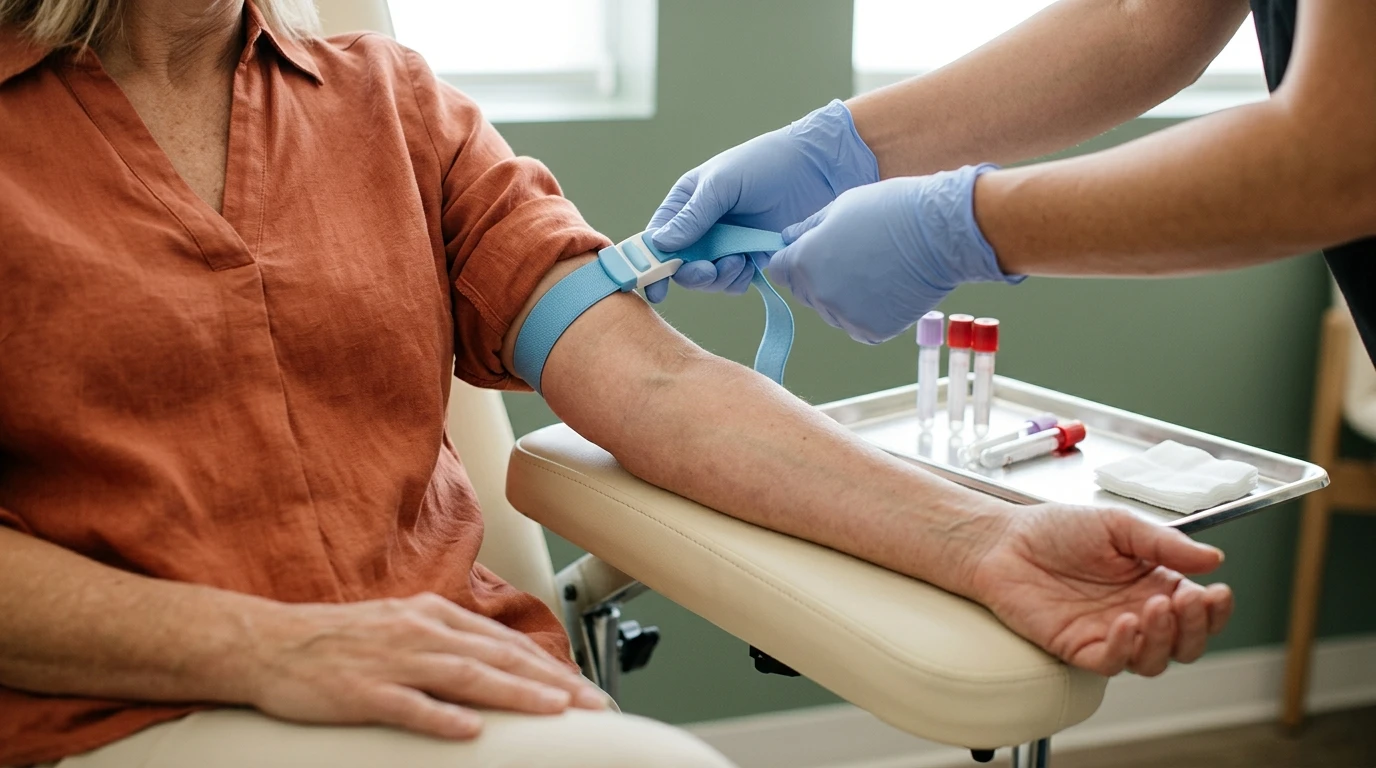
No single test can tell you that you are in perimenopause. The diagnosis is clinical: a clinician puts together your age, your cycle history and your symptoms. Tests have a supporting role, and it helps to know exactly what each one can establish.
| Test | What it can tell you | What it can’t |
|---|---|---|
| Perimenopause blood test for FSH | An FSH level above 25 IU/L is characteristic of the late transition (STRAW+10) | FSH rises and falls during the cycle, so one result is not a pass/fail line for your stage |
| Home urine FSH kit | Detects FSH accurately “about 9 out of 10 times,” per the FDA | “This test does not detect menopause or perimenopause”; a negative result does not rule either out |
| A broader hormone panel | A snapshot of levels on the day of the draw; useful for planning and monitoring treatment | Because estrogen is erratic in the transition, a snapshot cannot stage you |
| Pregnancy test | Whether a missed period is a pregnancy, which remains possible in perimenopause | Nothing about your stage |
| 12 months on a calendar | Confirms menopause | Works only in hindsight, and only if you have a cycle to track |
This table explains what tests measure. It does not replace a clinician’s interpretation of your own results.
The FDA’s guidance on home menopause tests is direct: doctors “would not use this test by itself,” and you should “not stop taking contraceptives based on the results.” Searches for FSH levels in menopause turn up many reference charts; we have not reproduced one here, because a number without your cycle history and symptoms does not answer the question.
Testing earns its place in specific situations: when changes start younger than expected, when your cycle cannot be read, or when symptoms could have another explanation. Fatigue, mood changes and irregular periods overlap with other conditions, which is one reason labs may be ordered. At Copper Wellness, that is how our clinicians approach it: labs are ordered as part of an evaluation, to rule out other causes and to shape and monitor a care plan, not to stamp a stage on a chart.
Can You Still Get Pregnant? The Practical Difference People Miss
This is the difference between the stages with the most immediate consequences. In perimenopause, ovulation is unpredictable, not absent. The Office on Women’s Health states that you can still get pregnant during perimenopause, “even if you miss your period for a month or a few months.” The National Institute on Aging advises that a woman who does not want to become pregnant should keep using birth control for at least a full 12 months after her last period, and the FDA warns against stopping contraception on the strength of a home test.
Once the 12 months are complete, natural pregnancy is no longer possible. If you are in your 40s and hoping to conceive, that is a separate and time-sensitive conversation to have with a fertility specialist; our fertility acupuncture page covers the clinic’s supportive care in that area.
When the Timing Is Unusual: Early, Premature and Surgical Menopause
Not everyone follows the typical timeline. According to the Office on Women’s Health page on early or premature menopause, menopause between ages 40 and 45 is called early menopause, and about 5% of women go through it naturally. Menopause before 40 is premature menopause, known medically as primary ovarian insufficiency. Smokers may reach menopause as much as two years earlier than non-smokers. Because early and premature menopause are associated with a higher risk of heart disease and osteoporosis, periods that stop or change markedly before 45 are a reason to be evaluated, not to wait and see.
Surgical or induced menopause is different again. When the ovaries are removed, or when cancer treatment stops ovarian function, there may be no gradual transition at all, and staging by periods does not apply. That care is led by the surgical or oncology team and a gynecologist. Copper Wellness does not perform surgery; our Nurse Practitioner can be part of follow-up care and symptom management alongside those specialists.
Track, Book, or Go Now: A Decision Checklist
Use this to decide what to do with what you are noticing.
Keep tracking and manage at home if:
- Your cycles are shifting but symptoms are mild and manageable.
- You are in the typical age range and nothing on the lists below applies.
- What to do: record the start date of each period, how heavy it is and how long it lasts, plus sleep, mood and hot flashes. Three to six months of notes is the most useful thing you can bring to any future visit.
Book an evaluation if:
- Symptoms are disrupting your sleep, work, mood or relationships.
- You have bleeding or spotting between periods, bleeding after sex, or periods that are heavier or last more days than usual. These are the changes ACOG’s guidance on perimenopausal bleeding says to report.
- Your periods stop or change markedly before age 45.
- You cannot read your cycle because of contraception, a hysterectomy or an ablation.
- You want to talk through hormone or non-hormone treatment.
Get seen promptly, or go now, if:
- You have any bleeding after 12 months without a period. The Office on Women’s Health says this “is not normal” and to see a provider as soon as possible. For proportion: in a meta-analysis of 129 studies in JAMA Internal Medicine, 91% of women with endometrial cancer had postmenopausal bleeding, yet the pooled risk of endometrial cancer among women with such bleeding was 9%. Most women who bleed will not have cancer, and that is exactly why it should be checked, not guessed at.
- Your bleeding is very heavy. ACOG defines heavy menstrual bleeding as soaking through one or more pads or tampons every hour for several hours in a row, bleeding for more than 7 days, or passing clots the size of a quarter or larger. Heavy bleeding can cause iron-deficiency anemia. If it comes with dizziness, a racing heart or shortness of breath, go to urgent care or an emergency department.
- You have chest pain, fainting or trouble breathing: call 911. If you have thoughts of harming yourself, call or text 988.
Who handles what: the work-up for abnormal bleeding, which ACOG describes as including an endometrial biopsy and pelvic or transvaginal ultrasound, is done by a gynecologist. Causes range from polyps and endometrial atrophy to endometrial hyperplasia and cancer. Copper Wellness does not perform those procedures and will refer you. If you are unsure which setting fits a given problem, our guide to urgent care vs primary care walks through it.
What Helps at Each Stage: Options and the Evidence Behind Them
This is an overview, not a treatment guide. The table uses the evidence gradings from The Menopause Society’s position statements and one guideline from the American College of Physicians, and it includes the rows that are uncomfortable for an integrative clinic to print.
| Symptom | Option | What the guideline says | Who provides it |
|---|---|---|---|
| Hot flashes and night sweats | Hormone therapy | “The most effective treatment for vasomotor symptoms” | Nurse Practitioner or physician, after evaluation |
| Cognitive behavioral therapy, clinical hypnosis | Recommended (Level I) | A licensed therapist or trained clinician | |
| SSRIs/SNRIs, gabapentin, fezolinetant (Level I); oxybutynin (Levels I–II) | Recommended | Nurse Practitioner or physician | |
| Acupuncture (Level II), chiropractic interventions (Levels I–III), supplements and herbal remedies (Levels I–II), cooling techniques, avoiding triggers, exercise, yoga (Level II) | Not recommended as treatments for hot flashes | — | |
| Vaginal dryness, pain with sex | Non-prescription lubricants and moisturizers | Enough for most women with mild symptoms | Over the counter |
| Low-dose vaginal estrogen, vaginal DHEA, systemic estrogen, ospemifene | Effective for moderate to severe symptoms | Nurse Practitioner or physician | |
| Urinary leakage with coughing, sneezing or exercise | Pelvic floor muscle training | First-line treatment for stress urinary incontinence (ACP: strong recommendation, high-quality evidence) | Pelvic floor therapist |
| Low mood, anxiety | Individual evaluation | No grading covered in this article; SWAN found the odds of depressive symptoms highest in late perimenopause | Primary care clinician, Nurse Practitioner or mental health professional |
The “not recommended” gradings apply to hot flashes specifically. They are not statements about what these approaches do for other complaints or for general health. Exercise, not smoking and good sleep habits still matter for your bones, your heart and how you feel day to day.
Hormone Therapy: Benefits, Risks and Who Decides
The Menopause Society’s 2022 hormone therapy position statement says hormone therapy “remains the most effective treatment for vasomotor symptoms” (hot flashes and night sweats) and for the genitourinary syndrome of menopause. It finds the benefit-risk balance favorable for women younger than 60, or within 10 years of menopause onset, who have no contraindications. The balance is less favorable when therapy starts more than 10 years after menopause or after age 60, because the absolute risks of coronary heart disease, stroke, venous thromboembolism and dementia are greater. The statement calls for individualized decisions and periodic re-evaluation. During perimenopause, when pregnancy is still possible, a gynecologist or Nurse Practitioner may instead discuss hormonal contraception, which can also help regulate bleeding.
Risks and side effects. ACOG lists these: estrogen taken alone raises the risk of uterine cancer, which is why a progestin is added for women who have a uterus. Combined therapy carries a small increased risk of heart attack and breast cancer. Both types carry a small increased risk of stroke and deep vein thrombosis, and non-oral forms may carry less clot risk.
What the FDA has changed. In a November 2025 announcement, the FDA said it is removing the boxed warnings that refer to cardiovascular disease, breast cancer and probable dementia from menopausal hormone therapy products. It is not seeking to remove the boxed warning for endometrial cancer on systemic estrogen-alone products. The labeled recommendation is to start systemic therapy within 10 years of menopause onset or before age 60. A change in labeling is not a statement that the therapy suits everyone.
Hormone therapy is never something to start on your own. At Copper Wellness it requires a medical evaluation, labs and ongoing supervision by Elise Sterritt, FNP-BC, our board-certified Family Nurse Practitioner, and responses vary from person to person. Our service pages explain the specifics: hormone therapy in general, hormone replacement therapy and bioidentical hormone therapy. For how the two types compare, see BHRT vs HRT.
Non-Hormone Options
Hormone therapy is not right for, or wanted by, everyone. The Menopause Society’s 2023 nonhormone therapy position statement recommends the options graded in the table above for hot flashes, along with weight loss and stellate ganglion block (Levels II–III). One of them, fezolinetant, was approved by the FDA in 2023 for “moderate to severe vasomotor symptoms, or hot flashes, caused by menopause”; it carries a warning about liver injury, which the FDA raised to a boxed warning in December 2024, and requires blood tests before and during treatment. Whether any prescription is appropriate is a decision for a Nurse Practitioner or physician who knows your history.
For bladder leakage, the American College of Physicians guideline in Annals of Internal Medicine recommends pelvic floor muscle training as first-line treatment for stress urinary incontinence, and pelvic floor muscle training combined with bladder training for mixed incontinence. That is the evidence behind pelvic floor therapy for leakage; it is not a treatment for vaginal dryness. At our clinic this care is provided by Dr. Lisa Lagomarcino, who holds a doctorate from Midwestern University and a specialized pelvic-health certification from the Herman & Wallace Pelvic Rehabilitation Institute.
Where Acupuncture Fits — and Where It Doesn’t
We offer acupuncture, so we owe you the full picture of the evidence for it.
What supports it. In the Acupuncture in Menopause trial, 209 peri- and postmenopausal women aged 45 to 60 who had at least four hot flashes a day received up to 20 treatments over six months or were placed on a waitlist. Hot flash frequency fell 36.7% at six months in the acupuncture group, against a 6.0% increase in the control group, and a 29.4% reduction was still present at 12 months.
What limits it. That trial compared acupuncture with no acupuncture, not with a sham procedure. A Cochrane review of 16 studies and 1,155 women found no significant difference in hot flash frequency between acupuncture and sham acupuncture, a moderate benefit compared with no treatment, and less effect than hormone therapy. Its authors concluded there was “insufficient evidence to determine whether acupuncture is effective,” with evidence of low or very low quality. The Menopause Society’s 2023 statement does not recommend acupuncture for hot flashes.
Our reading: acupuncture is a reasonable adjunct that some patients choose for comfort during the transition, and results vary. It is not a replacement for evidence-based treatment of moderate to severe hot flashes. Our page on acupuncture for hormone balance explains how we use acupuncture in that supporting role. Dr. Stephanie Madden, our founder, is a Doctor of Acupuncture and board-certified herbalist whose clinical focus includes hormonal imbalance. On herbs, the same statement does not recommend supplements or herbal remedies for hot flashes. If you take or are considering herbal medicine, discuss it with a board-certified herbalist and with whoever prescribes your medications.
Your First Visit: What Happens Step by Step
This is how our clinicians approach an evaluation for perimenopause or menopause at Copper Wellness. Hormone and menopause care is led by Elise Sterritt, FNP-BC, who has more than 15 years in healthcare.
- Before you come. Bring three to six months of cycle dates if you have them, a short symptom log, a list of medications, supplements and contraception, any family history of early menopause, and copies of recent lab results.
- The conversation. Your cycle history and symptoms are reviewed against the staging criteria described above, along with your medical history and what matters most to you.
- Labs where they are useful. Blood work is ordered to rule out other explanations and to inform treatment decisions.
- A plan. Depending on your stage, symptoms and risk factors, this may include hormone therapy, non-hormone options, referral to a gynecologist or another specialist, supportive care within the clinic, or a combination.
- Monitoring and ongoing support. Follow-up visits check how you are responding and adjust the plan. Needs change as you move from one stage to the next.
One Team for Every Stage of the Transition: How Copper Wellness Coordinates Your Care
The transition touches sleep, mood, bladder, bones and periods, often at the same time. Care for those problems is often split across separate offices that do not share notes. At Copper Wellness, our team works from one shared care plan under one roof:
- Nurse Practitioner-led medical care. Elise Sterritt, FNP-BC, evaluates, orders labs, and prescribes and supervises hormone therapy where it is appropriate.
- Acupuncture and herbal medicine with Dr. Stephanie Madden and with Dr. Anais Jackson-Gonzalez, who holds a Doctorate in Acupuncture and Chinese Medicine, focuses on women’s health and sees patients in English and Spanish.
- Pelvic floor therapy with Dr. Lisa Lagomarcino for leakage and pelvic symptoms.
- Physical therapy and massage therapy for strength, mobility and muscle tension.
All of it happens at a single location, 1654 W. North Ave. in Chicago, serving Bucktown, Wicker Park and the neighborhoods around them. We accept Blue Cross Blue Shield and Aetna as well as FSA and HSA payments, and a third-party billing department verifies coverage before treatment for patients using insurance. New patients can begin with a complimentary 15-minute virtual consultation.
FAQ
How do I know if I’m in perimenopause or menopause?
Look at your periods. If they are still coming, however irregularly, you are in perimenopause. If 12 consecutive months have passed with no period or spotting, you have reached menopause and are now postmenopausal. When you cannot read your cycle, for example after a hysterectomy or on hormonal contraception, a clinician uses your age, symptoms and sometimes lab markers instead.
Which is worse, perimenopause or menopause?
It differs from woman to woman, but research points to late perimenopause as the phase when symptoms rise most. Hot flashes commonly continue after the final period; in SWAN the median was 4.5 years beyond it. The memory and processing-speed dip measured in perimenopause was temporary in that study.
How long does perimenopause last?
Between two and eight years, and about four years for most women, according to the HHS Office on Women’s Health. It ends 12 months after your final period.
How long after perimenopause does menopause start?
There is no gap between them: perimenopause ends at the point menopause is confirmed. A more useful marker is the first time you go 60 days or longer without a period. STRAW+10 estimates that this late stage of the transition lasts one to three years before the final period.
Can you be in perimenopause with regular periods?
By the formal criteria, perimenopause begins when cycle length starts to vary by 7 days or more. Symptoms can appear earlier, though, while cycles still look regular, because hormone levels begin fluctuating before the calendar shows it.
Can you get pregnant during perimenopause?
Yes. Ovulation becomes unpredictable but does not stop, and pregnancy is possible even after skipped periods. The National Institute on Aging advises continuing birth control for at least a full 12 months after your last period if you do not want to become pregnant.
What are the stages of menopause — are there 3 or 5?
Clinicians usually name three: perimenopause, menopause and postmenopause. Researchers subdivide them further, into early and late perimenopause and early and late postmenopause, which is how longer lists arise. They describe the same timeline.
Can you be in perimenopause and menopause at the same time?
No. They are consecutive. Menopause is the point that ends perimenopause, and it is only recognized after 12 months without a period. If you bleed before then, you are still in perimenopause.
What should you not do during perimenopause?
Don’t stop contraception early, don’t ignore bleeding that is heavy, prolonged or between periods, and don’t rely on a home FSH test to tell you your stage. Don’t start hormones or supplements on your own, either; both belong in a conversation with a clinician who knows your history.
Is bleeding after menopause ever normal?
No. The Office on Women’s Health says any vaginal bleeding after menopause is not normal and should be checked as soon as possible. Most causes are not cancer, but it takes an evaluation by a gynecologist to find out which one applies to you.
If you would like help working out where you are in the transition and what, if anything, to do about it, schedule your complimentary consultation at Copper Wellness: call (872) 267-1717, email Hello@CopperWells.com, or book online at copperwellness.janeapp.com.