
Not directly. Menopausal hormone therapy is not a weight-loss treatment, and the biggest pooled analysis of randomized trials found that HRT makes essentially no difference to the number on the scale. What it can do is quieter: it appears to slow the build-up of belly fat, it may help hold on to a little lean …

Not directly. Menopausal hormone therapy is not a weight-loss treatment, and the biggest pooled analysis of randomized trials found that HRT makes essentially no difference to the number on the scale. What it can do is quieter: it appears to slow the build-up of belly fat, it may help hold on to a little lean muscle, and by easing night sweats it can give back the sleep that makes weight control easier. It also doesn’t cause the weight gain many women fear. In the words of the American College of Obstetricians and Gynecologists (ACOG), the estrogen in hormone therapy “may change where fat is stored in the body, but hormone therapy by itself won’t lead to weight loss.”
If you started HRT hoping the midlife pounds would come off, or avoided it because you heard it makes you gain, both experiences make sense once you see what the research measured. Below we separate strong evidence from weak, explain why your waistline can change while your weight barely moves, and cover what does move the scale after 40, including GLP-1 medications. This article is for education and isn’t a substitute for a medical evaluation.
Key Takeaways
- Across 28 randomized trials and 28,559 women, HRT changed average body weight by only 0.03–0.04 kg compared with no hormones. In practice that’s no effect, in either direction.
- The clearest effect is on where fat goes: a meta-analysis of 107 trials found 6.8% less abdominal fat and 12.9% lower insulin resistance in women without diabetes. Individual results vary.
- Weight loss is not an FDA-approved use of hormone therapy. The FDA lists moderate-to-severe hot flashes, vaginal dryness and discomfort, and preventing bone loss.
- Early observational data link HRT plus semaglutide or tirzepatide to more weight loss (16% vs. 12%, and 19.2% vs. 14.0%), but those studies can’t show the hormones caused the difference.
- The foundation is still lifestyle: the CDC recommends at least 150 minutes of moderate activity a week plus 2 days of muscle strengthening, and midlife women need enough protein to protect muscle.
HRT and Weight: What the Evidence Actually Shows
A 21-woman pilot and a review of 28,000 women often get quoted side by side online. This table sorts the main HRT weight loss questions by the strength of the evidence behind each answer.
| Question | Best available evidence | Study type and size | Bottom line |
|---|---|---|---|
| Does HRT change your weight on the scale? | Systematic review | 28 randomized trials, 28,559 women | No. About 0.03–0.04 kg difference vs. non-users. |
| Does HRT cause weight gain? | Same systematic review, plus national health guidance | 28 randomized trials | No average effect. Early bloating from fluid retention is common. |
| Does HRT reduce belly fat? | Meta-analysis (2006) | 107 randomized trials | Abdominal fat −6.8% in women without diabetes. The benefit is lost if HRT stops. |
| Does HRT protect muscle? | Randomized trial substudy | Randomized trial, 835 women, 3 years | Slightly less lean-tissue loss (−0.04 vs. −0.44 kg). Real, but small. |
| Does HRT affect insulin resistance and diabetes risk? | Same 2006 meta-analysis | 107 randomized trials | Insulin resistance −12.9%; new-onset diabetes risk ratio 0.7. |
| Does HRT add to GLP-1 weight loss? | Two cohort studies | Retrospective, 106 and 120 women | More weight loss with HRT, but observational only. Cause and effect not shown. |
Does HRT Help With Weight Loss? The Short Answer
Can HRT help you lose weight? On its own, no. Neither the trial evidence nor any guideline supports hormone replacement therapy for weight loss, and no HRT product is approved for it. If your real question is “will HRT help me lose weight?”, the honest answer is that it may help you keep a healthier shape and sleep better, and both support the habits that do move the scale.
The strongest evidence on HRT and weight loss comes from a Cochrane systematic review by Kongnyuy and colleagues, which pooled 28 randomized controlled trials covering 28,559 women. Compared with women who didn’t take hormones, women on estrogen alone weighed an average of 0.03 kg more (95% confidence interval −0.61 to 0.67 kg). Women on estrogen plus a progestogen weighed 0.04 kg more (−0.42 to 0.50 kg). Neither difference is meaningful, BMI didn’t differ, and there was no evidence that HRT prevents the weight gain usually seen around menopause. The reviewers noted too little data on waist-to-hip ratio and fat mass, which is exactly where other studies find an effect.
A 2026 clinical review in the journal Menopause by Maria D. Hurtado Andrade, MD, PhD, an endocrinologist at Mayo Clinic, reaches the same conclusion: “Hormone therapy (HT) is not indicated for weight loss.” She adds that hormone therapy “does not augment fat loss from lifestyle interventions but may improve their cardiometabolic yield.” HRT won’t make diet and exercise burn more fat, but it may help them do more for blood sugar and cholesterol.
What about the study that says HRT causes fat loss?
If you’ve searched this question, you may have come across a 1999 study in Maturitas that ranks near the top of Google. Women on combined transdermal estradiol and a progestin lost 2.1 kg of fat over three months and their waist-to-hip ratio fell, while weight in the control group didn’t change. But the study followed just 21 women (12 treated, 9 controls) for three months. A study that small can raise a question; it can’t outweigh 28 randomized trials with more than 28,000 participants.
Weight change is still worth raising with a clinician. Unexplained gain around the midsection is one of several reasons a hormone replacement therapy evaluation can make sense: a reason to get checked, not a promise that HRT will reverse it.
Why Menopause Changes Your Body (Even When the Scale Barely Moves)
Fat goes up, muscle goes down: what the SWAN study found
The Study of Women’s Health Across the Nation (SWAN) used DXA body-composition scans to follow 1,246 women through the menopause transition. Its 2019 analysis in JCI Insight found that weight “climbed linearly” through midlife, “without acceleration” at menopause. Underneath, though, the body was changing: “At the start of the MT [menopause transition], rate of fat gain doubled, and lean mass declined.” Fat gain went from about 1.0% a year to about 1.7% a year. Over the roughly 3.5-year transition, the average woman gained about 6% fat mass (around 1.6 kg) and lost about 0.5% of her lean mass (around 0.2 kg).
That’s why so many women say “my weight hasn’t changed much, but my body has.” Because these changes begin at the start of the transition, perimenopause weight gain and body-shape changes often show up before periods stop. If you’re not sure which stage you’re in, our guide to perimenopause vs. menopause explains the difference.
More visceral fat and a slower resting metabolism
A four-year study in the International Journal of Obesity followed 156 women with CT scans, DXA and calorimetry. Only the women who became postmenopausal during the study had a significant rise in visceral fat, the deeper fat packed around the abdominal organs. Their sleeping energy expenditure fell 7.9%, compared with 5.3% in women who stayed premenopausal. Their fat oxidation (how much fat the body burns for fuel) fell 32%. Physical activity also started dropping about two years before menopause.
Estrogen influences where fat is stored. As it declines, fat shifts from the hips and thighs toward the abdomen, and Dr. Hurtado Andrade’s review puts visceral fat accumulation at about 6% a year across the transition. That matters because, as the same paper notes, central fat raises the risk of cardiovascular disease, type 2 diabetes and sleep apnea and can worsen hot flashes. So when people ask “does estrogen help with weight loss?”, the more accurate framing is that estrogen affects fat distribution, not total weight.
An International Menopause Society writing group put it plainly in Climacteric in 2012: “weight gain per se cannot be attributed to the menopause transition,” but the hormonal change is associated with more total and abdominal fat.
It isn’t only hormones
Aging, less activity, poorer sleep, stress, medications and other health conditions all play a part, and how much each matters differs from person to person. Fatigue and weight gain also overlap with problems such as an underactive thyroid. That’s why our article on the signs you may need hormone replacement therapy stresses that weight gain alone isn’t a reason to start HRT. A proper evaluation usually starts with lab work to look at other possible causes.
HRT and Belly Fat: Where the Evidence Is Strongest
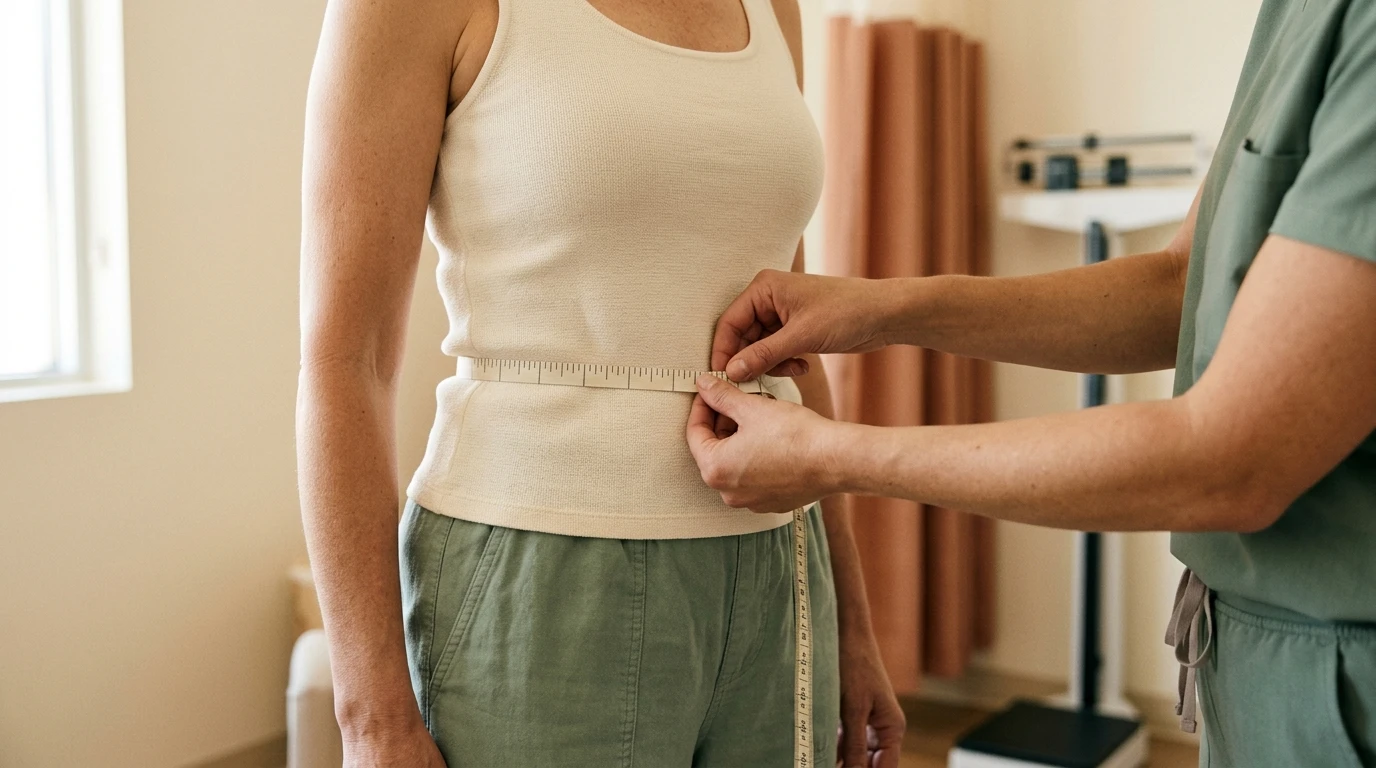
Menopause belly fat is where hormone therapy shows its clearest effect. A 2006 meta-analysis by Salpeter and colleagues in Diabetes, Obesity and Metabolism pooled 107 randomized trials. In women without diabetes, HRT reduced abdominal fat by 6.8%, lowered insulin resistance (measured as HOMA-IR) by 12.9%, and cut the rate of new-onset diabetes (relative risk 0.7). One detail matters later in this article: oral estrogen raised C-reactive protein, a marker of inflammation, while transdermal estrogen (patches and other forms absorbed through the skin) had no effect on it.
The muscle data are more modest. In a Women’s Health Initiative substudy of 835 women published in the American Journal of Clinical Nutrition, participants averaged 63 years old and were nearly 14 years past menopause. Over three years, women on estrogen plus progestin lost 0.04 kg of lean soft tissue, compared with 0.44 kg on placebo, and their fat shifted less toward the trunk. The authors themselves describe these effect sizes as small. Three more caveats:
- The benefit lasts only while you take it. Dr. Hurtado Andrade notes HRT limits the post-menopausal rise in abdominal and visceral fat “regardless of initiation timing, with benefits lost on discontinuation.”
- Route may matter. Transdermal estrogen “may offer more favorable body composition outcomes than oral formulations,” and lean-mass effects are “modest and inconsistent.”
- Not everyone benefits equally. The International Menopause Society says estrogen therapy “may partly prevent” the menopausal change in body composition, and more research is needed to identify who benefits.
So, does HRT help with belly fat? It may slow how much new abdominal fat builds up; it is not a way to lose fat you already carry. Does HRT change your body shape? For some women, modestly. Results vary, and no clinician can promise a specific change to your waistline. If your bigger concern is how menopause is affecting your body and symptoms overall, our menopause treatment page explains how that care is structured.
Does HRT Cause Weight Gain?
For many women this is the real question, and the fear has consequences. A 2000 review in Maturitas titled “Weight gain and hormone replacement therapy: are women’s fears justified?” found that “fear of weight gain is one of the main factors contributing to the poor compliance seen with” HRT. It concluded that the belief HRT “inevitably causes weight gain” isn’t supported by the evidence.
Does HRT make you gain weight on average? The Cochrane data say no. The UK’s NHS agrees: “There’s little evidence that most types of HRT make you put on weight,” and “You may gain some weight during the menopause and as you get older, but this often happens whether you take HRT or not.”
“On average” isn’t “never,” though: the NIH’s MedlinePlus lists “weight gain or loss” among possible side effects of estrogen. And if you’re wondering whether estrogen or progesterone causes weight gain on its own, neither estrogen-only nor combined therapy changed average weight in the Cochrane trials.
Bloating and fluid retention in the first months
Can HRT cause weight gain in the first weeks? What shows up is often fluid, not fat. ACOG’s patient FAQ on hormone therapy lists bloating (fluid retention) among the common side effects, along with temporary breast soreness, headaches and vaginal spotting. The 2000 Maturitas review notes that early increases “can be a result of rehydration.” The NHS says side effects usually improve over time and suggests staying on treatment for at least three months if possible. If bloating hangs on past that, ACOG suggests talking with your clinician about adjusting the dose.
Why am I gaining weight on HRT? A troubleshooting table
If you’re gaining weight on HRT, especially if it feels like rapid weight gain after starting, this table sorts the most common explanations. It isn’t a diagnosis. Never change your dose or stop treatment on your own; bring what you’re noticing to your prescriber.
| What you notice | Likely explanation | What to do |
|---|---|---|
| Puffiness, bloating or a tighter waistband in the first weeks | Fluid retention, a listed side effect of hormone therapy. Side effects usually settle within about 3 months. | Note when it started. If it persists, ask your prescriber whether the dose should be adjusted. |
| Slow, steady gain over many months | The midlife trend that happens with or without HRT. Fat gain speeds up during the transition even when weight rises steadily. | Review activity, strength training, protein and sleep. Track your waist measurement, not just your weight. |
| Breast tenderness, nausea, headaches or mood changes | Known estrogen- and progestogen-related side effects, which the NHS lists separately. | Keep a short symptom log and ask whether an adjustment to your regimen makes sense. |
| Sudden swelling or pain in one leg, chest pain or shortness of breath | Not a weight issue. These can be warning signs of a blood clot. | Seek emergency care right away (see the red-flags section below). |
The Indirect Route: Sleep, Hot Flashes, and Energy
This is where HRT can genuinely support weight control, just not the way some advertising suggests. Hot flashes and night sweats wake many women several times a night. ACOG notes that hormone therapy can help with night sweats that interrupt sleep, and that “poor sleep can lead to weight gain over time, so better sleep achieved with hormone therapy may help with weight control.”
According to The Menopause Society’s 2022 Hormone Therapy Position Statement, hormone therapy is the most effective treatment for vasomotor symptoms (hot flashes and night sweats) and for the genitourinary syndrome of menopause, and it prevents bone loss and fracture. That’s why Dr. Hurtado Andrade’s review recommends clinicians “consider hormone therapy in symptomatic women as part of a comprehensive weight management strategy.” The key word is symptomatic: if you sleep poorly but don’t have hot flashes, HRT isn’t the tool for that problem.
Midlife sleep problems often have more than one cause. Some patients add acupuncture for insomnia to their medical care, and our acupuncture team works within the same care plan as the Nurse Practitioner rather than separately from it.
What HRT Is (and Isn’t) FDA-Approved to Do
In February 2026 the FDA announced labeling changes for menopausal hormone therapy products. The announcement lists the approved uses as “moderate-to-severe hot flashes, vaginal dryness and discomfort, and preventing bone loss.” The FDA’s consumer update on hormone replacement therapies describes the same picture: relief of hot flashes, night sweats, vaginal dryness and painful intercourse, plus a possible reduction in osteoporosis risk. Weight isn’t mentioned at all, so prescribing hormone therapy for weight loss falls outside its approved uses.
The 2026 change is easy to overstate. The FDA removed statements about cardiovascular disease, breast cancer and probable dementia from the boxed warning on six products, and cited data showing that women who start hormone therapy within 10 years of the onset of menopause (generally before age 60) had reduced all-cause mortality and fractures. HRT is still not risk-free. According to the consumer update, cardiovascular and breast-cancer risks remain in the Warnings and Precautions section of the label, and the boxed warning about endometrial cancer stays on estrogen-alone products.
The main types of HRT
Estrogen alone is generally used for women who have had a hysterectomy. Women who still have a uterus also take a progestogen. As ACOG explains, estrogen alone thickens the uterine lining, and a progestin lowers that risk. Systemic forms (pills, skin patches, gels and sprays) treat whole-body symptoms like hot flashes. Low-dose vaginal forms (a ring, tablet or cream) treat local symptoms such as dryness. Choosing between them depends on your symptoms, your health history and your risk profile, not on weight.
Do bioidentical hormones work differently for weight?
No form of hormone therapy, bioidentical or otherwise, has been shown to cause weight loss. Copper Wellness offers bioidentical hormone therapy using compounded or commercially available formulations, so it’s worth knowing ACOG’s position: compounded hormones are not regulated by the FDA, there’s no evidence they are safer or more effective than FDA-approved products, and ACOG recommends FDA-approved hormone therapy over compounded preparations. Which option fits you is a decision made with the Nurse Practitioner based on your history and labs. Our article on BHRT vs. HRT explains the differences in more detail.
HRT vs. GLP-1 Medications: Different Jobs
If weight is your main goal, the medications actually approved for it are a separate category. When the FDA approved tirzepatide as Zepbound in November 2023, it approved it “for chronic weight management in adults with obesity” (BMI of 30 or higher) or overweight (BMI of 27 or higher) “with at least one weight-related condition,” used “in addition to a reduced calorie diet and increased physical activity.” Whether it’s tirzepatide or semaglutide for menopause-related weight gain, neither drug is specific to menopause, so in practice a menopause weight loss medication means a general weight-management medication, prescribed when you meet its criteria.
Do they work after menopause? A post hoc analysis of the SURMOUNT-1 trial, published in Obesity in 2025, found tirzepatide produced similar weight loss at every stage: 26% vs. 2% on placebo before menopause, 23% vs. 3% in perimenopause, and 23% vs. 3% after menopause. (The analysis was industry-sponsored, with authors and funding from the manufacturer, Eli Lilly.) These are trial averages, not predictions. Dr. Hurtado Andrade’s review notes that “individual weight loss response is highly variable,” and that obesity medications “should be considered long-term therapies because discontinuation results in weight regain.”
At Copper Wellness, Elise Sterritt, FNP-BC, provides medically supervised GLP-1 weight loss with semaglutide or tirzepatide. Every patient has an evaluation and lab work first to confirm the medication is clinically appropriate. Our explainer on how GLP-1 weight loss works covers the mechanism.
Can You Take HRT and a GLP-1 Together?
Some women take both, each prescribed for its own reason: hormone therapy for menopause symptoms, a GLP-1 medication for weight management when they meet its criteria. Early research on HRT and GLP-1 medications taken together:
- HRT and semaglutide: a 2024 retrospective study in Menopause reviewed 106 postmenopausal women on semaglutide, 16 of whom also used hormone therapy. Weight loss was 7% vs. 5% at 3 months and 16% vs. 12% at 12 months. The authors say larger studies are needed and that the design can’t establish cause and effect.
- HRT and tirzepatide: a Mayo Clinic cohort reported by Healio from the ENDO 2025 meeting followed 120 postmenopausal women who had taken tirzepatide for at least a year (40 of them also on hormone therapy), for a median of 18 months. Total weight loss was 19.18% with hormone therapy vs. 13.96% without, and 45% vs. 23.8% lost at least 20% of their body weight.
That tirzepatide study was later published in The Lancet Obstetrics, Gynaecology, & Women’s Health, as the Endocrine Society reported in January 2026. As the Endocrine Society’s news report quotes the researchers: “Because this was not a randomized trial, we cannot say hormone therapy caused additional weight loss.” Women on hormone therapy may differ in other ways (a healthy-user effect), and the authors said the findings don’t mean every woman should take both. A randomized trial is planned. Until then, treat this as an emerging finding your prescriber can weigh, not a reason to start hormones for weight.
There’s also a practical point that rarely comes up. GLP-1 medications slow gastric emptying, which “can reduce absorption of oral medications.” Dr. Hurtado Andrade notes this has been documented with oral contraceptives and may extend to oral hormone therapy, though dedicated studies in HT users are lacking. Because progestogen absorption protects the uterine lining, she suggests considering a non-oral progestogen and transdermal estradiol for women on both. Make sure every prescriber knows every medication you take.
What Actually Moves the Scale After 40

Here’s how to lose weight during menopause according to current clinical guidance, mostly from Dr. Hurtado Andrade’s 2026 review:
- A moderate calorie deficit. Eating 500–750 calories a day below your needs produces roughly 0.5–0.75 kg (about 1–1.7 lb) of weight loss a week. Long-term success depends more on sticking with the plan than on the exact mix of carbs and fat.
- Enough protein to protect muscle. Aim for at least 1.2 g of protein per kilogram of estimated fat-free mass a day, or an absolute target of 80–120 g a day. This matters especially in midlife, when muscle loss speeds up.
- Both cardio and strength training. The CDC’s baseline is 150 minutes of moderate aerobic activity (or 75 minutes of vigorous activity) a week plus muscle-strengthening on at least 2 days. Combined aerobic and resistance training “produces the best body composition outcomes,” with the 2026 review recommending at least 150 minutes of moderate aerobic activity during active weight loss and 250 minutes a week to maintain it.
- Support, not willpower alone. The review notes that programs combining education, coaching, diet changes and physical activity consistently outperform single-component approaches. An eating pattern built around vegetables, legumes, whole grains and lean protein, such as a Mediterranean-style diet, is one practical way to hit the calorie and protein targets above.
If an old injury or a sore knee keeps you from strength training, a physical therapist can build a program around those limits so you can load your muscles safely. And if bladder leaks make jumping or running uncomfortable, pelvic floor therapy can help address that barrier to staying active.
Is HRT the Right Tool for Your Goal? A Pre-Visit Checklist
Use this checklist to get ready for an appointment, not to diagnose yourself. Find the path that sounds most like you:
- You have bothersome hot flashes or night sweats, you’re under 60 or within 10 years of menopause, and you have no history of the conditions in path 3. A hormone therapy evaluation is reasonable. The Menopause Society describes the benefit-risk ratio as favorable in this group. Any effect on belly fat is a possible secondary benefit, not the reason to start.
- Weight is your main concern and you don’t have menopause symptoms. Using HRT for weight loss isn’t indicated. Start with the lifestyle foundation above. If your BMI is 30 or higher, or 27 or higher with a weight-related condition, ask about FDA-approved weight-management medication.
- You have a history of breast or endometrial cancer, stroke, heart attack, blood clots or liver disease. ACOG says systemic hormone therapy is usually not recommended in these situations. Talk with a clinician about nonhormonal options.
What to bring to your visit:
- A two-week symptom diary (hot flashes, night waking, mood, energy)
- Your menstrual history, including the date of your last period
- A list of every medication and supplement you take
- Your personal and family history of cancer, clots, stroke and heart disease
What to track instead of just the scale: waist circumference (the 2026 review recommends looking beyond weight and BMI), how often you wake at night, and how you feel during exercise. These show body-composition changes that weight alone can miss.
Side Effects, Risks, and Who Shouldn’t Take HRT
Hormone therapy is a prescription treatment with real side effects and risks. Here’s what the guideline bodies list.
Common side effects
- Vaginal spotting or bleeding, which ACOG says usually stops within 6 months
- Temporary breast soreness
- Bloating (fluid retention)
- Headaches
- Nausea and mood changes, among the estrogen- and progestogen-related effects the NHS lists
- Weight gain or loss in some individuals, per MedlinePlus, even though trials show no average effect
According to the NHS, side effects usually improve over time, and it advises seeing a doctor if they’re severe or last longer than three months. If they don’t ease, ACOG advises talking with your clinician about adjusting the dose.
Risks to understand
- Stroke and blood clots: ACOG describes a small increased risk, and notes that patches, sprays and rings may pose less risk than pills.
- Gallbladder disease: a small increased risk, per ACOG.
- Endometrial cancer: estrogen alone raises the risk in women with a uterus, which is why a progestogen is added. The FDA’s boxed warning on this remains for estrogen-alone products.
- Cardiovascular disease and breast cancer: these risks remain in the Warnings and Precautions section of the FDA label even after the 2026 boxed-warning change.
Timing and type matter. The Menopause Society says the benefit-risk ratio is most favorable for women under 60 or within 10 years of menopause who have no contraindications, and less favorable beyond that. Risks depend on the type, dose, duration, route and timing of therapy and on which progestogen is used, which is why treatment should be individualized and re-evaluated periodically.
Who usually shouldn’t take systemic HRT
According to ACOG, hormone therapy is not usually recommended if you have a history of breast or endometrial cancer, stroke, heart attack, blood clots or liver disease, or if you’re pregnant.
HRT always requires medical supervision
Hormone therapy is never something to start, adjust or stop on your own. At Copper Wellness, hormone care is led by Elise Sterritt, FNP-BC, a board-certified Family Nurse Practitioner with more than 15 years in healthcare, licensed in Illinois and Nevada. Care begins with a medical evaluation and labs, followed by ongoing monitoring and reassessment for as long as you’re on treatment. If you’re curious how a Nurse Practitioner’s role compares with a physician’s, see nurse practitioner vs. doctor for primary care.
When to Call Your Prescriber Right Away
Most HRT side effects are mild and settle with time. Some symptoms are not side effects to wait out. MedlinePlus lists these as reasons to contact a clinician immediately when taking estrogen:
- Sudden swelling or pain in the arms or legs
- Chest pain, shortness of breath or coughing up blood
- Breast lumps
- Swelling of the face, throat, tongue, lips, eyes, hands, feet, ankles or lower legs
Also call your prescriber about vaginal bleeding that continues beyond the first few months of treatment, or that starts again after it had stopped, since ACOG notes early spotting usually settles within 6 months. If you have chest pain, trouble breathing or are coughing up blood, call 911. Not sure whether something needs the emergency room? Our guide to urgent care vs. primary care can help, but when in doubt with chest or breathing symptoms, treat it as an emergency.
Weight, Hormones, and Your Whole Plan: How Copper Wellness Approaches It
Since HRT isn’t a weight-loss drug, what matters is having someone look at your symptoms, labs and goals together and match them to the right tools. Here’s how our hormone therapy care is set up:
- Labs before prescriptions. Elise Sterritt, FNP-BC, starts with comprehensive lab work and a review of your history and symptoms. Labs can be ordered at a location near you, with results reviewed over a video visit.
- In person or by telehealth. Care is available at our single clinic at 1654 W. North Ave. in Chicago (Bucktown/Wicker Park, also convenient to Lincoln Park, West Town and Logan Square) or via telehealth anywhere in Illinois.
- One shared care plan. Our Nurse Practitioner, physical therapists, pelvic floor therapist, chiropractors and acupuncturists communicate with each other about the same patient. If hot flashes, sleep, joint pain and weight are all in the picture, they’re treated as one plan.
- Hormone-focused integrative expertise. Founder Dr. Stephanie Madden holds a Doctor of Acupuncture from AOMA Graduate School of Integrative Medicine, is a board-certified herbalist, and focuses clinically on hormonal imbalance and complex cases. Patients interested in complementary care can learn about acupuncture for hormone balance as part of the overall plan.
- Clear billing. We accept Blue Cross Blue Shield and Aetna, as well as FSA and HSA payments, and a billing team verifies coverage before treatment. See our insurance page for details.
FAQ
How long does it take to lose weight on HRT?
There’s no reliable timeline, because HRT isn’t a weight-loss treatment and trials show no average change in weight. Early side effects like bloating usually settle within about three months. Judge HRT by whether your hot flashes and sleep improve, and rely on diet, exercise and, if appropriate, weight-management medication for the scale.
Will HRT help you lose belly fat?
HRT may slow how much new fat collects around your abdomen. A meta-analysis of 107 trials found 6.8% less abdominal fat in women without diabetes. It doesn’t remove fat you already have, the effect fades if you stop, and individual results vary.
Does HRT make your belly bigger?
A puffy, bloated belly in the first weeks is usually fluid retention, a common and typically temporary side effect. Over the longer term, randomized trials show no average weight gain from HRT. If bloating doesn’t ease after a few months, ask your prescriber whether the dose should be adjusted.
Is it harder to lose weight on HRT?
The evidence doesn’t suggest so. HRT doesn’t change average weight, and it neither adds to nor blocks the fat loss from diet and exercise. Midlife weight loss is harder for everyone because of muscle, metabolism and activity changes that happen with or without hormones.
What are the first signs that HRT is working?
For most women the first sign is fewer or milder hot flashes and night sweats, followed by better sleep. Hormone therapy’s approved uses are symptom relief and preventing bone loss, so those are the right measures of whether it’s working, not the scale.
Will I lose weight if I stop HRT?
No study we reviewed shows weight loss after stopping HRT. A 2026 Mayo Clinic review notes that HRT’s effect on limiting belly-fat gain is lost when it’s discontinued. If you’re thinking about stopping, plan it with your prescriber rather than stopping abruptly on your own.
Which type of HRT is best for weight loss?
No HRT formulation is approved or chosen for weight loss. The type, dose and route are chosen for your symptoms and risk profile. Transdermal estrogen does have some advantages worth discussing, including no rise in an inflammation marker in trials and no risk of the oral-absorption issue seen with GLP-1 medications.
Can you take HRT and a GLP-1 like semaglutide or tirzepatide together?
Some women do, with each medication prescribed for its own reason after an evaluation. Retrospective Mayo Clinic studies linked hormone therapy with greater weight loss on semaglutide (16% vs. 12%) and tirzepatide (19.2% vs. 14.0%), but the researchers say they can’t conclude the hormones caused it. Results vary, and a randomized trial is planned.
Do bioidentical hormones work better for weight loss?
There’s no evidence that any hormone therapy, including bioidentical or compounded preparations, causes weight loss. ACOG says there’s no evidence compounded hormones are safer or more effective than FDA-approved products and recommends FDA-approved therapy. The right formulation for you is a decision to make with your Nurse Practitioner.
Wondering whether your symptoms point to hormone therapy, a GLP-1 medication, a strength plan or something else entirely? Start with a free consultation at Copper Wellness. Call (872) 267-1717, email Hello@CopperWells.com, or book online at copperwellness.janeapp.com. Hormone and weight-management visits are available at our Chicago clinic on North Avenue or by telehealth across Illinois.