

If a doctor or an MRI report mentioned bulging disc vs herniated disc and left you more confused than before, you're not alone. These two terms get used interchangeably all the time, but they describe different things happening in your spine — and knowing which one you're dealing with can help you understand your symptoms …

If a doctor or an MRI report mentioned bulging disc vs herniated disc and left you more confused than before, you’re not alone. These two terms get used interchangeably all the time, but they describe different things happening in your spine — and knowing which one you’re dealing with can help you understand your symptoms and treatment options.
What Is a Bulging Disc?
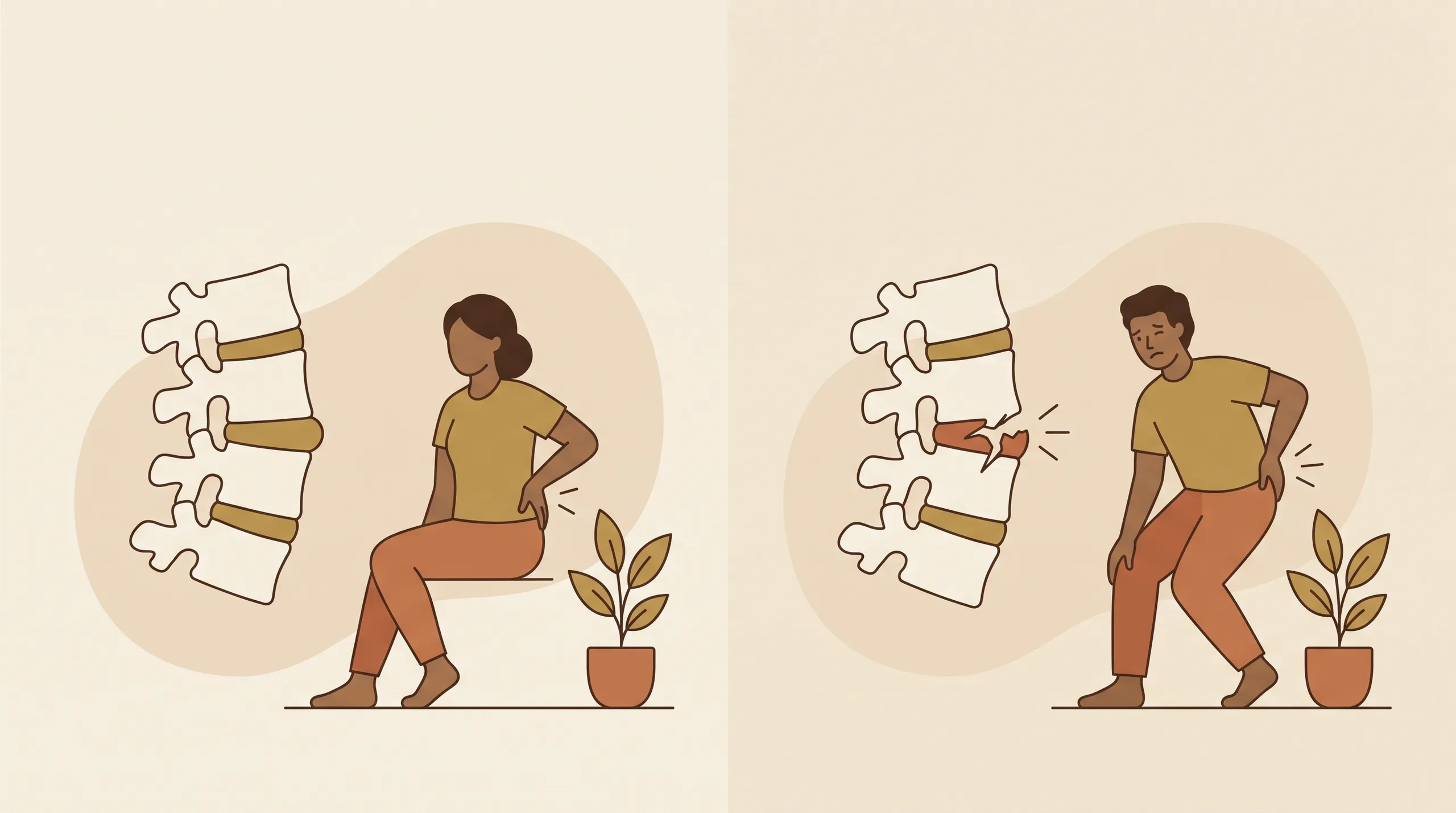
A bulging disc happens when the outer layer of a spinal disc weakens and extends slightly beyond its normal space, while the inner material stays contained. Think of it like a tire that’s lost a little air and started to flatten out — the shape has changed, but nothing has actually broken through.
Bulging disc symptoms can vary widely. Many people have a bulging disc with no pain at all, especially if it isn’t pressing on a nearby nerve. When symptoms do occur, they typically include localized back or neck pain, mild stiffness, and occasional discomfort that worsens with certain movements or after sitting for long periods.
What Is a Herniated Disc?
A herniated disc is a step further along the same spectrum. Instead of just bulging outward, the outer layer of the disc actually tears, allowing some of the softer inner material to push through. According to Mayo Clinic, a herniated disc is more likely to cause pain than a bulging disc because it protrudes farther and is more likely to compress nearby nerve roots.
Herniated disc symptoms tend to be more noticeable, often including sharp or radiating pain, numbness, tingling, or weakness that travels down an arm or leg depending on where the affected disc is located.
Bulging Disc vs Herniated Disc: Key Differences
Understanding the difference between bulging disc and herniated disc comes down to how much the disc material has moved and how likely it is to affect a nearby nerve. You may also see this described as disc bulge vs disc herniation — the terms are used interchangeably to describe the same two conditions.
| Feature | Bulging Disc | Herniated Disc |
|---|---|---|
| Outer layer | Weakened, but intact | Torn or ruptured |
| Inner material | Stays contained | Pushes through the tear |
| Typical symptoms | Often mild or none | Often sharper, more radiating pain |
| Nerve compression risk | Lower | Higher |
| How it’s usually found | Often incidental on imaging | Often diagnosed due to symptoms |
Slipped Disc — Is It the Same Thing?
“Slipped disc” is a common phrase, but it’s not a precise medical term. When people ask about slipped disc vs herniated disc or slipped disc vs bulging disc, they’re usually describing either condition. Discs don’t actually slip out of place — they bulge or herniate — but the phrase has stuck around in everyday language.
Treatment Options for Bulging and Herniated Discs
Bulging disc treatment and herniated disc treatment often overlap and typically start with conservative approaches: activity modification, targeted exercise, and manual therapies aimed at reducing pain and improving mobility. Most people with either condition improve without surgery. Surgical options are generally reserved for cases involving significant nerve compression, progressive weakness, or pain that doesn’t respond to weeks of conservative care.
Can a Chiropractor Help With a Bulging or Herniated Disc?
This is one of the most common questions we hear, and the honest answer is: often, yes — but not always, and not for every case. A chiropractor for herniated disc or bulging disc care typically uses gentle spinal adjustments, flexion-distraction techniques, and targeted mobility work to reduce pressure on the affected area and ease nerve irritation.
Research supports this approach for many patients. A study published in the Journal of Manipulative and Physiological Therapeutics compared patients with MRI-confirmed lumbar disc herniations treated with either spinal manipulative therapy or nerve root injections, finding that spinal manipulation was a comparably effective option for many patients dealing with disc-related pain.
That said, chiropractor for bulging disc or herniated disc care isn’t right for every situation. If you’re dealing with significant nerve compression, progressive weakness, or loss of bladder or bowel control, you need medical evaluation first — not spinal manipulation. Our chiropractic care team will always start with a thorough evaluation to determine whether you’re a good candidate before beginning any hands-on treatment. So can a chiropractor help a herniated disc, or can a chiropractor fix a bulging disc, in your specific case? That depends on your imaging, your symptoms, and your history — which is exactly what that first evaluation is for.
Is It Sciatica, a Pinched Nerve, or a Disc Problem?
These terms often get lumped together, but they describe different things. Sciatica vs herniated disc: sciatica is a symptom — radiating pain along the sciatic nerve — and a herniated disc is one possible cause of it, though not the only one. Similarly, when comparing pinched nerve vs herniated disc, a pinched nerve describes compression itself, while a herniated disc is one specific structural cause of that compression. In other words, a herniated disc can cause sciatica or a pinched nerve, but not every case of sciatica involves a herniated disc.
When to See a Doctor
Most bulging and herniated discs improve with conservative care, but some symptoms need immediate medical attention, including:
- Loss of bladder or bowel control
- Progressive weakness in a leg or arm
- Numbness in the groin or inner thighs (saddle anesthesia)
- Severe pain that isn’t improving after several weeks of care
If you experience any of these, seek medical evaluation before pursuing chiropractic or other manual therapy.
Not sure whether chiropractic care is right for your situation? You can book a consultation and get a personalized evaluation from our team.
FAQs
Is a bulging disc worse than a herniated disc?
Generally, no. A herniated disc tends to cause more noticeable symptoms because the inner disc material has actually broken through the outer layer, making nerve compression more likely. A bulging disc is usually a milder form of disc displacement.
Can a bulging or herniated disc heal on its own?
Many bulging and herniated discs improve over time with conservative care, including rest, targeted exercise, and manual therapies. The body can reabsorb some herniated disc material over months, though healing time varies by individual and severity.
Can a chiropractor make a herniated disc worse?
When performed by a trained provider after a proper evaluation, chiropractic care is generally considered safe for appropriate candidates. That’s why a thorough assessment before treatment matters — it helps rule out cases where manual therapy isn’t the right first step.
Does Copper Wellness treat herniated and bulging discs?
Yes. Our chiropractic team evaluates each patient’s symptoms and imaging to determine whether hands-on care is appropriate, then builds a treatment plan around your specific diagnosis and goals.